

Photo adjustments
Proportionally resized and converted to WebP without cropping, retouching or changing the photographed subject.
Explore the region
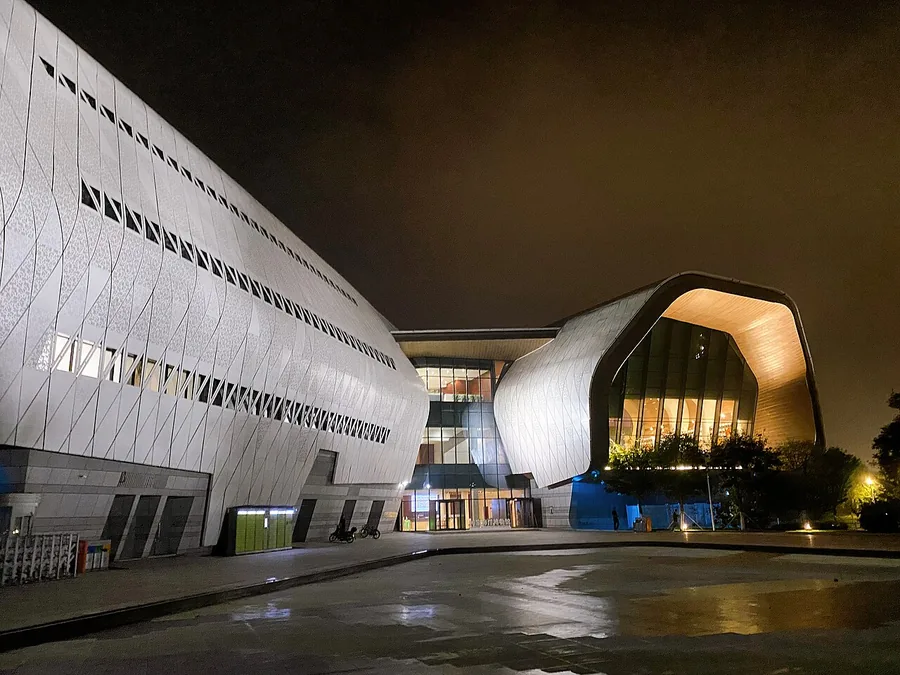
About National Maritime Museum of China
Its permanent areas include Ancient Oceans, the Age of Dragons, Today's Oceans and Journeys of Discovery. Fossils from early marine communities provide a concrete starting point, while the newer Future Oceans presentation connects past changes with possible future conditions. Choose a sequence of related galleries rather than trying to absorb the whole building at once; this is a substantial Binhai museum visit, separate from central Tianjin's museum cluster.
The museum originated from a 2007 proposal by more than 30 members of the Chinese Academy of Sciences and the Chinese Academy of Engineering, who wrote to the State Council recommending a national maritime museum; the proposal was approved, and after a site-selection process beginning in 2008, the National Development and Reform Commission approved a location in the eastern coastal area of Binhai New Area, Tianjin, in 2010.
A global design competition in 2012-2013 shortlisted six firms; the winning scheme, submitted by the Australian architect Philip Cox (菲利普·考克斯), was chosen unanimously in a second round, and won the World Architecture Award, the World Culture Building Award and the Best Competition Design of the Year at the 2013 World Architecture Festival in Singapore. Construction began in October 2014 and the building passed completion inspection in December 2018.
The Ancient Oceans gallery, on the first floor, covers 2,577 square metres and presents 4.6 billion years of oceanic evolution in geological sequence. Jointly administered by the Ministry of Natural Resources (自然资源部) and the Tianjin municipal government, the museum is described as the world's largest maritime museum; it opened for trial operation on 1 May 2019, closed from 24 January 2020 during the COVID-19 outbreak, and reopened on 14 July 2020.
What to look for
- Ancient Oceans displays on early life, including stromatolites and Chengjiang-biota fossils.
- Today's Oceans and the Future Oceans presentation for contrasting present and future marine environments.
The surrounding area
Separate coastal municipal area with maritime and modern cultural attractions.
Location & getting there
Getting to National Maritime Museum of China
The museum's official address is 377 Haixuan Road in the Sino-Singapore Tianjin Eco-City, Binhai. Use this address rather than the inconsistent street number in older travel listings.
Combine your visit
Suggested order within this visit:
-
Ancient Oceans
Begin with the formation of marine environments and early life.
-
Today's Oceans
Compare the ancient record with present-day seas.
-
Future Oceans
Finish with the museum's forward-looking interpretation.
This sequence is an editorial suggestion based on the features described in the sources. Access to individual buildings or areas should be checked locally; no travel time or shared admission is implied.
Find National Maritime Museum of China
国家海洋博物馆 · 滨海新区
The pin marks the area, not the entrance.
More places nearby
Approximate straight-line distances between map pins, not travel distances.
Binhai Aircraft Carrier Theme Park 泰达航母主题公园
6 km awayThe central attraction of this Binhai theme park is Kiev, a retired Soviet aircraft carrier adapted for visitors. Its scale is most apparent when comparing the flight deck with the vessel's internal spaces. Other displayed naval…
View guide →Dongjiang Bay Beach 东疆湾沙滩
11 km awayDongjiang Bay is a constructed sandy beach on the eastern side of Tianjin's port peninsula. Breakwaters enclose the waterfront, giving it a different character from an undeveloped open-coast beach. The broad sandy shore is the…
View guide →Binhai Library 滨海图书馆
13 km awayBinhai Library is known for a luminous spherical auditorium surrounded by sweeping white terraces in its central atrium. Designed by MVRDV with local partners and opened in 2017, the building turns the idea of shelves into a…
View guide →Sources & visit information
The sources below support the place-specific description and arrival information. Suggested combinations are editorial planning ideas; confirm current opening, entry arrangements and transport services for your date.
- National Maritime Museum: permanent exhibitions and official address ↗
- Tianjin Government: Future Oceans exhibition ↗
- Chinese Wikipedia: 国家海洋博物馆 (revision 93731016, 2026-08-01) ↗
- English Wikipedia: National Maritime Museum of China (revision 1368784264, 2026-08-11) ↗
Background paragraphs translated and condensed from Wikipedia contributors, "国家海洋博物馆", Chinese Wikipedia · CC BY-SA 4.0. Source revision 93731016.
Background paragraphs condensed from Wikipedia contributors, "National Maritime Museum of China", English Wikipedia · CC BY-SA 4.0. Source revision 1368784264.