

Entry & permits for Tibet (Xizang)
Foreign tourists need Tibet entry approval, commonly called a Tibet Travel Permit, and an organised visit arranged through a specialist travel agency in China. Confirm your approved route before booking transport. Requirements differ for Taiwan residents and for travellers using mainland or Hong Kong/Macao Chinese resident documents; check the document guide before you book.
Check the travel-document requirements →Policy scope verified: 2026-09-06. UK FCDO: China regional travel advice ↗ State Council Taiwan Affairs Office: Tibet entry approval ↗ Xizang Department of Culture and Tourism: Medog border permit notice ↗
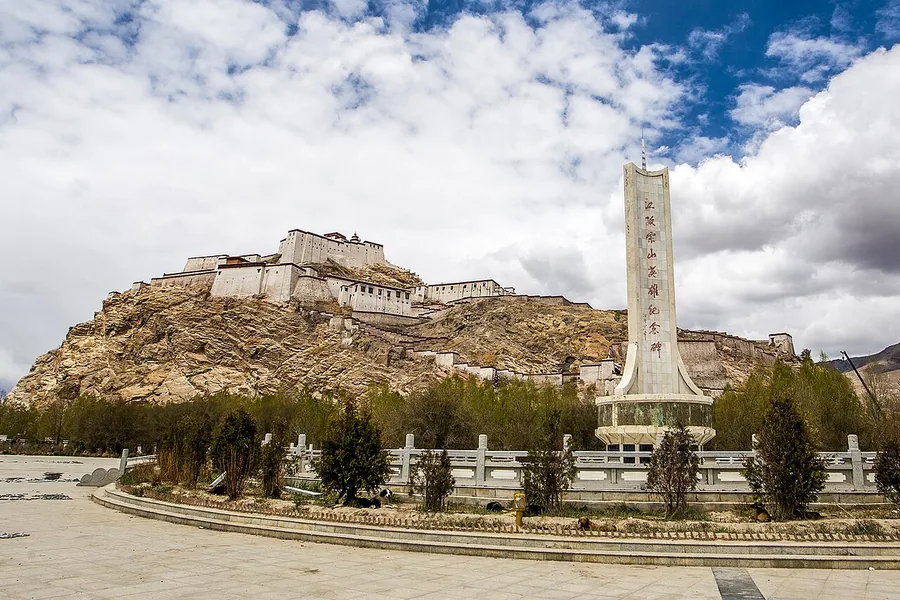
Photo adjustments
Proportionally resized and converted to WebP without cropping, retouching or changing the photographed subject.
Explore the region
About Gyantse Dzong
The fortress controlled an important approach towards the Tsangpo Valley and Lhasa and became a major site of the 1904 British expedition. Restored sections and the surviving hilltop fabric make its defensive role legible, while views connect the stronghold with the town and surrounding agricultural plain. The climb is substantial, so an exterior study from below can also give a clear sense of its commanding position.
In 967, Pelkhor-tsen (白阔赞) built a palace-fortress on the hill to govern the Nyang Chu River (年楚河) valley. The settlement's early name meant 'top of the royal city'. During the Phagmodrupa period it became one of Tibet's thirteen major dzongs, combining a fortress with an administrative district. The castle housed officials responsible for administration, law, taxation, economic affairs and religion.
The site became a Major Historical and Cultural Site Protected at the National Level (全国重点文物保护单位) in 1961. Although much of the wall fabric is ruined, fourteenth-century murals survive in Newari and Gyantse styles. The former government council chamber (江孜宗政府议事厅) displays land registers and figures recreating officials at work. A stone inscription from the sixtieth year of the Qianlong era (乾隆) records an inspection of the border by imperial representatives.
What to look for
- The fortress walls and buildings fitted to the steep rocky spur.
- Views from the accessible fortress route across Gyantse and its surrounding plain.
The surrounding area
A separate western urban centre anchored by Tashilhunpo, suitable for a considered extension from Lhasa.
Location & getting there
Getting to Gyantse Dzong
Start from Gyantse town below the fortress; the documented fortress entrance is on the eastern side.
- Confirm the open route before climbing, as access to individual restored areas may differ from the full outline visible from town.
Combine your visit
Suggested order for this visit:
-
Fortress base
Understand how the rock shaped the defensive walls.
-
Open fortress route
Explore the restored and surviving structures.
-
Upper viewpoint
Read the relationship between fortress, town and valley from above.
This is an editorial sequence based on the features described in the sources. Confirm access locally; no walking time, shared admission or guaranteed interior access is implied.
Find Gyantse Dzong
江孜宗山 · 日喀则
The pin marks the area, not the entrance.
More places nearby
Approximate straight-line distances between map pins, not travel distances.
Palcho Monastery 白居寺
Less than 1 km awayPalcho, also called Pelkor Chode or Baiju Monastery, brings together several Tibetan Buddhist traditions at the foot of Gyantse’s hills. Its outstanding feature is the Kumbum: a stepped stupa filled with small chapels, sculpture…
View guide →Gyantse 江孜
2 km awayGyantse occupies the Nyang Chu valley at the meeting of old trade routes between central Tibet and the southern Himalayan passes. Two neighbouring landmarks make its history tangible: the Dzong crowns a rocky hill, while Palcho…
View guide →Naining Monastery 乃宁寺
12 km awayNaining Chode stands in the upper Nyang Chu valley at Nanni village, south of Gyantse. Its religious buildings and the memorial outside the gate reflect different parts of its history, including the fighting here during the…
View guide →Sources & visit information
The linked encyclopedia sources support background and place descriptions. Current opening hours, ticket prices, booking rules and transport schedules have not been independently verified for this guide. Confirm them with the venue or operator before travelling.
- Wikipedia: Gyantse Dzong ↗
- Chinese Wikipedia: 江孜宗山 (revision 93356747, 2026-07-07) ↗
- English Wikipedia: Gyantse Dzong (revision 1367096145, 2026-08-01) ↗
Visitor information adapted and edited from Wikipedia contributors · CC BY-SA 4.0. Source revision 1367096145.
Background paragraphs translated and condensed from Wikipedia contributors, "江孜宗山", Chinese Wikipedia · CC BY-SA 4.0. Source revision 93356747.
Background paragraphs condensed from Wikipedia contributors, "Gyantse Dzong", English Wikipedia · CC BY-SA 4.0. Source revision 1367096145.