

Entry & permits for Tibet (Xizang)
Foreign tourists need Tibet entry approval, commonly called a Tibet Travel Permit, and an organised visit arranged through a specialist travel agency in China. Confirm your approved route before booking transport. Requirements differ for Taiwan residents and for travellers using mainland or Hong Kong/Macao Chinese resident documents; check the document guide before you book.
Check the travel-document requirements →Policy scope verified: 2026-09-06. UK FCDO: China regional travel advice ↗ State Council Taiwan Affairs Office: Tibet entry approval ↗ Xizang Department of Culture and Tourism: Medog border permit notice ↗
City & district guides
About Naining Monastery
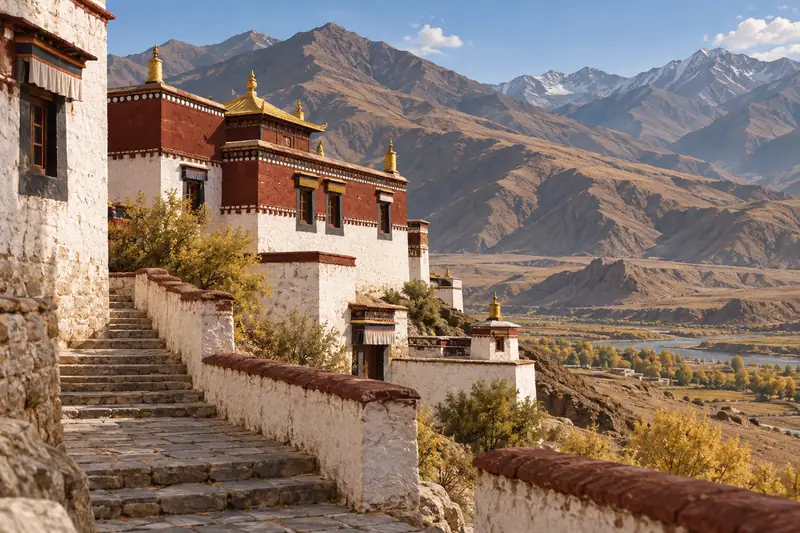
Its religious buildings and the memorial outside the gate reflect different parts of its history, including the fighting here during the British expedition of 1904. The Utse hall retains a wooden doorway associated with that battle, while the later Naining Jokhang contains painted Buddhist figures. A useful visit separates the memorial account from the monastery's continuing worship and architectural history, without relying on disputed casualty totals.
The monastery was founded during the reign of the Tibetan king Chire Bajin (赤热巴巾) by Achangjia Qiangbaisangbu (阿羌甲·强拜桑布), a disciple of Padmasambhava (莲花生). According to local tradition, he was an Indian monk who chose the site after seeing the Nyang Chu's (年楚河) western bank shaped like a crouching elephant, auspicious for spreading Buddhism. The monastery originally followed the Nyingma school, changed to Kadam during the era of Atisha (阿底峡), and became Gelug after Tsongkhapa (宗喀巴) visited twice in the 15th century to promote religious reform. It was the birthplace of 'Nangsa Wangmo' (朗萨雯波), one of the eight great Tibetan operas.
The monastery occupies the upper Nyang Chu valley at an elevation of 4,100 metres. Kangmar's county seat (康马县城) lies forty kilometres to its south, while Gyantse's county seat (江孜县城) lies ten kilometres to its north. Zhaxi Dajie Mountain (札西达节山) borders the monastery to the east and the river to the west.
The monastery was listed as a Tibet Autonomous Region cultural relic protection unit in 1996. Though put forward for the seventh group of Major Historical and Cultural Sites Protected at the National Level (全国重点文物保护单位), it was not selected then; it was included in the eighth group of that designation on 7 October 2019.
What to look for
- The trilingual 1904 battle memorial outside the monastery gate and the Utse hall's historic wooden doorway.
- Naining Jokhang's assembly-hall paintings of Shakyamuni, Tara and other Buddhist figures.
The surrounding area
A separate western urban centre anchored by Tashilhunpo, suitable for a considered extension from Lhasa.
Location & getting there
Getting to Naining Monastery
Use Naining Chode/Nanni Monastery (乃宁曲德寺、南尼寺) in Nanni village, Nanni Township, Kangmar County, in the Nyang Chu valley south of Gyantse.
- Give both the village and monastery names when arranging the road journey; this is outside the Gyantse town-centre monastery complex.
Combine your visit
Suggested order for this visit:
-
Battle memorial outside the gate
Read the site's historical interpretation before entering the worship spaces.
-
Utse hall doorway
Examine the surviving architectural detail associated with the 1904 fighting where access allows.
-
Naining Jokhang
Finish with the later hall and its Buddhist mural decoration.
This is an editorial sequence based on the features described in the sources. Confirm access locally; no walking time, shared admission or guaranteed interior access is implied.
Find Naining Monastery
乃宁寺 · 日喀则
The pin marks the area, not the entrance.
More places nearby
Approximate straight-line distances between map pins, not travel distances.
Gyantse江孜
11 km awayGyantse occupies the Nyang Chu valley at the meeting of old trade routes between central Tibet and the southern Himalayan passes. Two neighbouring landmarks make its history tangible: the Dzong crowns a rocky hill, while Palcho…
View guide →Palcho Monastery白居寺
12 km awayPalcho, also called Pelkor Chode or Baiju Monastery, brings together several Tibetan Buddhist traditions at the foot of Gyantse’s hills. Its outstanding feature is the Kumbum: a stepped stupa filled with small chapels, sculpture…
View guide →Gyantse Dzong江孜宗山
12 km awayGyantse Dzong crowns the rocky spur above Gyantse, with defensive walls following the shape of the hill. The fortress controlled an important approach towards the Tsangpo Valley and Lhasa and became a major site of the 1904…
View guide →Sources & visit information
The linked encyclopedia sources support background and place descriptions. Current opening hours, ticket prices, booking rules and transport schedules have not been independently verified for this guide. Confirm them with the venue or operator before travelling.
Visitor information adapted and edited from Wikipedia contributors · CC BY-SA 4.0. Source revision 93287589.
Background paragraphs translated and condensed from Wikipedia contributors, "乃宁曲德寺", Chinese Wikipedia · CC BY-SA 4.0. Source revision 93287589.