

Entry & permits for Tibet (Xizang)
Foreign tourists need Tibet entry approval, commonly called a Tibet Travel Permit, and an organised visit arranged through a specialist travel agency in China. Confirm your approved route before booking transport. Requirements differ for Taiwan residents and for travellers using mainland or Hong Kong/Macao Chinese resident documents; check the document guide before you book.
Check the travel-document requirements →Policy scope verified: 2026-09-06. UK FCDO: China regional travel advice ↗ State Council Taiwan Affairs Office: Tibet entry approval ↗ Xizang Department of Culture and Tourism: Medog border permit notice ↗
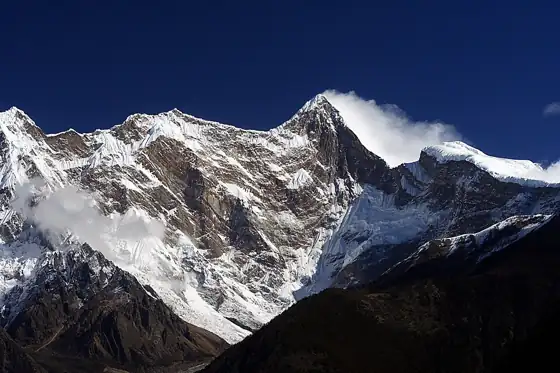
Photo adjustments
Resized and WebP compressed; subject not altered.
Explore the region
About Namcha Barwa
The contrast between its snow-covered summit and the much lower forested valley gives the mountain its exceptional visual scale. A sightseeing visit centres on established canyon viewpoints, not the summit coordinate. The north-bank Suosong area is a documented place to watch the peak, although cloud often hides it. Give the mountain time to appear and use the surrounding river landscape as part of the visit.
The peak was located by British surveyors in 1912, but the area remained largely unvisited until Chinese mountaineers began attempts in the 1980s. A joint Chinese-Japanese expedition reconnoitred the mountain in 1990, and another reached 7,460 metres in 1991 before losing a member, Hiroshi Onishi, in an avalanche. A third Chinese-Japanese expedition established six camps on the South Ridge, over the intermediate peak Nai Peng (7,043 metres), and reached the summit on 30 October 1992.
The peak rises to 7,782 metres within the 180-kilometre Namcha Barwa Himal range. According to local tradition, the name recalls a spear piercing the sky, an image in the Tibetan epic of King Gesar (格萨尔王传). The mountain is regarded as a sacred site of the Bon religion (苯教).
What to look for
- Namcha Barwa’s steep snow-covered profile above the Yarlung Tsangpo valley, when visible.
- The river terraces and forested slopes around the north-bank Suosong viewing area.
The surrounding area
Eastern valleys, lakes and canyon scenery around Basum Tso and the Yarlung Zangbo.
Location & getting there
Getting to Namcha Barwa
Use the Yarlung Tsangpo Grand Canyon visitor centre to arrange the north-bank route towards Suosong and Dalin.
- The mountain’s summit pin is an orientation marker; remain within the formally open viewing areas along the visitor route.
Combine your visit
Suggested order for this visit:
-
Suosong viewing area
Begin with the documented north-bank view towards Namcha Barwa.
-
Dalin visitor-route viewpoints
Continue along the same approved north-bank route for another angle on the mountain and valley.
This is an editorial sequence based on the features described in the sources. Confirm access locally; no walking time, shared admission or guaranteed interior access is implied.
Find Namcha Barwa
南迦巴瓦峰 · 林芝
The pin marks the area, not the entrance.
More places nearby
Approximate straight-line distances between map pins, not travel distances.
Yarlung Tsangpo Grand Canyon 雅鲁藏布大峡谷
12 km awayThe Yarlung Tsangpo cuts around Namcha Barwa at the eastern end of the Himalayas, creating a landscape of deep relief, forested slopes and a powerful river far below the snow peaks. The visitor area near Pai introduces this…
View guide →Lulang International Tourism Town 鲁朗国际旅游小镇
34 km awayLulang’s tourism town is arranged around Zhatang Lhamo Lake, with hotels, guesthouses and a commercial street beneath the forested mountains. Its modern visitor facilities sit within a valley already known for village…
View guide →Lulang Forest Viewpoint 鲁朗林海观景台
35 km awayLulang Forest Viewpoint looks down from the Sejila mountainside into a deep forested valley. Conifers form the main texture of the view, with snow-covered peaks, clouds and seasonal rhododendrons changing its appearance. This is…
View guide →Sources & visit information
The sources below support the place-specific description and arrival information. Suggested combinations are editorial planning ideas; confirm current opening, entry arrangements and transport services for your date.
- Wikipedia: Namcha Barwa ↗
- Nyingchi tourism route: Suosong village as a Namcha Barwa viewpoint ↗
- Grand Canyon operator: approved north-bank Suosong–Dalin visitor route ↗
- Chinese Wikipedia: 南迦巴瓦峰 (revision 91955613, 2026-03-19) ↗
- English Wikipedia: Namcha Barwa (revision 1357725304, 2026-06-04) ↗
Visitor information adapted and edited from Wikipedia contributors · CC BY-SA 4.0. Source revision 1357725304.
Background paragraphs translated and condensed from Wikipedia contributors, "南迦巴瓦峰", Chinese Wikipedia · CC BY-SA 4.0. Source revision 91955613.
Background paragraphs condensed from Wikipedia contributors, "Namcha Barwa", English Wikipedia · CC BY-SA 4.0. Source revision 1357725304.