

Entry & permits for Tibet (Xizang)
Foreign tourists need Tibet entry approval, commonly called a Tibet Travel Permit, and an organised visit arranged through a specialist travel agency in China. Confirm your approved route before booking transport. Requirements differ for Taiwan residents and for travellers using mainland or Hong Kong/Macao Chinese resident documents; check the document guide before you book.
Check the travel-document requirements →Policy scope verified: 2026-09-06. UK FCDO: China regional travel advice ↗ State Council Taiwan Affairs Office: Tibet entry approval ↗ Xizang Department of Culture and Tourism: Medog border permit notice ↗
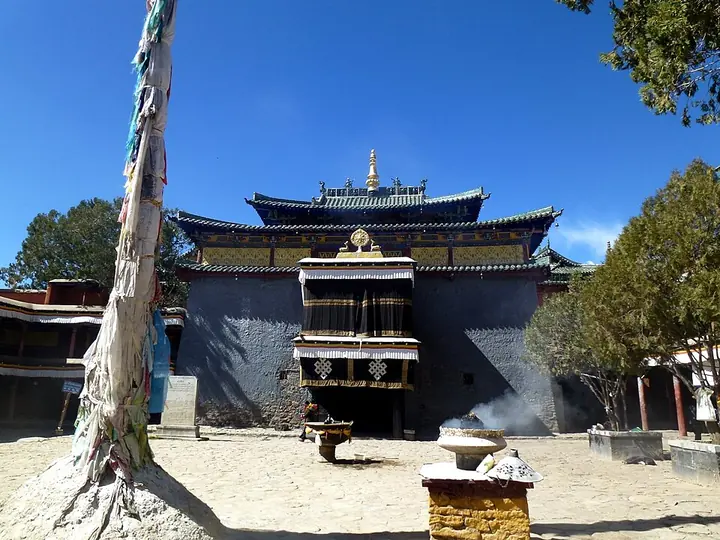
Photo adjustments
Full frame retained; proportionally resized and converted to WebP. No retouching or changes to the photographed subject. Card displays may crop the view.
City & district guides
About Shalu Monastery
The combination is especially clear at the main Shalu Lhakhang. Inside, the paintings are equally important: narrative scenes from the Buddha's lives run through the ground-floor circumambulatory corridor, while mandalas occupy other sacred spaces. The monastery is also associated with the scholar Buton Rinchen Drub, whose work helps explain its importance as a centre of Buddhist learning and artistic exchange.
Chetsun Sherab Jungnay (吉尊·西绕琼乃) founded the temple in 1087. An expansion supported by the Yuan court in 1320 established much of its later scale, artwork and architectural character. A destructive earthquake struck in 1329, and rebuilding began in 1333 with funding from the emperor. Tibetan and Han Chinese craftspeople worked together on the reconstruction, using glazed building materials brought from inland China or made locally under their guidance.
Buton Rinchen Drub (布敦·仁钦珠), who lived from 1290 to 1364, became abbot after the 1320 rebuilding. During his tenure he taught four classes of tantra, revised the Buddhist canon and compiled its catalogue. His writings comprise more than a hundred works in twenty-eight volumes. The monastery is the founding seat of the Shalu school, also called the Buton school.
What to look for
- Shalu Lhakhang's green glazed double-eaved roof above the Tibetan-style main building.
- The ground-floor corridor's grid-like Jataka narrative paintings and surviving mandala murals in accessible rooms.
The surrounding area
A separate western urban centre anchored by Tashilhunpo, suitable for a considered extension from Lhasa.
Location & getting there
Getting to Shalu Monastery
Approach Shalu Monastery (夏鲁寺) in Gyaco Xung/Jiacuo Xiong Township (甲措雄乡), southeast of central Shigatse. It occupies a mountain recess outside the main city.
- Arrange the return road journey separately and ask which mural corridors are accessible; historical descriptions do not guarantee every room is open.
Combine your visit
Suggested order for this visit:
-
Main courtyard and roofline
Read the building's Tibetan and Chinese architectural elements from outside.
-
Ground-floor circumambulatory corridor
Focus on the narrative mural sequence where access is permitted.
-
Open main-hall spaces
Connect the paintings with the monastery's images, scriptures and scholarly history.
This is an editorial sequence based on the features described in the sources. Confirm access locally; no walking time, shared admission or guaranteed interior access is implied.
Find Shalu Monastery
夏鲁寺 · 日喀则
The pin marks the area, not the entrance.
More places nearby
Approximate straight-line distances between map pins, not travel distances.
Tashilhunpo Monastery扎什伦布寺
20 km awayTashilhunpo rises against a hill in central Shigatse. Founded in 1447, it became the traditional seat of the Panchen Lamas, whose memorial stupas form an important part of the complex. The huge gilded Maitreya image gives the…
View guide →Gyantse Dzong江孜宗山
63 km awayGyantse Dzong crowns the rocky spur above Gyantse, with defensive walls following the shape of the hill. The fortress controlled an important approach towards the Tsangpo Valley and Lhasa and became a major site of the 1904…
View guide →Palcho Monastery白居寺
63 km awayPalcho, also called Pelkor Chode or Baiju Monastery, brings together several Tibetan Buddhist traditions at the foot of Gyantse’s hills. Its outstanding feature is the Kumbum: a stepped stupa filled with small chapels, sculpture…
View guide →Sources & visit information
The linked encyclopedia sources support background and place descriptions. Current opening hours, ticket prices, booking rules and transport schedules have not been independently verified for this guide. Confirm them with the venue or operator before travelling.
Visitor information adapted and edited from Wikipedia contributors · CC BY-SA 4.0. Source revision 93289214.
Background paragraphs translated and condensed from Wikipedia contributors, "夏鲁寺", Chinese Wikipedia · CC BY-SA 4.0. Source revision 93289214.
Background paragraphs condensed from Wikipedia contributors, "Shalu Monastery", English Wikipedia · CC BY-SA 4.0. Source revision 1367130007.