

Photo adjustments
Converted to WebP and resized without changing the subject or cropping the source frame.
About Han Yangling
Its small terracotta people and animals offer an intimate contrast with Qin Shi Huang’s life-size army. The underground display lets visitors view excavated pits through protective glazing, while the wider site includes gate and ritual-building remains. Focus on how these objects and structures represented a complete imperial household; the visitor display does not enter the emperor’s main burial chamber.
Construction of the mausoleum and its adjoining town of Yangling (阳陵邑) began in the fifth year of Emperor Jing (汉景帝刘启) (153 BCE), when people were recruited to resettle at the town. Emperor Jing died in 141 BCE and was buried ten days later; Empress Wang (王皇后) died fifteen years afterward, in 126 BCE, and was buried beside him in a shared mausoleum area with separate chambers, the whole project having taken twenty-eight years to complete.
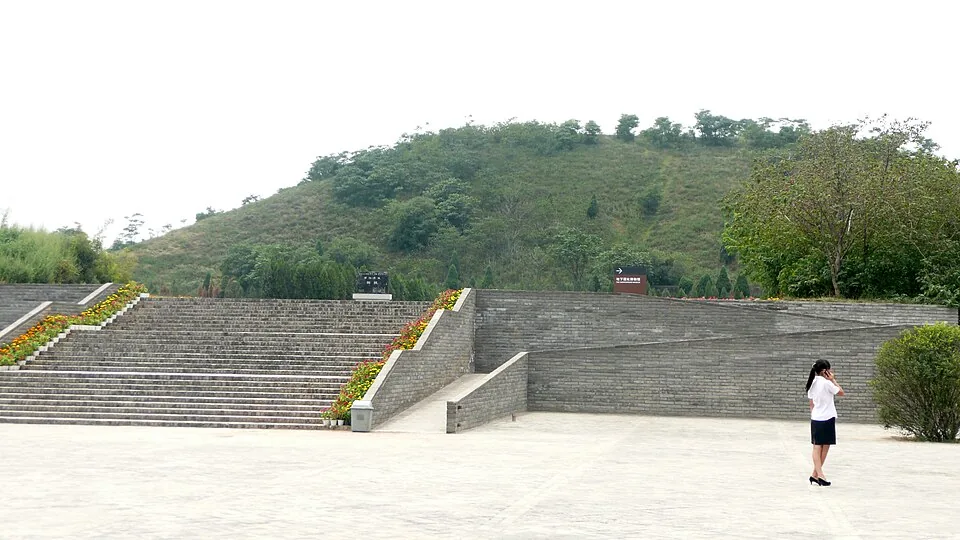
The emperor's mound rises about 31 metres and is surrounded by eighty-one radiating accompanying pits. A large gate on the southern side formed the principal entrance to the emperor's mausoleum precinct. The empress's mound, 450 metres to the east, rises approximately 25.5 metres and has twenty-eight accompanying pits. Two ritual-building sites stand southwest and southeast of the emperor's mound. Further groups of twenty-four pits each lie northwest and southeast of it. Most finds are military-related, leading archaeologists to interpret these groups as representations of the Han Southern and Northern Armies (南军、北军).
The site was listed as a Shaanxi provincial cultural relics protection unit in 1956 and, in 2001, as a Major Historical and Cultural Site Protected at the National Level (全国重点文物保护单位) among the Western Han imperial tombs. Objects excavated from the mausoleum were found in 2016 to contain tea residue dated to the second century BCE.
What to look for
- The small terracotta people and animals in the protected burial-pit displays.
- The underground museum’s glazed view into excavated areas.
- The southern gate remains and the imperial mound landscape.
Location & getting there
Getting to Han Yangling
Travel to the Han Yangling museum complex on the airport-road corridor in the Zhengyang area, north of the Wei River.
- Arrange a return road connection; the archaeological galleries and outdoor remains occupy separate parts of the grounds.
Combine your visit
Suggested order within this visit:
-
Archaeological collection displays
Understand the people, animals and objects represented in the pits.
-
Underground pit museum
See the objects within their excavated setting.
-
Southern gate and mound landscape
Relate the small figures to the scale of the mausoleum.
This sequence is an editorial suggestion based on the features described in the sources. Access to individual buildings or areas should be checked locally; no travel time or shared admission is implied.
Find Han Yangling
汉阳陵 · 咸阳近郊行程
The pin marks the area, not the entrance.
More places nearby
Approximate straight-line distances between map pins, not travel distances.
Hancheng Lake Park汉城湖
15 km awayHancheng Lake is a long urban water park beside the Han Chang’an ruins in northwestern Xi’an. It reuses the former Tuanjie Reservoir corridor and combines flood-management functions with a modern Han-themed landscape. Dafeng…
View guide →Xi'an Xianyang Airport西安咸阳国际机场
17 km awayXi’an Xianyang International Airport has an expanded terminal layout following the opening of Terminal 5 in February 2025. Terminals 2, 3 and 5 serve different flights, making the terminal on the current booking the first detail…
View guide →Zhaohui Pagoda昭慧塔
17 km awayZhaohui Pagoda rises over a square in Gaoling, northeast of central Xi’an. Also known as the Sanyang Temple Pagoda, this octagonal brick tower has thirteen closely spaced eaves. Its form is best read from outside: the narrowing…
View guide →Sources & visit information
The sources below support the place-specific description and arrival information. Suggested combinations are editorial planning ideas; confirm current opening, entry arrangements and transport services for your date.
- Wikipedia: 汉阳陵 ↗
- Wikivoyage: Xianyang ↗
- English Wikipedia: Yangling Mausoleum of Han (revision 1374008465, 2026-09-09) ↗
Visitor information adapted and edited from Wikipedia contributors · CC BY-SA 4.0. Source revision 94092457.
Visitor information adapted and edited from Wikivoyage contributors · CC BY-SA 4.0. Source revision 5155702.
Background paragraphs translated and condensed from Wikipedia contributors, "汉阳陵", Chinese Wikipedia · CC BY-SA 4.0. Source revision 94092457.
Background paragraphs condensed from Wikipedia contributors, "Yangling Mausoleum of Han", English Wikipedia · CC BY-SA 4.0. Source revision 1374008465.