

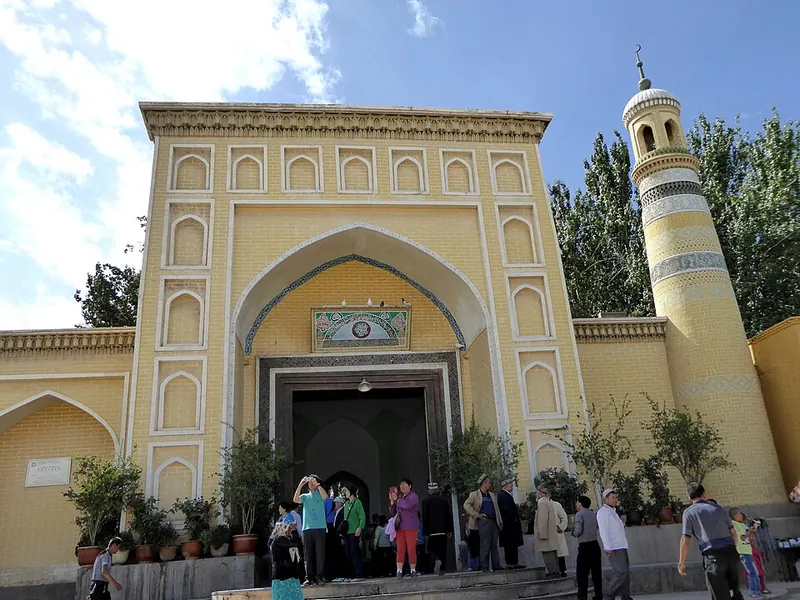
Photo adjustments
Full frame retained; proportionally resized and converted to WebP. No retouching or changes to the photographed subject. Card displays may crop the view.
Explore the region
About Id Kah Mosque
Its yellow-toned entrance, flanking towers and deeper courtyard spaces give it a strong presence in the surrounding streets. The complex developed through successive rebuilding and enlargement, so it should be understood as a layered monument. Visitor admission and religious use have their own arrangements; check the current entrance notice rather than relying on old accounts of access.
The first mosque was built here in 1442 and enlarged in 1538. Further work during the sixteenth century created a larger mosque suitable for Friday congregational prayer. An expansion in 1798 used funds left by a woman who died while travelling through Kashgar, and the mosque acquired its present name, meaning a place for festival worship. Alterations in 1873 established its present scale.
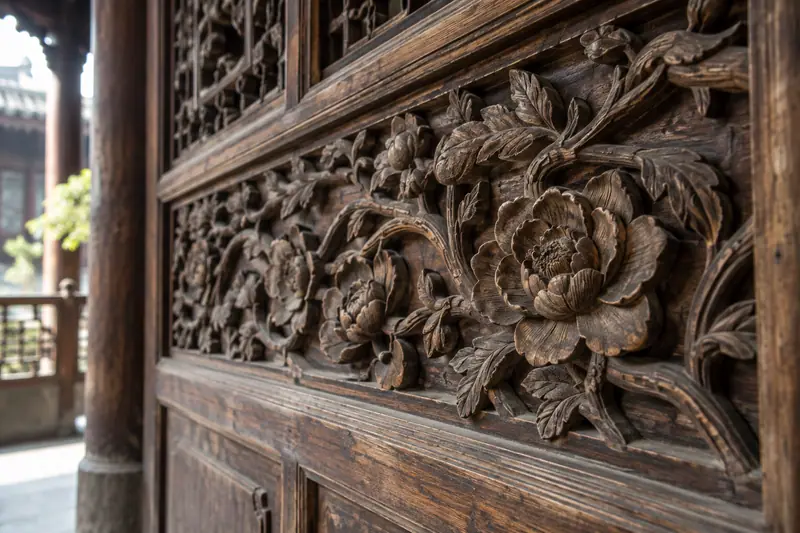
The complex faces east and covers 16,800 square metres. Beyond the gateway, 36 teaching rooms line the north and south sides of the courtyard. The prayer space stands on a raised platform to the west, with inner and outer halls whose roof is carried by 158 pale-blue columns. Carved timber and painted ceiling decoration accompany a central niche in the main hall.
What to look for
- The monumental entrance frames the edge of the old-city square.
- Courtyard and prayer-building spaces reveal the larger layout where visitor access is permitted.
Background & history
The Id Kah Mosque (Uyghur: ھېيتگاھ مەسچىتى, romanized: Hëytgah Meschiti; Chinese: 艾提尕尔清真寺; pinyin: Àitígǎ'ěr Qīngzhēnsì; derived from Persian: عیدگاه, romanized: Eidgāh, lit. 'Place of Festivities') is a mosque in Kashgar, in the Xinjiang autonomous region of China. With the capacity of 20,000 worshipers inside the mosque and its sahn, it is the largest mosque in China. Completed in the 15th century with subsequent renovations, during the 20th and 21st centuries the mosque was a key focal point for civil unrest centered on the Uyghurs, including the Xinjiang conflict and ongoing human rights abuses. The mosque has been mostly closed for worship since 2016 due to Chinese authorities' attempts to limit religious extremism and terrorism. It is open to elderly worshipers on select holy days.
Excerpt from Wikipedia: Id Kah Mosque · Wikipedia contributors · CC BY-SA 4.0. Selected introductory sentences; formatting simplified. Background information, not current visitor-service advice.
The surrounding area
A southwestern urban and cultural chapter with craft streets, food and residential life.
Location & getting there
Getting to Id Kah Mosque
Use Id Kah Mosque at Id Kah Square in central Kashgar. Confirm the current visitor admission period and accessible areas at the entrance, and follow instructions on dress and photography.
Combine your visit
Choose from these complementary stops when planning your visit.
-
Id Kah Square艾提尕尔广场
See the entrance within the old-city setting.
-
Permitted mosque route获准参观路线
Follow the current visitor arrangement.
-
Old-city public lanes喀什古城公共街巷
Continue into the surrounding craft and market streets.
This is a suggested combination, not a timed route; confirm the opening and transport arrangements for your date.
Find Id Kah Mosque
艾提尕尔清真寺 · 喀什地区
The pin marks the area, not the entrance.
More places nearby
Approximate straight-line distances between map pins, not travel distances.
Kashgar 喀什
Less than 1 km awayKashgar is an oasis city at the western end of the Tarim Basin, long connected with routes into Central Asia and the Pamir region. Its old-city lanes, craft spaces, mosque architecture and museums reveal different parts of that…
View guide →Kashgar High Platform Houses 高台民居
1 km awayKashgar’s High Platform Houses rise in layers above the Tuman River, with narrow lanes, earthen walls and buildings spanning parts of the streets. The neighbourhood has undergone restoration and infrastructure work, and reopened…
View guide →Kashgar Museum 喀什博物馆
3 km awayKashgar Museum places the old city within the wider history of the western Tarim Basin and Kunlun region. Its permanent programme combines local archaeological objects with a broader Xinjiang history display and an exhibition on…
View guide →Sources & visit information
The linked encyclopedia sources support background and place descriptions. Current opening hours, ticket prices, booking rules and transport schedules have not been independently verified for this guide. Confirm them with the venue or operator before travelling.
- Id Kah Mosque — Wikipedia geographic and historical reference ↗
- Chinese Wikipedia: 艾提尕尔清真寺 (revision 92991211, 2026-06-08) ↗
Geographic and historical facts selectively adapted from Wikipedia contributors, Id Kah Mosque · CC BY-SA 4.0. Source revision 1373462610.
Background paragraphs translated and condensed from Wikipedia contributors, "艾提尕尔清真寺", Chinese Wikipedia · CC BY-SA 4.0. Source revision 92991211.