

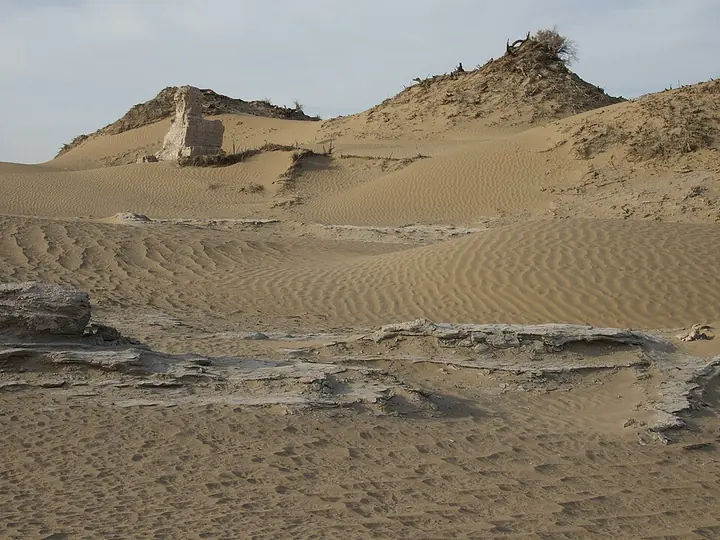
Photo adjustments
Full frame retained; proportionally resized and converted to WebP. No retouching or changes to the photographed subject. Card displays may crop the view.
Explore the region
About Ni'ya Ruins
Wooden documents, household objects, textiles and traces of orchards reveal a community connected to the southern Silk Road. Its importance comes from this evidence of ordinary life as much as from monumental remains. The archaeological site is remote and protected; museum collections offer a more practical introduction for most visitors.
Aurel Stein (斯坦因) investigated the site on four visits between 1901 and 1931. Later work identified approximately one hundred dwellings, burial areas, animal shelters, orchards and fields. Finds inside the houses included iron axes and sickles, pottery storage vessels and jars of preserved crops, adding specific evidence for domestic work and agriculture.
In 2007, researchers examined a parchment wrapper that contained plant-derived powder, possibly spices or medicine. Removing the powder revealed a text in clear black ink. Comparison with other early documents led to its identification as early Sogdian writing, adding another script to the written materials recovered from the settlement.
What to look for
- Wooden documents record administration and everyday transactions.
- Dwellings, agricultural traces and textiles reveal the life of an oasis community.
Background & history
The Niya ruins (simplified Chinese: 尼雅遗址; traditional Chinese: 尼雅遺址; pinyin: Níyǎ Yízhǐ), is an archaeological site located about 115 km (71 mi) north of modern Niya Town on the southern edge of the Tarim Basin in modern-day Xinjiang, China. The ancient site was known in its native language as Caḍ́ota, and in Chinese during the Han dynasty as Jingjue (Chinese: 精絕; pinyin: Jīngjué, Old Chinese tseng-dzot). Numerous ancient archaeological artifacts have been uncovered at the site. Niya was once a major commercial center on an oasis on the southern branch of the Silk Road in the southern Taklamakan Desert. During ancient times camel caravans would cut through, carrying goods from China to Central Asia.
Excerpt from Wikipedia: Niya ruins · Wikipedia contributors · CC BY-SA 4.0. Selected introductory sentences; formatting simplified. Background information, not current visitor-service advice.
Location & getting there
Getting to Ni'ya Ruins
Use Minfeng as the local enquiry point and confirm any proposed site visit with the heritage authority before arranging desert transport. No routine walk-up admission or public bus to the ruins is established by this guide. Xinjiang Museum provides a conventional alternative for learning about Niya finds.
Combine your visit
Choose from these complementary stops when planning your visit.
-
Xinjiang Museum新疆维吾尔自治区博物馆
Begin with the regional archaeological collections.
-
Minfeng heritage enquiry民丰文博咨询
Confirm what local interpretation is currently available.
-
Niya only if authorised尼雅原址仅限获准安排
Treat an original-site visit as a separately approved undertaking.
This is a suggested combination, not a timed route; confirm the opening and transport arrangements for your date.
Find Ni'ya Ruins
尼雅遗址 · 和田地区
The pin marks the area, not the entrance.
More places nearby
Approximate straight-line distances between map pins, not travel distances.
Rawak Stupa 热瓦克佛寺
236 km awayRawak preserves a Buddhist stupa and enclosure walls in the desert north of Hotan. Its cross-shaped base and the remains of its surrounding religious complex make it an important witness to ancient Khotan’s connections with…
View guide →Melikawat Ruins 买力克阿瓦提故城
271 km awayMelikawat is an archaeological site south of Hotan associated with the ancient Khotan region. Surviving walls and scattered material remains provide evidence of a settlement whose precise historical identification remains…
View guide →Tarim Poplar Forest Park 塔里木胡杨林公园
401 km awayTarim Poplar Forest Park near Luntai brings desert poplars, river scenery and sculptural dead trees into a managed visitor landscape. Autumn colour is the familiar image, but spring and summer reveal the living woodland in…
View guide →Sources & visit information
The sources below support the place-specific description and arrival information. Suggested combinations are editorial planning ideas; confirm current opening, entry arrangements and transport services for your date.
- Ruoqiang Government archive: Niya and Loulan protected-site access context; not a current admission offer ↗
- Niya ruins — Wikipedia geographic and historical reference ↗
- Chinese Wikipedia: 尼雅遺址 (revision 93217186, 2026-06-27) ↗
- English Wikipedia: Niya ruins (revision 1365371811, 2026-07-22) ↗
Geographic and historical facts selectively adapted from Wikipedia contributors, Niya ruins · CC BY-SA 4.0. Source revision 1365371811.
Background paragraphs translated and condensed from Wikipedia contributors, "尼雅遺址", Chinese Wikipedia · CC BY-SA 4.0. Source revision 93217186.
Background paragraphs condensed from Wikipedia contributors, "Niya ruins", English Wikipedia · CC BY-SA 4.0. Source revision 1365371811.