

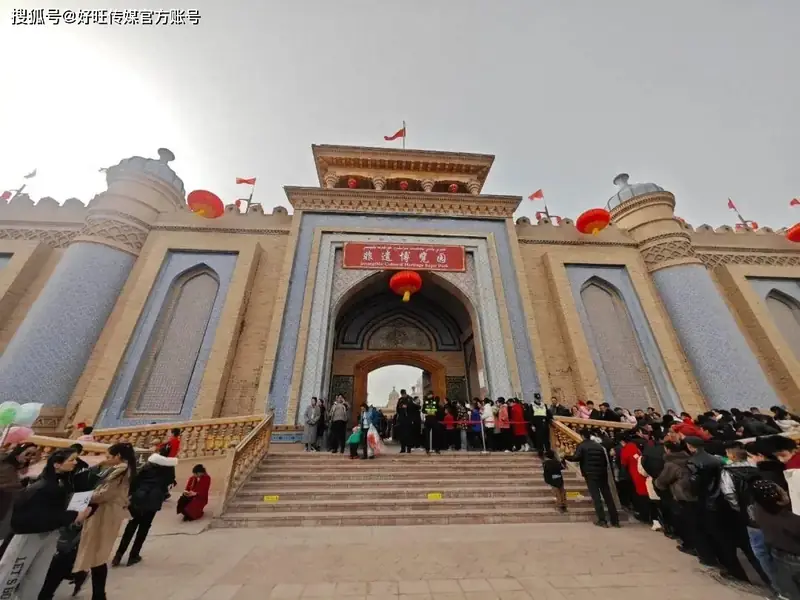
Photo adjustments
EXIF orientation normalized; resized without changing aspect ratio; converted to WebP. No subject edits.
Explore the region
About Yarkant Khanate Royal Tombs
The Silk Roads heritage portal records that the site, which it calls Shache Royal Tombs and gives as also called Alatunluke mazar, was first built in 1533 as the tomb garden of the khanate's first khan Sultan Said, and later became the family burial ground of the khans after the second khan Rashid and Amannisahan were also buried there. It records the site as made up of three parts — a mosque, the burial ground and the Amannisahan mausoleum — with the mosque in the west, under a painted canopy on a raised platform, the burial ground, the main part, in the middle, and Alatun in the east.
The same page records the tombs standing on a raised platform in the middle of the enclosure behind a wall and inside a wooden railing, arranged in rows, all built of grey brick with patterned markers. It records one tomb in the south-west corner as unusual in having a wooden frame house over a domed tomb, the frame's four sides made of grid-patterned walls under a mainly red pattern, with a large burial area to the north. At the south-east corner it places the mausoleum built in memory of Amannisahan, wife of Khan Rashid and a master of the Twelve Muqam, square-bodied with a dome and two tiers of projecting eaves and mainly white; the site's built area it gives as 5,000 square metres, and it records the enclosure walls and the outer walls of the graves as carrying plaster-carved patterns and inscriptions.
The China Huaxia Cultural Heritage Foundation's page records the site as lying north of Alatun Delwaz between the old and new towns of the Shache county town, first built in 1533 to commemorate Sultan Said, the first khan of the Said dynasty. It records the site as distinctive in layout and decorative pattern and as fine Islamic architecture, of historical value for understanding the politics, economy, customs and burial practice of the time, classes it as an ancient tomb, and records that in May 2006 the State Council published it as a sixth-batch major historical and cultural site protected at national level. The same page records the Yarkant Khanate as an Islamic local regime established in Ming-dynasty Xinjiang that took its name from its capital Yarkant, today Shache, was ruled by descendants of Chagatai, and was founded in 1514 and fell in 1680, lasting 166 years under eleven generations of khans.
The catalogue calls the site 叶尔羌汗国王陵, while the Silk Roads portal heads its account 莎车王陵 and gives 阿勒屯鲁克麻扎 as the site's other name; this record declares that divergence rather than harmonising the names. Neither page gives the site a boundary in the form a visitor notice would, and neither states which parts of it are open or who administers it. The Silk Roads portal describes the burial ground as the longest-preserved and largest remaining; that is a ranking, and this record does not adopt it.
What to look for
- The mosque that the Silk Roads portal records in the west of the enclosure, under a painted canopy on a raised platform
- The tombs the same page records on a raised platform inside a wooden railing, arranged in rows and all built of grey brick with patterned markers
- The tomb in the south-west corner that the same page records as unusual, with a wooden frame house over a domed tomb and grid-patterned walls under a mainly red pattern
- The Amannisahan mausoleum at the south-east corner, which the same page records as square-bodied with a dome, two tiers of projecting eaves and a mainly white finish
- The plaster-carved patterns and inscriptions the same page records on the enclosure walls and the outer walls of the graves
Location & getting there
Getting to Yarkant Khanate Royal Tombs
Check which interiors and courtyards are accessible. Active places of worship and protected monuments may have different visitor rules.
- Search for 叶尔羌汗国王陵 with 喀什地区 and 莎车县.
Find Yarkant Khanate Royal Tombs
叶尔羌汗国王陵 · 莎车县
No reliable map pin yet: search by the Chinese name.
Sources & visit information
The linked sources support the identity and background described in this introduction. Opening hours, admission, activity availability and exact arrival arrangements have not been comprehensively checked. Confirm current visitor information with the venue; the original catalogue locality and editorial review flag are retained.