

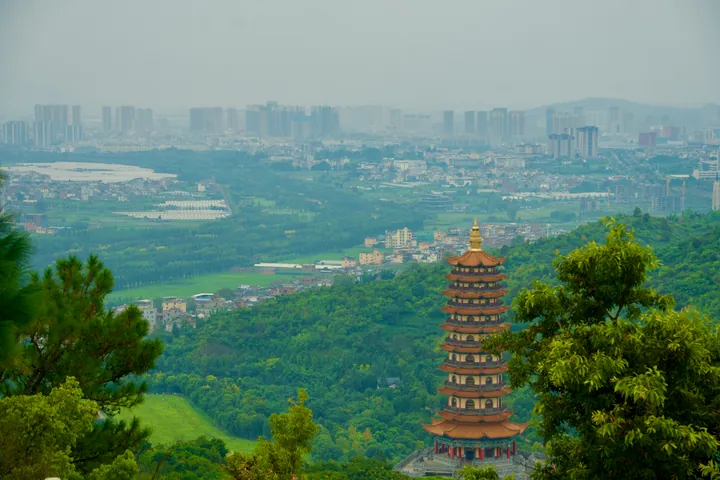
Photo adjustments
Full frame retained; proportionally resized and converted to WebP. No retouching or changes to the photographed subject. Card displays may crop the view.
Explore the region
About Jinping Mountain
According to the Honghe prefectural government, Mile Temple, halfway up the mountain, was first built in the Song dynasty, rebuilt in the Ming dynasty, renovated during the Qing Qianlong era, and expanded in 1999. It has three main courtyards, Daxiong, Dazhi and Dayun, each housing one of five named Maitreya Buddha statue forms: Qiangba, Tianguan, Siwei, Xianguang and Budai; the Honghe Hani and Yi autonomous prefectural government describes the temple as one of the well-known 'sites of Maitreya practice'.
A 19.99-metre-tall Maitreya Buddha statue stands at the mountain's core, reached via a flight of 1,999 steps. The mountain's other main attraction, the Houhai Cultural Theme Park, is themed around closeness to nature and leisure, built around a landscape-garden and original-ecological-forest setting while retaining traditional cultural-life scenic spots, and combines entertainment, dining, lodging, sightseeing and tea-art production.
What to look for
- the 19.99-metre Maitreya Buddha statue at the mountain's core, reached via 1,999 steps
- Mile Temple's three courtyards (Daxiong, Dazhi and Dayun), each housing one of five named Maitreya statue forms
- the Houhai Cultural Theme Park's landscape-garden and forest setting
Location & getting there
Getting to Jinping Mountain
Check which interiors and courtyards are accessible. Active places of worship and protected monuments may have different visitor rules.
- Search for 锦屏山 with 红河哈尼族彝族自治州 and 弥勒市.
Find Jinping Mountain
锦屏山 · 弥勒市
No reliable map pin yet: search by the Chinese name.
Sources & visit information
The linked sources support the identity and background described in this introduction. Opening hours, admission, activity availability and exact arrival arrangements have not been comprehensively checked. Confirm current visitor information with the venue; the original catalogue locality and editorial review flag are retained.