


Explore the region
About Jingdong Confucian Temple
Jingdong Confucian Temple (景东文庙), once the Confucian temple of Jingdong sub-prefecture (景东直隶厅), stands at 111 Yuping Road in Jinping Town (锦屏镇), Jingdong Yi Autonomous County (景东彝族自治县), in Pu'er (普洱), Yunnan.
The temple was founded in 1442, the seventh year of the Ming Zhengtong reign, and moved to its present site at the foot of Yuping Mountain (玉屏山) in 1682, under the Kangxi Emperor of the Qing. It faces east, with the Chuan River (川河) in front and Yuping Mountain behind. Heritage protection came in stages: Jingdong county listed it in August 1986, the Yunnan provincial government placed it on its third list of protected sites in December 1987, and on 5 March 2013 the State Council added it to the seventh national list of key protected heritage sites (全国重点文物保护单位). In December 2016 it was approved as a national AAA tourist attraction.
Yunnan Net calls it one of the more complete old buildings in southwest Yunnan, a representative Confucian temple of the frontier areas long settled by the Dai, and the earliest-founded and largest Confucian temple in Pu'er. The complex covers 5,292 square metres and is laid out as terraced courtyards, five deep, climbing symmetrically along a central axis. The temple buildings stand on the right and the school buildings on the left.
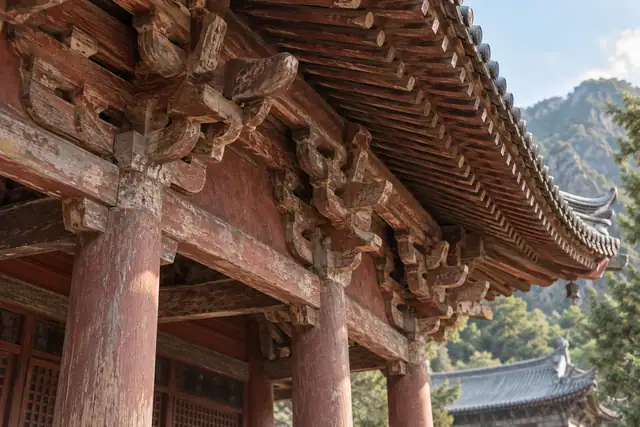
The complex is made up of a screen wall, a ritual pond (泮池), the Sishui memorial archway (泗水牌坊), Kuixing Pavilion (魁星阁), a hexagonal pavilion, the bell and drum towers, Lingxing Gate (棂星门), Dacheng Gate (大成门), the Tianzi Platform (天子台) and Dacheng Hall (大成殿), with side wings on both sides. Dacheng Hall is five bays wide under a single-eaved hip-and-gable roof, and the temple holds statues of Confucius and twelve of his followers. Yellow glazed tiles cover the roofs, carved reliefs decorate the Sumeru-style plinths (须弥座), and a chun tree (椿) more than 500 years old shades the courtyards.
What to look for
- Dacheng Hall (大成殿), five bays wide with a single-eaved hip-and-gable roof
- The screen wall and the ritual pond (泮池)
- Lingxing Gate (棂星门) and Dacheng Gate (大成门)
- Kuixing Pavilion (魁星阁), the hexagonal pavilion and the bell and drum towers
- Carved reliefs on the Sumeru-style plinths (须弥座)
- A chun tree (椿) more than 500 years old
- Statues of Confucius and twelve of his followers
Location & getting there
Getting to Jingdong Confucian Temple
- Search for 景东文庙 with 普洱市 and 景东彝族自治县.
Find Jingdong Confucian Temple
景东文庙 · 景东彝族自治县
No reliable map pin yet: search by the Chinese name.
Sources & visit information
Written from the linked sources and checked sentence by sentence against quoted extracts by a separate reviewer on 2026-09-23. Opening hours, admission and access arrangements are not covered; confirm current visitor information with the site.
Some facts checked against Wikipedia contributors, "景东文庙" · CC BY-SA 4.0.