

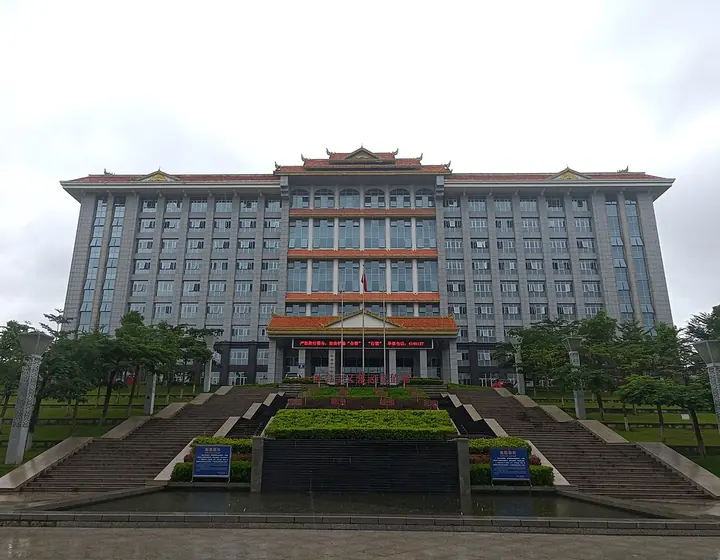
Photo adjustments
Full frame retained; proportionally resized and converted to WebP. No retouching or changes to the photographed subject. Card displays may crop the view.
Explore the region
About Ruili
Jiele Golden Pagoda gathers a main gilded tower and smaller surrounding stupas at Jiele village, while Moli Rainforest follows a wooded valley towards its waterfall. These offer a clearer first sightseeing plan than trying to cover every border-market attraction at once. Keep the two visits separate, with road transfers, and use the ordinary visitor entrances; neither requires crossing the international border.
The older name Mengmao means 'foggy place' in Tai Nuea, while the modern name is associated with the Shweli River (瑞丽江). Ruili became a county in 1952 and a county-level city in 1992. The former city of Wanding (畹町) was incorporated into its jurisdiction in 1999. Border trade supports local industries including jade and rosewood furniture.
The climate is warm and humid, with a long summer and little distinct winter. The dry season runs from December through April, followed by a wet season from May through October. Dry heat increases before the arrival of the Indian Ocean monsoon. Most rainfall falls between June and September, while the surrounding vegetation includes monsoon evergreen broad-leaved forest.
What to look for
- Jiele Golden Pagoda presents a group of gilded stupas in a village religious setting.
- Moli Rainforest combines dense vegetation, smaller cascades and the principal Moli Waterfall.
Background & history
Ruili (simplified Chinese: 瑞丽; traditional Chinese: 瑞麗; pinyin: Ruìlì; Tai Nüa: ᥛᥫᥒᥰ ᥛᥣᥝᥰ; Shan: မိူင်းမၢဝ်း; Thai: เมืองมาว; Burmese: ရွှေလီ), called Möng Mao in Tai, is a county-level city of Dehong Prefecture, in the west of Yunnan province, China. It is a major border crossing between China and Myanmar, with the town of Muse located across the border.
Excerpt from Wikipedia: Ruili · Wikipedia contributors · CC BY-SA 4.0. Selected introductory sentences; formatting simplified. Background information, not current visitor-service advice.
Location & getting there
Getting to Ruili
For the cultural stop, use Jiele Golden Pagoda in Jiele village northeast of central Ruili. Moli Rainforest has a separate scenic-area entrance farther northeast; arrange that road transfer independently rather than following forest-fire tracks.
Combine your visit
Suggested order for the visit:
-
Jiele Golden Pagoda
Start with the grouped stupas and religious setting.
-
Moli Rainforest
Make a separate transfer for the managed forest-and-waterfall route.
This is an editorial sequence of named spaces or places. It does not imply a verified walking connection or promise opening, ticket availability or a journey time.
Find Ruili overview
瑞丽 · 德宏州
The pin marks the area, not the entrance.
Sources & visit information
The sources below support the place-specific description and arrival information. Suggested combinations are editorial planning ideas; confirm current opening, entry arrangements and transport services for your date.
- Ruili ↗
- Ruili government: scenic-area directory ↗
- Moli Rainforest operator introduction ↗
- Jiele Golden Pagoda destination description ↗
- Chinese Wikipedia: 瑞丽市 (revision 93030666, 2026-06-11) ↗
- English Wikipedia: Ruili (revision 1357927573, 2026-06-05) ↗
Visitor information adapted and edited from Wikipedia contributors, “Ruili” · CC BY-SA 4.0. Source revision 1357927573.
Background paragraphs translated and condensed from Wikipedia contributors, "瑞丽市", Chinese Wikipedia · CC BY-SA 4.0. Source revision 93030666.
Background paragraphs condensed from Wikipedia contributors, "Ruili", English Wikipedia · CC BY-SA 4.0. Source revision 1357927573.