

Photo adjustments
Resized and WebP compressed; subject not altered.
Explore the region
About Yunhe Rice Terraces
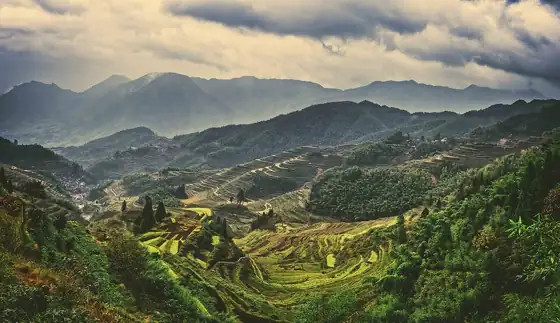
Their narrow plots and retaining edges make the work of adapting steep ground visible. Xiayang offers a closer view of the terrace pattern, while Qixingdun provides a higher perspective across the slopes. Seasonal planting and weather change the appearance substantially. Choose viewpoints and the operating scenic transport first, leaving the agricultural plots to the people who farm them.
Cultivation began during the Tang dynasty and expanded under the Yuan and Ming. In the early Ming, large-scale rice farming was closely associated with local silver mining and smelting. Later, small plots and a declining rural workforce contributed to abandonment. Reclamation since the start of the twenty-first century has restored more than 5,000 mu (亩) of terraces.
The terraces occupy headwaters of Fuyun Stream (浮云溪), a tributary of the Ou River (瓯江). A wetland park here became a provincial park in 2011 and formally entered the National Wetland Park list in 2019. The agricultural system separately joined China's national list of Important Agricultural Heritage Systems in 2017.
What to look for
- Xiayang reveals the layered pattern of narrow fields and their retaining edges.
- Qixingdun provides a higher view of the cultivated mountain slopes.
Location & getting there
Getting to Yunhe Rice Terraces
Approach the main Yunhe Terraces visitor centre at Meiyuan Village in Chongtou. Confirm the current connection to Xiayang and Qixingdun, including whether the scenic cableway is operating.
Combine your visit
A suggested sequence linking the specific features of this visit.
-
Xiayang terrace viewpoint
Begin with a closer reading of the individual fields.
-
Qixingdun viewpoint
Compare that detail with the wider mountain landscape after the scenic transfer.
This order is editorial. Confirm access and any transfers between stops; it does not establish a walking route, same-day connection or common admission ticket.

Find Yunhe Rice Terraces
云和梯田 · 丽水市
The pin marks the area, not the entrance.
More places nearby
Approximate straight-line distances between map pins, not travel distances.
Guyan Huaxiang 古堰画乡
36 km awayGuyan Huaxiang brings together the Tongji irrigation works and an artists’ riverside settlement. The curved weir diverts water into a canal system, while old camphor trees and Wenchang Pavilion make the channel a cultural…
View guide →Songyang County 松阳古村
44 km awaySongyang’s county town offers a practical introduction to a wider landscape of traditional villages. In Xiping’s Ming-Qing old street, workshops for ironworking, scale-making and cotton work sit among homes and shops, while the…
View guide →Baizhangxia 百丈漈
56 km awayBaizhangji in Wencheng descends through three contrasting waterfall stages within a deep valley. The first is a tall drop, the second combines falling water with an overhanging rock corridor, and the third spreads into a…
View guide →Sources & visit information
The sources below support the place-specific description and arrival information. Suggested combinations are editorial planning ideas; confirm current opening, entry arrangements and transport services for your date.
Visitor information adapted and edited from Wikipedia contributors, “云和梯田” · CC BY-SA 4.0. Source revision 93931995.
Background paragraphs translated and condensed from Wikipedia contributors, "云和梯田", Chinese Wikipedia · CC BY-SA 4.0. Source revision 93931995.