

Explore the region
About Wutun Monastery and Regong Art Village
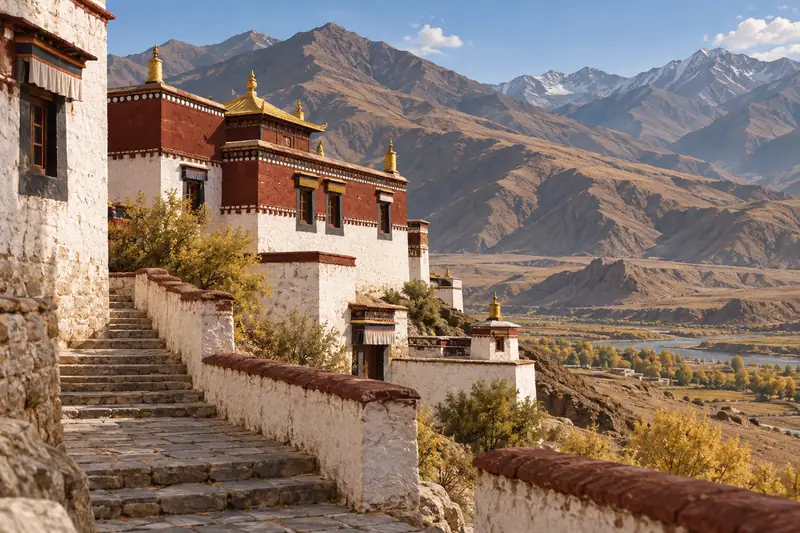
The Huangnan Daily feature on the prefecture's sights places the two temples in Wutun village on the east bank of the Longwu River in Tongren and says that, together with Nianduhu temple, Guomari temple and the Wake temple in Bao'an town, they are known as the Longwu four stockade temples, adding that the Wutun temples are among the Qinghai temples holding the larger numbers of precious relics. It describes Wutun Upper Temple as a subsidiary temple of Longwu temple, which is a nationally protected key cultural relic site, gives its Tibetan name Hwadan Qunjo Ling as meaning 'auspicious dharma-wealth island', dates it to 1645, and says it belongs to the Gelug school and holds a great assembly hall and a Tsongkhapa hall more than 200 years old. The same feature calls Wutun Upper Temple the 'school of Regong art', whose monks are skilled in painting, clay sculpture and carving. It places Wutun Lower Temple at Wutun Xiazhuang, 7 km east of Longwu town, on the flat river terrace of the Longwu valley, gives its Tibetan name as Gadan Pentsok Chuling and dates it to 1648.
The Guangming Daily report republished on the Qiushi website sets out the village's place in the tradition. It describes Tongren as known at home and abroad for Regong art, mainly thangka, appliqué and sculpture, as Qinghai's only national historical and cultural city and as the third cultural-ecological protection zone approved by the State Council, after Minnan and Huizhou culture; it quotes the city's culture, sport, tourism and broadcasting director, Chen Yunzhang, saying that Tongren is called Regong in Tibetan, meaning the golden valley where dreams come true, and that it is a famous home of Tibetan painters with eight national-level masters of arts and crafts. The report describes Wutun village in Longwu town as the core area of Regong art and where most Regong artists are concentrated, with more than 90 per cent of households processing and making Regong artworks. The catalogue name is a compound label joining the temple and the village: the cited pages treat them as separate places in the same village, and neither describes them as one site.
What to look for
- The great assembly hall and the Tsongkhapa hall at Wutun Upper Temple, which the Huangnan Daily account dates back more than 200 years
- Wutun Upper Temple itself, which that account calls the 'school of Regong art' for its monks' painting, clay sculpture and carving
- Wutun Lower Temple, whose Tibetan name the same account gives as Gadan Pentsok Chuling and which it dates to 1648
- The working studios of Wutun village, which the Guangming Daily report describes as a studio in every home and a painter in every person
Location & getting there
Getting to Wutun Monastery and Regong Art Village
Check which interiors and courtyards are accessible. Active places of worship and protected monuments may have different visitor rules.
- Search for 吾屯寺与热贡艺术村 with 黄南藏族自治州 and 同仁市.
Find Wutun Monastery and Regong Art Village
吾屯寺与热贡艺术村 · 同仁市
No reliable map pin yet: search by the Chinese name.
Sources & visit information
The linked sources support the identity and background described in this introduction. Opening hours, admission, activity availability and exact arrival arrangements have not been comprehensively checked. Confirm current visitor information with the venue; the original catalogue locality and editorial review flag are retained.