

Photo adjustments
Full frame retained; proportionally resized and converted to WebP. No retouching or changes to the photographed subject. Card displays may crop the view.
Explore the region
About Baiyun Mountain
The place and the name. The Yulin party history and local gazetteer office places Baiyun Mountain five kilometres south of Jia County town and calls it the largest Taoist holy place in north-west China and a national key cultural relic protection unit, adding that the scenic area is built to the standard for creating an AAAAA-grade site. Both sources record that the mountain was anciently called Shuanglong Ridge and also Cuo'e Ridge, and that it took the name Baiyun Mountain because cloud gathers round it all year; the temple, they say, is called Baiyun Abbey after the line about the mountain gate needing no lock because the white cloud seals it. The portal's feature describes the site as close to the Yellow River and built against the hill, with cloud, dense pines and cypresses and a crowd of temples, known in the north-west, north China and beyond as a famous place of the Guanxi region, and gives it as a national AAAA-grade tourist area.
The founding. The Yulin page records, from the Jia County gazetteer, that in the thirty-third year of the Wanli era the Quanzhongnan Taoist Li Yufeng came to Baiyun Mountain while travelling, found the scenery fine and settled there, gathering herbs to heal the sick and teaching the people, and that his reputation and skill as a physician earned him the name Zhenren Yufeng among the people; from then on, the page says, he directed the building of the abbey.
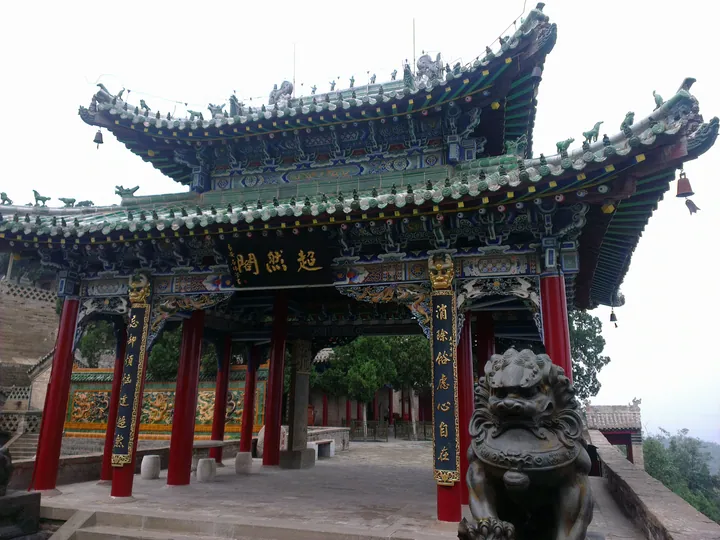
The buildings. The portal's feature describes the temple as a complete and grandly regulated ancient building group of halls, archways, pavilions, passages and bridges, among others, with a built area of 81,000 square metres, rising with the hill in three axes, dense but well spaced. It says the main and secondary axes are both laid out symmetrically, that the buildings are mostly timber-framed and make full use of mortise-and-tenon joints of more than twenty kinds, and that the roofs take forms including xieshan, xuanshan, yingshan and double eaves, covered variously in glazed and plain tiles, which produces an effect that is graded by height and rank and rich in colour. It adds that the ridge figures are varied and well made, that the timber archways stand free with flying eaves and upturned corners, and that the building as a whole follows Ming and Qing construction rules while taking in a distinct local style.
What the site holds. The Yulin page records that the abbey holds more than 1,590 coloured murals showing Taoist and Buddhist narrative scenes and landscapes with figures, richly coloured, along with Ming iron bells and Qing bronze bells among other relics. The portal's feature describes the murals in more detail as mainly Taoist stories and Buddhist narrative scenes, including large coloured fine-brush paintings, coloured serial pictures of legends, landscape scrolls and lightly toned ink flower paintings, mostly the work of folk painters of the Ming and Qing and among the site's most artistically valuable folk art. It records 157 steles, some recording benefactions and some bearing calligraphy left by scholars and travellers, among them two cursive-script steles written in the Wanli era by Wu Zongyi, grain official of Shanxi, and the wooden board inscribed 'Yuxu Palace' hanging in the Zhenwu hall, written by the founding Taoist Li Yufeng.
The music and the fairs. The portal's feature records that the temple holds traditional fairs on the third day of the third month, the eighth day of the fourth month and the ninth day of the ninth month in the lunar calendar, the fourth-month one being the busiest, with people coming from Inner Mongolia, Henan, Shanxi, Shaanxi, Gansu, Ningxia and elsewhere to make pilgrimage, travel and trade, as many as a hundred thousand in a day at the peak. It also records that the site's Taoist music, known as the rhyme of Baiyun, has both classical and court elements because the Taoist Wang Zhenshou and others came from the Baiyun Abbey in Beijing in the thirty-sixth year of the Wanli era, which the page dates to 1608, with a warrant from the Shaanxi provincial administration to direct the site's religious affairs and brought Beijing Baiyun Abbey's music there, and a southern style as well because in the Kangxi era the Taoist Miao Tairen travelled widely in the south collecting music from famous mountains.
What to look for
- The Zhenwu hall, which the portal's feature names as the place where the 'Yuxu Palace' board written by the founding Taoist Li Yufeng hangs.
- The more than 1,590 murals both sources describe, mainly Taoist and Buddhist narrative scenes and landscapes with figures, mostly the work of Ming and Qing folk painters.
- The 157 steles the portal's feature counts, including two cursive-script steles written in the Wanli era by the Shanxi grain official Wu Zongyi.
- The roofscape, which the feature describes as using xieshan, xuanshan, yingshan and double-eave forms with glazed and plain tiles in a graded, colourful arrangement.
- The timber archways the feature singles out, standing free with flying eaves and upturned corners.
- The three axes on which the buildings climb the hillside, laid out symmetrically on the main and secondary axes.
- The Ming iron bells and Qing bronze bells the Yulin page lists among the site's relics.
Location & getting there
Getting to Baiyun Mountain
Check which interiors and courtyards are accessible. Active places of worship and protected monuments may have different visitor rules.
- Search for 白云山 with 榆林市 and 佳县.

Find Baiyun Mountain
白云山 · 佳县
No reliable map pin yet: search by the Chinese name.
Sources & visit information
The linked sources support the identity and background described in this introduction. Opening hours, admission, activity availability and exact arrival arrangements have not been comprehensively checked. Confirm current visitor information with the venue; the original catalogue locality and editorial review flag are retained.