

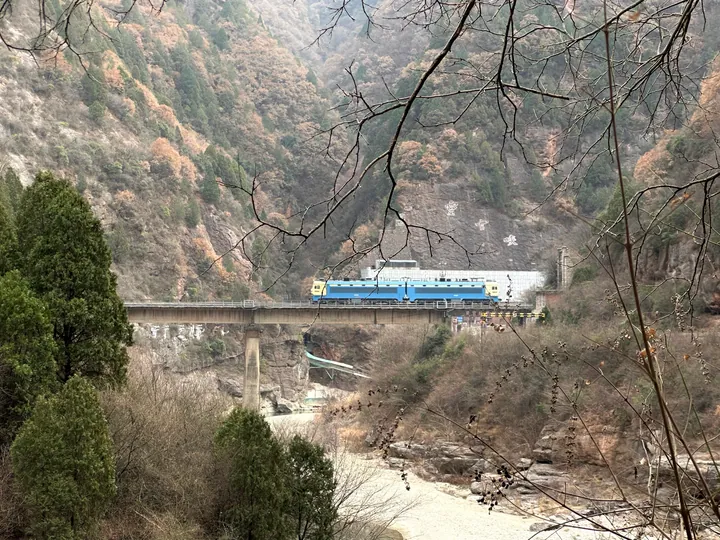
Photo adjustments
Full frame retained; proportionally resized and converted to WebP. No retouching or changes to the photographed subject. Card displays may crop the view.
Explore the region
About Lingguan Gorge
An essay in the railway-literature section of China State Railway Group's own site describes the gorge as about ten kilometres long, deep in the Qinling, with high mountains on both sides and a narrowest point of just over twenty metres, filled by the Jialing River, the road and the old Baocheng line. The scenic area's own text gives 3.6 kilometres of the gorge as the stretch it has developed, and describes the place as a national 3A-grade scenic area whose character it sums up as railway relics, a leisure oxygen bar and ancient Qiang culture; it places the site 5 km southwest of the county town, beside an ancient Qiang culture demonstration park. The Baocheng railway opened to traffic on New Year's Day 1958 and completed electrification on 1 July 1975, which the county's page calls China's first electrified railway. The scenic area is known through Du Pengcheng's essay 夜走灵官峡, written when he reported from the railway construction site here, and the county's page says the area was made by taking that essay as its background, using the abandoned tunnels and recreating the construction scenes in five display zones with sound, light, electricity, sculpture and reconstructed scenes.
The county's page dates the flood that forced the re-routing to August 1981, after more than forty days of continuous rain in Feng County. An essay on China State Railway Group's own site records continuous heavy rain in the Qinling on 21 August 1982 that flooded the section's roadbed, let water into the tunnels and destroyed the station buildings, and puts the rebuilding of the line and the abandonment of the Lingguan Gorge section in the following year; this record states the two accounts as the pages give them. A Xinhua News Agency photo feature records that the locality then used the abandoned tunnel route to make the scenic area, with the Baocheng railway culture experience hall and a rail mini-train among its sites, and the China State Railway Group's essay records that the Feng County government has built the place into the Baocheng railway relics park. That hall is built inside the scenic area's No. 2 railway tunnel, runs 450 metres and covers about 2,500 square metres, and was made on the original tunnel remains with a preface hall, a 夜走灵官峡 experience area, a Baocheng railway spirit experience area, a science section and a closing hall. The essay records that the tunnels and covered galleries of the old line survive, with slogans from decades ago still faintly visible on the tunnel walls and large sculptures of the railway builders standing at the tunnel mouths.
What to look for
- The Baocheng railway culture experience hall inside the No. 2 railway tunnel: 450 metres long, about 2,500 square metres, with a preface hall, a 夜走灵官峡 experience area, a Baocheng railway spirit experience area, a science section and a closing hall
- The tunnels and covered galleries of the abandoned line, where the essay records slogans from decades ago still faintly visible on the walls and large sculptures of the railway builders at the tunnel mouths
- The rail mini-train, whose route the county's page gives as 3.2 kilometres through the abandoned tunnel section
- The old plank road on the river bank that the county's page dates to the Three Kingdoms period
- The 1,040-metre Qiang people's valley and the ancient Qiang culture the scenic area's own text names among its features
Location & getting there
Getting to Lingguan Gorge
Confirm the visitor entrance and which boat or walking routes operate on your date. Rainfall, water levels and weather can change access.
- Search for 灵官峡 with 宝鸡市 and 凤县.
Find Lingguan Gorge
灵官峡 · 凤县
No reliable map pin yet: search by the Chinese name.
Sources & visit information
The linked sources support the identity and background described in this introduction. Opening hours, admission, activity availability and exact arrival arrangements have not been comprehensively checked. Confirm current visitor information with the venue; the original catalogue locality and editorial review flag are retained.