


Photo adjustments
Full frame retained; proportionally resized and converted to WebP. No retouching or changes to the photographed subject. Card displays may crop the view.
Explore the region
About Qiachuan Wetland
Qiachuan Wetland (洽川) is a Yellow River wetland scenic area in Heyang County (合阳县), Shaanxi, on the Shaanxi–Shanxi border. It sits on the river's second terrace in Qiachuan town (洽川镇), 23 km east of the Heyang county seat and 180 km from Xi'an.
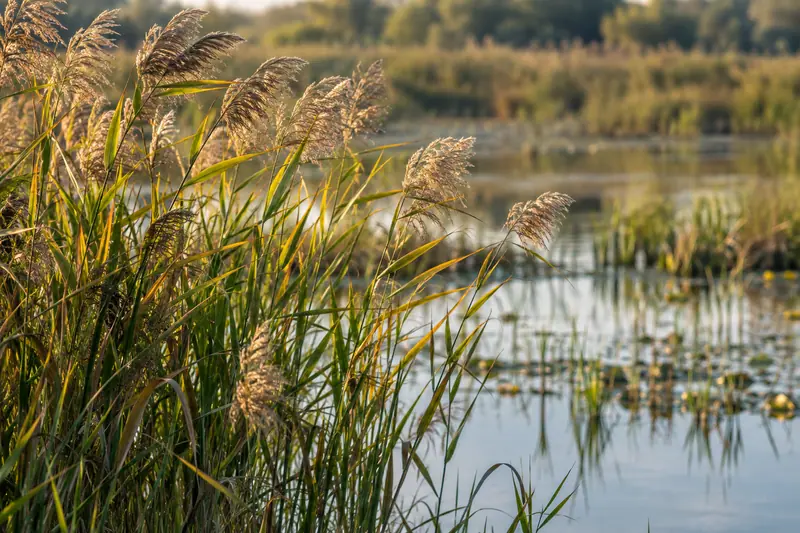
After passing Hukou (壶口) and Longmen (龙门), the Shaanxi stretch of the Yellow River opens out at Heyang, and Heyang County's media centre calls Qiachuan the largest hot-spring, lake-type wetland in the Yellow River basin. The scenic area covers 176 square kilometres and is one of Shaanxi's five National Key Scenic Areas (国家重点风景名胜区). It holds a reed marsh that the county media centre puts at 150,000 mu, with lotus ponds and spring vents scattered through the wetland.
Qiachuan carries some very old associations. Chinese Wikipedia records that Qi (启), a Xia king of the 21st century BC, granted the land to a younger son, creating the state of Youshen (有莘国). The Book of Songs (诗经) poem 'Guanju' (关雎) is set here, the area is given as the home town of Tai Si (太姒), wife of the Zhou king Wen, and local legend says King Wen met Tai Si by chance in the wetland. The legendary ruler Di Ku (帝喾) is said to be buried here, and the Han-dynasty stele of Cao Quan, magistrate of Heyang (合阳令曹全碑), was unearthed at Qiachuan. A scenic-area guide quoted by the county's media centre links more than 30 of the 305 poems in the Book of Songs to the place.
Heyang County's media centre describes the wetland as an important stopover on China's inland bird migration routes. Chinese Wikipedia lists 72 rare bird species, among them red-crowned cranes, black storks, great bustards, swans and grey herons, and county photo reports show swans, grey herons and common cranes in the reeds in autumn and early winter. The 'seven fen springs' (瀵泉七眼) stay around 30°C all year and carry copper, strontium and selenium. At Virgin Spring (处女泉), the best known, many vents stir the sandy bed, and visitors try a 'sand-wave bath' (沙浪浴) in which they float without sinking; Xiayang Fen (夏阳瀵) has the largest flow of the group. Visitors walk the reed beds on wooden boardwalks and ride bamboo rafts along the channels.
What to look for
- Virgin Spring (处女泉), a warm spring whose many vents stir the sand, used for 'sand-wave' bathing
- Xiayang Fen (夏阳瀵), the highest-yielding of the seven fen springs
- The reed marsh, gold in early September and white with reed flowers in early winter
- Lotus ponds scattered among the reed beds
- Migratory birds such as swans, grey herons and common cranes
- Bamboo-raft trips through the wetland channels and wooden boardwalks over the reeds
Location & getting there
Getting to Qiachuan Wetland
- Search for 洽川 with 渭南市 and 合阳县.
Find Qiachuan Wetland
洽川 · 合阳县
No reliable map pin yet: search by the Chinese name.
Sources & visit information
Written from the linked sources and checked sentence by sentence against quoted extracts by a separate reviewer on 2026-09-23. Opening hours, admission and access arrangements are not covered; confirm current visitor information with the site.
Some facts checked against Wikipedia contributors, "洽川" · CC BY-SA 4.0.