

Photo adjustments
Full frame retained; proportionally resized and converted to WebP. No retouching or changes to the photographed subject. Card displays may crop the view.
Explore the region
About Tongwan City Ruins
Tongwan City Ruins (统万城遗址) are the remains of the capital of the Great Xia (大夏) state, founded by the Xiongnu leader Helian Bobo (赫连勃勃), in desert on the north bank of the Wuding River (无定河) at the northern tip of Jingbian County (靖边县), Yulin, Shaanxi. Local people call the site Baichengzi (白城子), 'White City'.
Helian Bobo, of the Tiefu (铁弗) branch of the Xiongnu, declared the Great Xia state in 407 and in 413 set more than 100,000 people from the peoples north of the Qinling to building a capital. The name means 'unify the realm and rule ten thousand states'. His official Chigan Ali (叱干阿利) oversaw the work: the pale earth was steamed and then rammed, and, according to the Book of Jin, if an iron awl went an inch into a wall, the builders were executed and walled up inside it. Helian Bobo died in the city in 425, and two years later Northern Wei took it. Tongwancheng then served as the seat of Xiazhou, later of the Sui Shuofang commandery, and from 881 as the Tangut (党项) base under Tuoba Sigong (拓跋思恭), military governor of Xiazhou. In 994 the Song, judging it too deep in the desert to hold, had it destroyed and moved its people away. It was a capital for 15 years but a northern stronghold for nearly 600.
Sand later buried the site; its exposed walls of pale earth, mainly lime, quartz sand and white clay, gave it its local name. In 1845 the magistrate He Bingxun (何炳勋) confirmed that the ruins were the old Xiazhou city, and Shaanxi heritage workers verified this in 1956, recovering bronze seals, mirrors and Buddha figures. The State Council placed it on the national list of protected heritage sites in 1996, and in November 2012 the National Cultural Heritage Administration added it to China's tentative list for World Heritage.
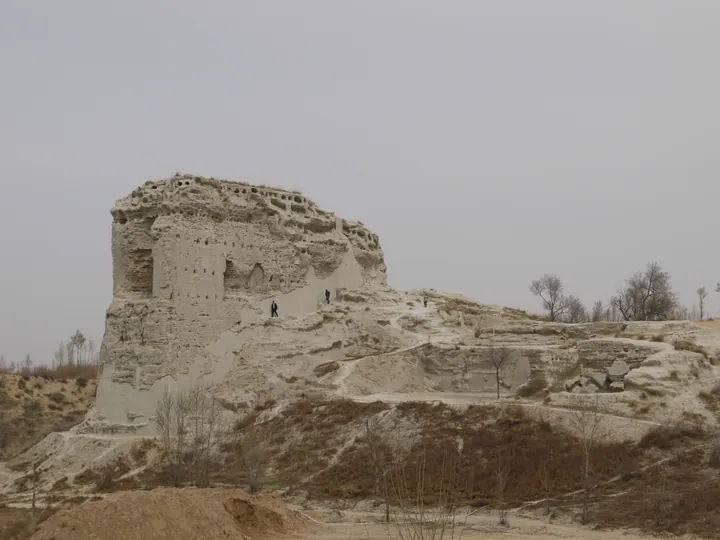
Everything that survives is rammed earth. The outer city, an irregular 7.7 square kilometres, held homes and markets; the inner city is split into an eastern city of government offices and a western imperial city, which is the best preserved. Its four gates were named Zhaowei (招魏, 'bring Wei to surrender'), Chaosong (朝宋, 'face Song'), Fuliang (服凉, 'subdue Liang') and Pingshuo (平朔, 'pacify the north'). Bastions stud the walls, 22 on the eastern city and 38 on the western; two are hollow shafts used as storehouses, which the county government calls very rare in Chinese city building. In the western city the southwest corner platform survives to 26.62 m, and at the centre rises the 19-metre base of the Yong'an Terrace (永安台), where Helian Bobo handled state affairs and his son Helian Chang (赫连昌) took the throne in 425.
What to look for
- The white rammed-earth walls of the western city, the best-preserved part of the ruins
- The Yong'an Terrace (永安台), a 19-metre rammed-earth base at the centre of the western city, reinforced in 2004
- The southwest corner platform of the western city, 26.62 metres high
- Hollow bastion No. 1 on the western city's south wall, a storage shaft projecting 17 metres
- Outlines of the barbican enclosures at the western and northern gates
Location & getting there
Getting to Tongwan City Ruins
- Search for 统万城遗址 with 榆林市 and 靖边县.
Find Tongwan City Ruins
统万城遗址 · 靖边县
No reliable map pin yet: search by the Chinese name.
Sources & visit information
Written from the linked sources and checked sentence by sentence against quoted extracts by a separate reviewer on 2026-09-23. Opening hours, admission and access arrangements are not covered; confirm current visitor information with the site.
Some facts checked against Wikipedia contributors, "统万城" · CC BY-SA 4.0.