

Photo adjustments
Full frame retained; EXIF orientation normalized, proportionally resized to at most 800 pixels and converted to WebP. No generated pixels or subject changes. Cards may crop the display.
Explore the region
About Weiyang Palace Site of Han Chang'an City
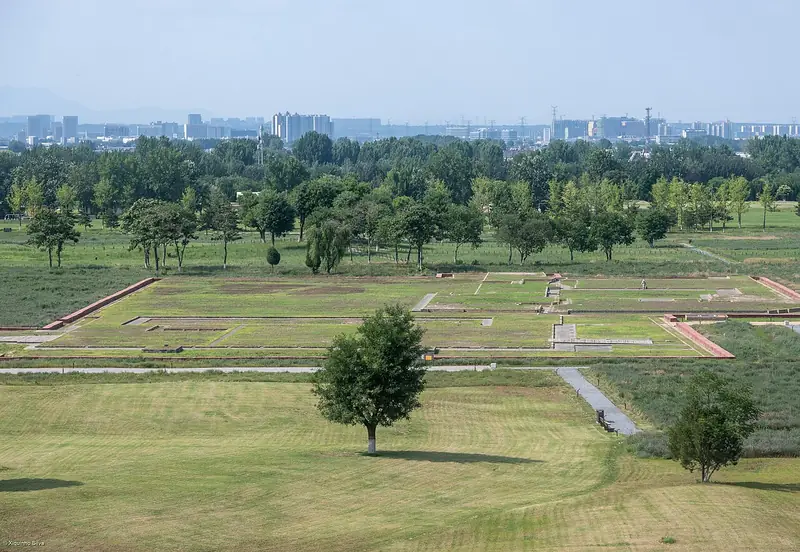
Weiyang Palace Site of Han Chang'an City (汉长安城未央宫遗址) is the ruin of the chief palace of the Western Han capital Chang'an (长安), in the southwest corner of the old walled city, now in Weiyang District (未央区) of Xi'an (西安).
Chancellor Xiao He (萧何) oversaw its construction from 200 BC to 198 BC, and every Western Han emperor used it as the formal palace. It burned in the fighting that ended Wang Mang's (王莽) Xin dynasty, yet later regimes kept returning: Dong Zhuo (董卓) housed the Han court here in 190, the Later Zhao (后赵) set 160,000 labourers to rebuild it in 345, and the Former Qin, Later Qin, Western Wei and Northern Zhou all ruled from it. Tang buildings on the site were abandoned in the late Tang.
Excavated walls measure 8,800 m around a near-square about 2,150 to 2,250 m on each side, enclosing 5 km²; Chinese Wikipedia describes it as the largest palace of ancient China. At the centre, the Front Hall (前殿) stood on a platform 350 m long that rises in three terraces to 15 m at the north end. The platform, built on a hill of the Longshou range (龙首山), once carried the Qin Zhangtai (章台), and archaeologists found Yangshao-culture (仰韶文化) graves on it. The Jiaofang Hall (椒房殿), 360 m further north, took its name from walls plastered with pepper and mud, which gave the inner walls a warm colour and scented the air.
Other digs uncovered the central government office compound, where over 50,000 inscribed bone tallies, mostly ox bone, turned up; scholars read them as records of goods sent to the palace from around the country. Two archive pavilions stood in the north: Shiqu Pavilion (石渠阁), which held the Qin court's books after the fall of Qin, and Tianlu Pavilion (天禄阁), with up to 3,090 scrolls, a key source for Sima Qian's (司马迁) Records of the Grand Historian (史记). The artificial Cang Pool (沧池) in the southwest, 0.196 km² in area, had an artificial hill, Jiantai (渐台), heaped up in the middle of the water.
The whole Han Chang'an ruin was listed in 1961 in the first batch of national key cultural relics protection units. From 2012 nine villages, about 15,000 people and more than 1,000 businesses were moved off the palace site, and a protection and display area opened in 2013. In 2014 UNESCO inscribed the palace ruins within its Silk Roads: Chang'an-Tianshan Corridor serial World Heritage property.
What to look for
- Front Hall (前殿) platform, 350 m long and rising in three terraces
- Jiaofang Hall (椒房殿), part of the inner palace, named for its pepper-plastered walls
- Shiqu Pavilion (石渠阁) platform, 7 m high, where the Han kept the Qin palace's books and archives
- Tianlu Pavilion (天禄阁) platform, the library that fed Sima Qian's Records of the Grand Historian
- Zhicheng Gate (直城门), the main gate in the west palace wall
Location & getting there
Getting to Weiyang Palace Site of Han Chang'an City
- Search for 汉长安城未央宫遗址 with 西安市 and 未央区.
Find Weiyang Palace Site of Han Chang'an City
汉长安城未央宫遗址 · 未央区
No reliable map pin yet: search by the Chinese name.
Sources & visit information
Written from the linked sources and checked sentence by sentence against quoted extracts by a separate reviewer on 2026-09-23. Opening hours, admission and access arrangements are not covered; confirm current visitor information with the site.
Some facts checked against Wikipedia contributors, "未央宫" · CC BY-SA 4.0.