

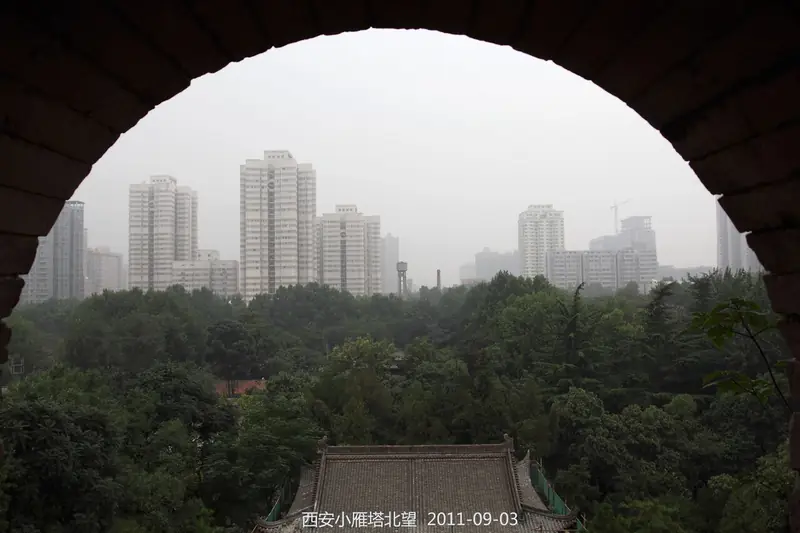
Photo adjustments
Full frame retained; EXIF orientation normalized, proportionally resized to at most 800 pixels and converted to WebP. No generated pixels or subject changes. Cards may crop the display.
Explore the region
About Small Wild Goose Pagoda and Xi'an Museum
The pagoda is the reason the site matters. The heritage administration's entry records that it was built to house the Buddhist scriptures and images brought back by the Tang monk Yijing, that it stands in Beilin District, Xi'an, that it was first built in 707 and that it is also called the Jianfu Temple pagoda. It began as a 15-storey brick pagoda with close-set eaves, was damaged by several earthquakes and repaired several times, and now has 13 storeys and stands 43.38 metres high. The administration connects it directly with a major event in the history of Buddhism's spread along the Silk Roads, Yijing's voyage west by sea in search of the dharma, and records that the Jianfu Temple where it stands was one of the three great scripture-translation centres of Tang Chang'an, evidence of how widespread Buddhism was in the city under the Tang. The Xinhua report of 2023 gives the building reign as the Jinglong years of Emperor Zhongzong, 707 to 710, records that the pagoda had 15 storeys and now has 13 and stands 43.4 metres high, and that after more than 1,300 years it is still intact overall; it also records that the pagoda and the old bell in the Jianfu Temple bell tower together form the Yanta morning bell, one of the eight famous scenes of the Guanzhong plain.
The temple's history runs back further than the pagoda. The National Cultural Heritage Administration's 2017 feature records that in 684 the imperial house built Jianfu Temple to pray for Emperor Gaozong and that the pagoda was completed inside it in 707 to 709. It records that Yijing returned from India, entered Jianfu Temple in 706 and there translated 32 Buddhist scriptures, disciplines and treatises in 108 fascicles, and that the pagoda was built to store the scriptures he brought back. It records the site's later milestones in order: the State Council declared the pagoda a nationally protected cultural relics unit of the first batch in 1961; the Xi'an Small Wild Goose Pagoda keeping office was set up in 1963; the pagoda's scenic area opened to the public in 1980; the city began planning a museum south-west of the pagoda in 1996; the project was listed as a provincial and municipal key project in October 1999; the city formally started building the Xi'an Museum in November 2000 with a total investment of 220 million yuan; and the museum opened on 18 May 2007. The feature records that the museum's construction filled the gap of a municipal museum reflecting the city's historical development.
What the museum holds and shows is set out in the same feature. It records that the museum is made up of the Tang Small Wild Goose Pagoda Jianfu Temple historic scenic area, the museum building and the Small Wild Goose Pagoda historic culture park, that it covers 245 mu, and that it is a national first-class museum combining a World Heritage site, a nationally protected cultural relics unit, historic buildings and a modern exhibition hall. It records holdings of 110,742 items, of which more than 10,740 are precious relics of the third grade or above, and an exhibition hall designed under the direction of Zhang Jinqiu, an academician of the Chinese Academy of Engineering, with a floor area of more than 16,000 square metres and an exhibition area of more than 5,500 square metres. The permanent exhibition 古都西安 has two parts: 千年古都 traces the city's development through models of cities of the Zhou, Qin, Han, Tang, Song, Yuan, Ming and Qing periods, and 帝都万象 shows relics from the Xi'an area in three sections, 周秦文明, 汉唐风采 and 府城华章. Five permanent thematic exhibitions show Buddhist figures, jade, painting and calligraphy and seals from the collection, and the pagoda's own history and value. Two of them are on the pagoda area's central axis: the 小雁塔·荐福寺历史展 in the scripture library, showing the temple's and the pagoda's history at each stage, and the 丝路明珠小雁塔 exhibition in the Mahavira Hall, made to accompany the pagoda's joint World Heritage nomination.
The catalogue calls this entry 小雁塔与西安博物院, pairing the pagoda with the museum, and that pairing is what the sources describe. The catalogue also asked for the booking channel, the venue and closure notices, and no cited source gives any of the three: neither the heritage administration's entry, nor the National Cultural Heritage Administration's feature, nor the Xinhua report states the museum's opening hours, how tickets are obtained or when it closes. The museum's own website was not usable as a source here, because its pages carry no text a reader can cite. Visitors should check the museum directly. On the district the sources differ: the heritage administration's entry places the pagoda in 碑林区, which is the district this entry is catalogued under, and the Xinhua report places it in 雁塔区; this record states 碑林区 and does not adjudicate. On the height the two figures differ by rounding, 43.38 metres in the administration's entry against 43.4 metres in the Xinhua report, and this record gives the administration's.
What to look for
- The Small Wild Goose Pagoda itself, 13 storeys and 43.38 metres high, which the heritage administration records began as a 15-storey brick pagoda with close-set eaves and was damaged by earthquakes and repaired several times
- The Jianfu Temple the pagoda stands in, which the administration records was one of the three great scripture-translation centres of Tang Chang'an
- The 小雁塔·荐福寺历史展 in the scripture library on the pagoda area's central axis, which the National Cultural Heritage Administration records shows the temple's and the pagoda's history at each stage
- The 丝路明珠小雁塔 exhibition in the Mahavira Hall on the same axis, recorded as made to accompany the pagoda's joint World Heritage nomination
- The permanent exhibition 古都西安, whose first part 千年古都 traces the city through models of cities of the Zhou, Qin, Han, Tang, Song, Yuan, Ming and Qing periods and whose second part 帝都万象 shows relics of the Xi'an area
- The museum's permanent thematic exhibitions of Buddhist figures, jade, painting and calligraphy and seals, drawn from its holdings of 110,742 items
- The Jianfu Temple bell tower, whose old bell and the pagoda together the Xinhua report records as forming the Yanta morning bell, one of the eight famous scenes of the Guanzhong plain
Location & getting there
Getting to Small Wild Goose Pagoda and Xi'an Museum
Confirm the venue or campus, reservation channel and exhibition calendar. A museum name may cover more than one building.
- Search for 小雁塔与西安博物院 with 西安市 and 碑林区.

Find Small Wild Goose Pagoda and Xi'an Museum
小雁塔与西安博物院 · 碑林区
No reliable map pin yet: search by the Chinese name.
Sources & visit information
The linked sources support the identity and background described in this introduction. Opening hours, admission, activity availability and exact arrival arrangements have not been comprehensively checked. Confirm current visitor information with the venue; the original catalogue locality and editorial review flag are retained.