


Explore the region
About Xianglu Temple
Where it stands. The Shaanxi Normal University resource-library entry places the temple on a stone peak outside the county town on its north-east side, about 200 metres from the town wall, facing the Yellow River on the east and open on three sides, reached only by a narrow path from the town on the north-west. The People's Photo caption gives the same 200 metres east of Jia County town, on the summit of Xianglu Peak, and the same arrangement of a single narrow path linking it to the town's old gate on the north-west.
The rock that names it. Both accounts describe a huge rock standing in front of the peak, five metres across and more than twenty metres high and shaped like a stemmed incense burner, from which the temple takes its name. The university entry adds that the rock stands south-east of the temple and that a Guanyin tower was built on its top; the People's Photo caption gives the gap between the rock and the main peak as two metres. The university entry records that the rock and the temple courtyard were once joined by a wooden bridge three metres long and one metre wide, since rebuilt in reinforced concrete, known as the broken bridge, and describes crossing it as alarmingly exposed. It also records that east of the peak stands the Jiao pavilion, built in the fortieth year of the Wanli era, which the page dates to 1612, from which the Yellow River is seen below in a broad, misty expanse.
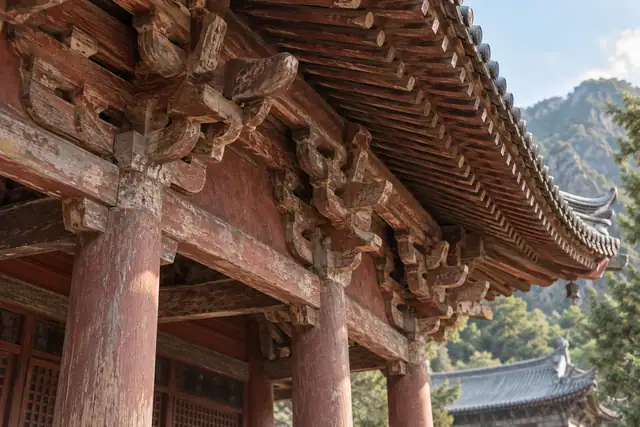
The buildings and what they hold. The People's Photo caption records that the main hall on the peak is the shrine to the Holy Mother, with side halls to left and right and, to the south, a mountain gate, a stone archway and the like. The university entry counts eight stone steles, one stone archway, one shrine to the Holy Mother and 54 murals, and records that in the Republican period the teacher Chen Ziming wrote a couplet for the temple: 'Raise your head and the town walls seem to be in the sky; before your eyes the smoky villages are in a mirror.'
The evening sight. The People's Photo caption records that 'Incense Burner in the Evening Light' is one of the eight sights of Jia County: when the sun goes down the afterglow casts the reflection of the lone pavilion onto the water of the Yellow River, and local people call the place 'little Penglai'. It adds that the temple looks across the Yellow River to Shanxi on the far bank.
The listing. The university entry records that the temple was damaged in 1966 and lost many relics, that repair began in 1982 and the original appearance has largely been restored, that the county government listed it as a county-level key cultural relic protection unit in May 1982, that a stone path up to the temple from the Yellow River beach was built in 2002, and that the Shaanxi provincial government listed it as a provincial-level key cultural relic protection unit on 24 September 2003.
The two accounts differ on when the temple was founded. The university entry, which cites the 2008 Jia County gazetteer, gives the eleventh year of the Wanli era, which it dates to 1583, with four later enlargements in 1590, 1600, 1612 and 1613. The People's Photo caption gives the forty-second year of the Wanli era, which it dates to 1614, on the authority of the stone stele surviving in the temple. The disagreement is not resolved here.
What to look for
- The huge rock in front of the peak, five metres across and more than twenty metres high, shaped like a stemmed incense burner, with the Guanyin tower on its top.
- The broken bridge between the rock and the temple courtyard, once a wooden bridge three metres long and one metre wide and now rebuilt in reinforced concrete.
- The shrine to the Holy Mother, given by the People's Photo caption as the main hall on the peak.
- The side halls and the mountain gate and stone archway to the south of the main hall.
- The Jiao pavilion east of the peak, built in the fortieth year of the Wanli era, which the university entry dates to 1612, for the view down onto the Yellow River.
- The eight stone steles, one stone archway and 54 murals the university entry counts inside the temple.
- The couplet by the teacher Chen Ziming, and the reflection of the lone pavilion on the river that gives the 'Incense Burner in the Evening Light' sight its name.
Location & getting there
Getting to Xianglu Temple
Check which interiors and courtyards are accessible. Active places of worship and protected monuments may have different visitor rules.
- Search for 香炉寺 with 榆林市 and 佳县.
Find Xianglu Temple
香炉寺 · 佳县
No reliable map pin yet: search by the Chinese name.
Sources & visit information
The linked sources support the identity and background described in this introduction. Opening hours, admission, activity availability and exact arrival arrangements have not been comprehensively checked. Confirm current visitor information with the venue; the original catalogue locality and editorial review flag are retained.