

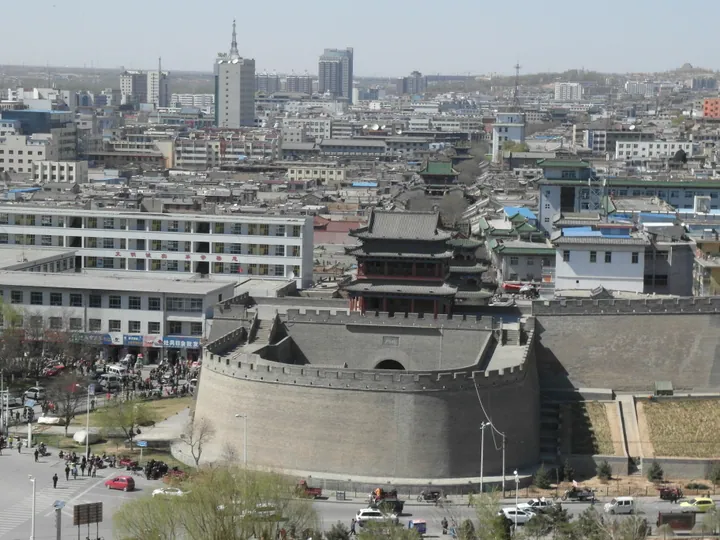
Photo adjustments
Full frame retained; proportionally resized and converted to WebP. No retouching or changes to the photographed subject. Card displays may crop the view.
Explore the region
About Yulin Ancient City
A fort was built in 1449, a guard (wei) established in 1471, and the city was then enlarged three times, an episode the district heritage page calls the 'three expansions of Yuyang'. Its walls were faced in brick in the late Ming. Surviving wall sections total nearly 5,500 metres, and the page records five city gates – Zhenwu on the east, Zhenyuan on the south and Guangyu on the north, with the two on the west wall no longer standing – along with two gate towers and moats outside the north, west and south walls. The page describes the site as an important component of the Ming Great Wall, a World Cultural Heritage property, and a case for studying the Ming frontier defence system.
The town's spine is its north-south street. Between 1472 and 1754 six tower buildings were raised along it in sequence – Wenchang Ge, Wanfo Lou, Xingming Lou, Zhong Lou, Kaige Lou and Gu Lou – a composition the sources call the 'six towers riding the street'. The Yulin Daily feature puts the street at about 1.5 kilometres from the south gate to the Drum Tower, with shops on both sides, and says the preserved old street has become an important marker of Yulin's status as a national historical and cultural city. Courtyards inside the city imitate the architecture of Beijing's old city, and for that reason the heritage page records the name 'Little Beijing'; more than 30 east-west lanes cross the city.
What to look for
- Surviving Ming wall sections, recorded at nearly 5,500 metres in total, and the three surviving gate positions – Zhenwu on the east, Zhenyuan on the south and Guangyu on the north.
- The six tower buildings along the main street – Wenchang Ge, Wanfo Lou, Xingming Lou, Zhong Lou, Kaige Lou and Gu Lou – known as the 'six towers riding the street'.
- The courtyards and lanes: the heritage page records more than 30 east-west lanes and courtyard houses modelled on Beijing's old-city architecture.
- Pailou Lane (牌楼巷), named for the 德政牌楼 archway that stood at its entrance between Kaige Lou and Zhong Lou; the archway standing today is a 2005 reconstruction on the original site.
- The street's intangible-heritage life: exhibition halls and performances, with national-level items including northern Shaanxi folk songs, 陕北道情 and 二人台, and local foods such as 羊肉臊子面 and 清涧煎饼.
Location & getting there
Getting to Yulin Ancient City
Identify the main visitor approach and any separately managed houses, museums or performances. Ask before entering residential spaces or photographing residents.
- Search for 榆林古城 with 榆林市 and 榆阳区.

Find Yulin Ancient City
榆林古城 · 榆阳区
No reliable map pin yet: search by the Chinese name.
Sources & visit information
The linked sources support the identity and background described in this introduction. Opening hours, admission, activity availability and exact arrival arrangements have not been comprehensively checked. Confirm current visitor information with the venue; the original catalogue locality and editorial review flag are retained.