

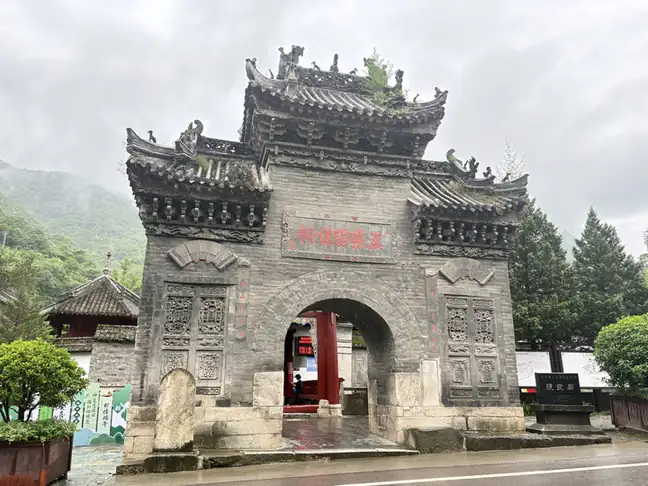
Photo adjustments
EXIF orientation normalized; resized without changing aspect ratio; converted to WebP. No subject edits.
Explore the region
About Zhang Liang Temple
The State Council listed 张良庙 in the sixth batch of national key cultural relic sites, published on 9 June 2006, with the era given as 明至清 and the address as Liuba County. A provincial gazetteer entry, credited to 《汉中地区名胜古迹》, says the shrine is one of Shaanxi's first batch of provincially listed key cultural relic sites and stands on 庙台子 street below 紫柏山, 17 km north of the county.
That entry gives the origin story: tradition holds that 张良, courtesy name 子房, chief adviser to 刘邦, retired here under the pretext of 辟谷, and that later people built a shrine to him, naming it 留侯祠 and calling it 张良庙 in common use. It records shrines both on the summit and in the col of 紫柏山, the summit one known as 张良老庙 with five rooms still standing, and says that from the late Ming to 1850 the col shrine was repeatedly extended.
It places the col shrine on the south slope of 柴关岭 and the south-east slope of 紫柏山, where the two mountains form an armchair shape, with a river in front rising in 柴关岭 and one behind rising in 紫柏山. It gives the shrine as six large courtyards and 156 rooms over 14,200 m², with the gate facing east beside the road, a screen wall with a landscape painting before it, a stone stele on the left of the gate inscribed 紫柏山汉张留侯辟谷处, and a brick archway whose lintel reads 汉张留侯祠.
Inside, the entry describes the 进履桥, the 灵官殿, 三清殿, the main hall, the 方丈院, the 南花园 with the 五云楼 and 辟谷亭, the 北花园 with the 拜石亭, and the 回云亭. Above them the 授书楼 stands on a man-made hill over 100 m high built of marble and Nanyang jade, two storeys, begun in 1850 and the last of the shrine's major buildings; the entry calls it the highest and most visited point, named 紫柏中峰 because it backs onto the centre of 紫柏山.
The entry records more than 100 surviving cliff and stone inscriptions, over 50 wooden plaques and more than 30 wood and stone couplets, and a 张良庙文物管理所 set up in 1980 to manage the shrine. A filing with the Shaanxi Provincial Public Institution Registration Administration records 陕西省留坝县张良庙博物馆 at 留侯镇庙台子村, with 留坝县文物旅游局 as its sponsoring unit and 12 staff; its 2025 account records completing and passing acceptance of a lightning-protection project in October that year and compiling 《张良庙匾联石刻诗文集注》 and material on 《素书》, with 46 articles published during the year.
The gazetteer carries no publication date, and its account of the buildings is stated here as the gazetteer's rather than as a current survey; it also gives no source for the traditional story of 张良's retirement here. Neither source gives opening hours, tickets or which parts of the shrine are open.
What to look for
- The 授书楼, on its man-made hill, which the gazetteer calls the shrine's highest and most visited point.
- The 进履桥 and the 拜石亭, both named, as the entry explains, for episodes between 张良 and 黄石公.
- The 南花园 with its 五云楼 and 辟谷亭, and the 北花园 with its four brick pools.
- The surviving inscriptions, plaques and couplets – more than 100 cliff and stone inscriptions, over 50 wooden plaques and more than 30 wood and stone couplets, as the gazetteer counts them.
Location & getting there
Getting to Zhang Liang Temple
Check which interiors and courtyards are accessible. Active places of worship and protected monuments may have different visitor rules.
- Search for 张良庙 with 汉中市 and 留坝县.
Find Zhang Liang Temple
张良庙 · 留坝县
No reliable map pin yet: search by the Chinese name.
Sources & visit information
The linked sources support the identity and background described in this introduction. Opening hours, admission, activity availability and exact arrival arrangements have not been comprehensively checked. Confirm current visitor information with the venue; the original catalogue locality and editorial review flag are retained.