

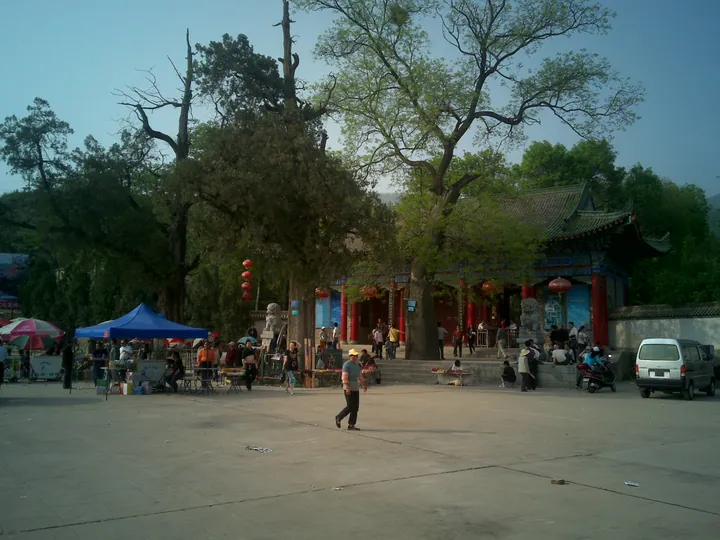
Photo adjustments
Full frame retained; proportionally resized and converted to WebP. No retouching or changes to the photographed subject. Card displays may crop the view.
Explore the region
About Duke of Zhou Temple
The municipal culture and tourism bureau describes the group as covering 62 hectares and holding more than thirty old buildings along with a number of cypresses and pagoda trees the page ascribes to the Tang and Han dynasties, with pavilions, terraces and towers among the halls; it calls this the largest historic building complex in the Guanzhong region, and the county government calls the temple one of the largest and most complete surviving complexes of its kind for this sacrifice in China. The State Council listed the temple as a national key protected cultural relic in 2006. In 2004 archaeologists working beside it found a group of high-ranking Zhou dynasty tombs, from which large numbers of bronzes and oracle bones came; one bone carries the two characters 周公, which the county's page calls the first discovery of a written record bearing directly on the Duke of Zhou. A sacrifice is held at the temple each Qingming, which the county's page describes as bringing scholars, descendants of the Zhou surname and ordinary visitors together for the reading of a memorial text, the old rituals and court music.
The temple's twentieth-century history is the county page's subject. According to the Qishan County Gazetteer, the county put its second junior middle school, known as the Duke of Zhou temple middle school, in the temple in 1953; the school moved to the Liang Xingyuan ancestral hall at Fanjiaying in September 1965 and was renamed, becoming Fanjiaying senior middle school in 1973. In 1967, with approval, the county party committee made the temple a rear archive store for the Shaanxi Provincial Public Security Department and the provincial archives administration, and it was then closed for management as an archive. The county page records that this use led to timely repairs and protected the buildings and their artefacts, the first phase repairing doors, windows and roof tiles on 56 structures including the front west wing hall, the middle wing hall, a small pavilion, the Jiang Yuan main hall and Yueyang Dong, and later work sealing, burying or re-timbering the temple's stone figures, inscriptions and buildings as the archive store required. On 9 September 1983 the provincial party committee general office and the county party committee and government formally handed the temple over to local administration free of charge; it reopened on the tenth day of the third lunar month in 1984 with its traditional temple fair and opened formally to the public from June 1985.
What to look for
- The hall of the Three Dukes of Zhou, the main body of the complex, with the Jiang Yuan and Houji halls secondary to it and pavilions, terraces and towers among them
- The more than thirty surviving historic buildings spread across the temple's 62 hectares
- The cypresses and pagoda trees the municipal page ascribes to the Tang and Han dynasties
- The stone figures and inscriptions the county page records being sealed, buried or re-timbered while the temple served as an archive store
- The site beside the temple where the 2004 excavation found high-ranking Zhou dynasty tombs with bronzes and oracle bones, one bone bearing the characters 周公
Location & getting there
Getting to Duke of Zhou Temple
Check which interiors and courtyards are accessible. Active places of worship and protected monuments may have different visitor rules.
- Search for 周公庙 with 宝鸡市 and 岐山县.
Find Duke of Zhou Temple
周公庙 · 岐山县
No reliable map pin yet: search by the Chinese name.
Sources & visit information
The linked sources support the identity and background described in this introduction. Opening hours, admission, activity availability and exact arrival arrangements have not been comprehensively checked. Confirm current visitor information with the venue; the original catalogue locality and editorial review flag are retained.