

Explore the region
Service facts checked: 21 October 2026. Access and worship schedules can change; confirm current on-site arrangements before making a special trip.
A small religious precinct, not a museum circuit
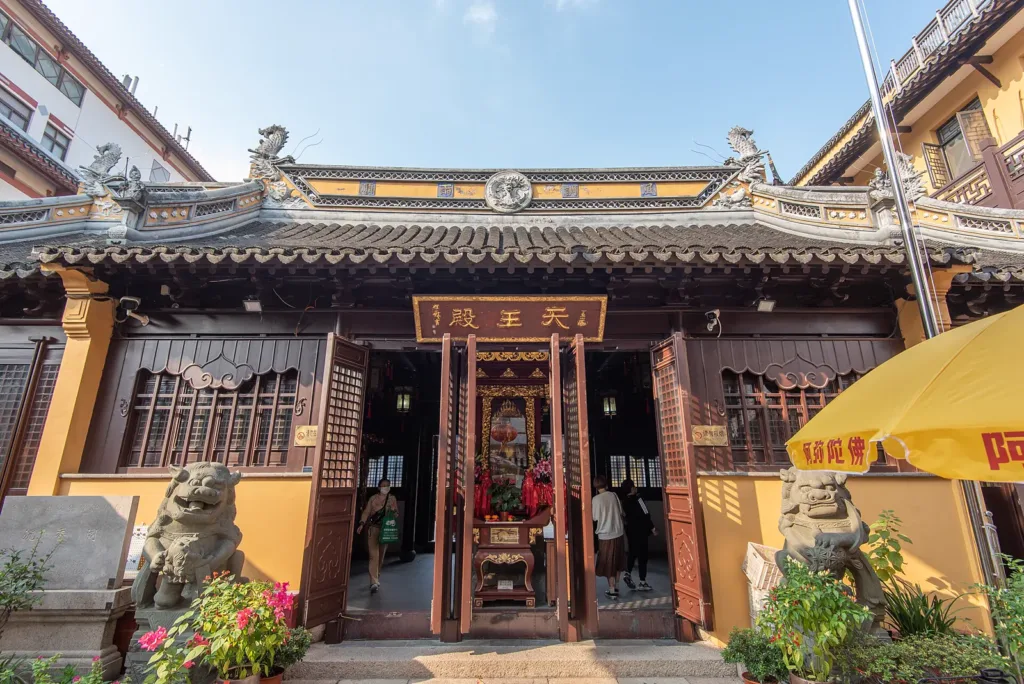
Chenxiang Ge is an active Buddhist nunnery as well as a protected heritage site. Shanghai’s Huangpu District Government identifies it as a national-level protected cultural relic and discusses it within the district’s religious and heritage landscape. Its purpose is not simply to display historic architecture, so visitors should keep voices low, follow signs and staff directions, and avoid interrupting worship or entering restricted areas.
A local historical account dates the temple’s beginnings to 1600 and associates its name with an agarwood Guanyin linked to Pan Yunduan, the Ming official also associated with Yuyuan Garden. Accounts differ in how they describe the image’s arrival; treat the story as local temple tradition, not a verifiable shipwreck narrative. The original statue was later lost. The Guanyin now associated with the pavilion is a later replacement, not the original.
What to notice inside, if access is permitted
The temple is laid out as a south-facing sequence of three courtyards. A traditional stone gateway leads toward the Hall of Heavenly Kings; the next court is centred on the Mahavira Hall, and the rear part of the precinct includes Ciyun Hall and the upper Guanyin Pavilion. Historical descriptions name supporting spaces such as bell and drum towers and side halls. This sequence helps explain the temple as a working compound rather than a single freestanding “pavilion.” The exact rooms open to visitors can vary, so read the current signs and do not assume the upper pavilion is accessible.
If the grounds are open to visitors, begin at the south-facing entrance and take the courts in order toward the rear. Pause at the gateway and look up at its carved details, then note how the halls become progressively more inward-facing. Spend time only in areas that are clearly open; there is no reason to seek out private rooms or follow residents. A calm, respectful visit may take around 30–60 minutes, as an editorial estimate rather than a temple-set duration.
Getting there and checking admission
Take Metro Line 10 or Line 14 to Yuyuan Garden (豫园). Published directions conflict on the useful exit: the Amap place listing reports Exit 7 and about 330 m, while the Baidu Baike route note reports Exit 1 and about 700 m. Neither could be confirmed as the reliable pedestrian approach, so no exit or distance is recommended. Use 29 Chenxiangge Road, Huangpu District (上海市黄浦区沉香阁路29号) as the walking destination and confirm the gate on arrival. For a taxi or ride-hail, enter 沉香阁路29号; this is the listed street address, not a verified curbside drop-off or confirmation that the temple entrance is open to visitors. The legacy guide’s address of 338 Fuyou Road does not match the commonly listed temple address and should not be used.
As of 21 October 2026, I could not verify a current official visitor notice confirming public sightseeing hours, a ticket price, advance reservations, or which halls are open. Commercial travel listings display operating times, but that is not a substitute for a current statement from the temple. Do not assume admission is free, that a paid ticket is required, or that the entire precinct is open. Check the temple’s posted notice or ask at the entrance before planning around a visit.
Chenxiang Ge can be paired in a broader old-city day with Yuyuan Garden or Shanghai City God Temple, but plan them as separate sites with their own access rules. Nearby religious places serve different communities and are not part of a single temple ticket or guaranteed walking itinerary.
Combine your visit
A suggested sequence linking the specific features of this visit.
-
Temple entrance and accessible courtyard
Begin with the religious precinct and its old-city setting.
-
Wooden devotional figure, if the hall is open
See the specifically documented carved statue without assuming access to every floor.
-
Fuyou Road Mosque福佑路清真寺
Compare another religious tradition on the same old-city road.
This order is editorial. Confirm access and any transfers between stops; it does not establish a walking route, same-day connection or common admission ticket.
Find Chenxiang Ge Temple
沉香阁 · 黄浦区
The pin marks the area, not the entrance.
More places nearby
Approximate straight-line distances between map pins, not travel distances.
Yuyuan Garden 豫园
Less than 1 km awayYuyuan Garden began as a Ming-period private garden created by Pan Yunduan for his father. It occupies a compact but intricate sequence of halls, rockeries, ponds and corridors beside Shanghai’s City God Temple.
View guide →City God Temple 上海城隍庙
Less than 1 km awayShanghai’s City God Temple is a Taoist religious precinct beside Yuyuan Garden. Its history connects the worship of local protective deities with the growth of the old city.
View guide →Fuyou Road Mosque 福佑路清真寺
Less than 1 km awayFuyou Road Mosque developed from a Muslim community that raised funds for a permanent prayer place in 1870. The building combines a traditional Qing-style exterior and interior arrangement with Islamic religious functions.
View guide →Sources & visit information
Sources checked on 21 October 2026. Hours, tickets, reservations and transport can change; confirm with the operator before you go.
Image credits & notes (1)
- Entrance frontage of Chenxiang Ge Temple, photographed in 2020. Photo: SiyuwjPhoto: CC BY-SA 4.0