

Explore the region
Service facts checked: 21 October 2026
Scope: The church and its visitor approach only. Holy Trinity remains a religious site; the visit lengths below are editorial suggestions, not operating promises.
A church, not a museum
Holy Trinity’s history reaches back to the first church on this site in 1847. The present red-brick building was completed in 1869 to a design by British architect Sir George Gilbert Scott; the square bell tower followed in 1893. In 1875 it became the seat of the Church of England’s Diocese of North China. The church is now affiliated with China’s national Protestant Three-Self Patriotic Movement and China Christian Council.
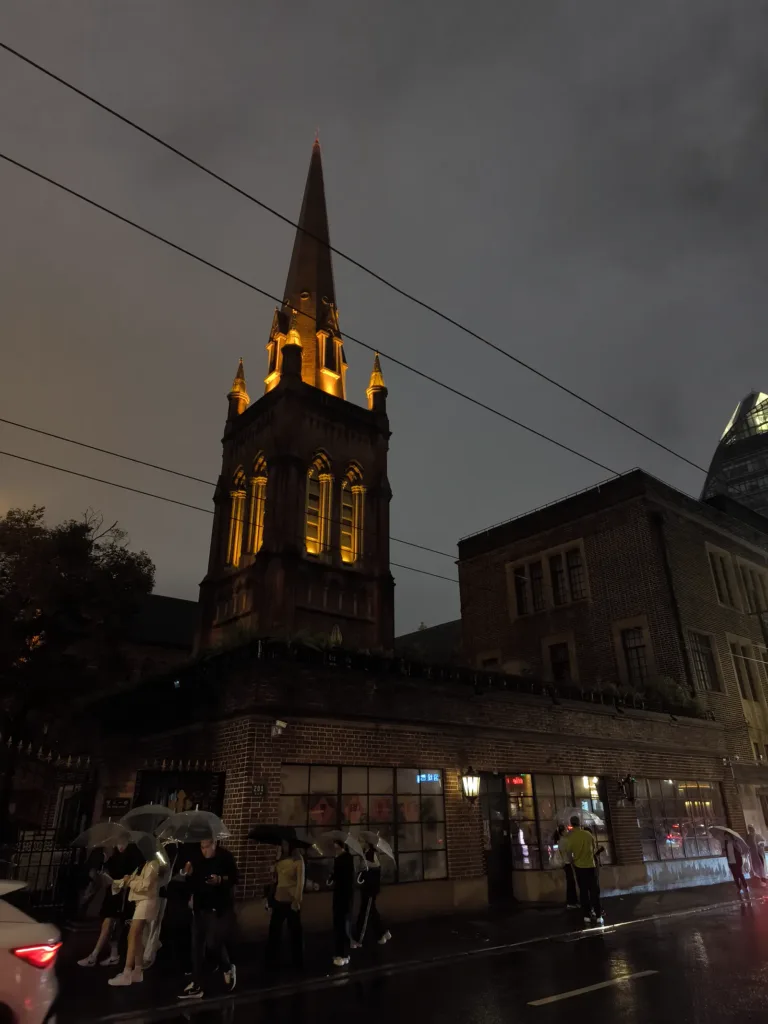
The church’s nickname, the “Red Chapel,” comes from its exposed red-brick walls. Its plan is a Latin cross, with the main worship space arranged as a basilica. The 48-metre tower is the most legible feature from the surrounding streets: it rises above the lower main church and gives this modest-scale corner a strong vertical marker. The building is protected as a Major Historical and Cultural Site at the National Level, designated in 2019.
What to look for
Begin outside. From the public street, take in the contrast between the red brick and the pointed arches, then look up to compare the church’s broad, low body with the slender tower. The district heritage account describes the building as Victorian Gothic Revival and notes its Latin-cross layout. The church’s own institutional history describes a five-aisled basilica, brick-and-timber construction, rows of columns, and a half-dome above the sanctuary. These details explain the building’s structure; they should not be mistaken for a promise that visitors can enter the church.
If the congregation has explicitly confirmed an interior visit for your date, look for the colored-glass windows, the arcaded side aisles and the high sanctuary half-dome. The district’s 2023 heritage report also notes the patterned central floor and two transepts. These are descriptions of the historic interior, not a guarantee that every feature will be accessible or that photography will be permitted.
Check access before you go
Holy Trinity is a worship space as well as a protected building. On 21 October 2026, Shanghai’s official tourism listing displayed its opening status as “Not open.” A Huangpu District government article from 2023 said to consult the “圣三一堂” public WeChat account for appointment details, but that dated instruction does not establish today’s opening hours. I could not verify a current church-issued public schedule, ticket price, reservation process or ordinary visitor entrance. Do not assume the church is open for walk-in sightseeing, even on a Sunday; confirm directly through a current church notice before setting out.
Without confirmed permission to enter, treat this as a brief exterior stop and remain on public streets. Do not enter a churchyard, gate or service without authorization. If a visit coincides with worship, follow staff directions and keep clear of the congregation. Allow about 20–30 minutes for an exterior look and photographs; this is an editorial estimate, not a site operating duration.
Getting there
The Shanghai tourism listing gives No. 201 Jiujiang Road, Huangpu District, while the older China Revealed page gives No. 219. Set 上海圣三一堂(黄浦区九江路201号) as a taxi or ride-hail destination, but do not assume the vehicle can stop at a church gate: the public visitor entrance and an authorized curbside drop-off point have not been verified. Follow the driver’s lawful stopping point and current street controls, then remain on public streets unless the church confirms entry.
For Metro, use East Nanjing Road (南京东路), Lines 2 and 10. The available city transit source confirms the station and lines but not a dependable church-specific exit. From the station, continue on foot toward Jiujiang Road near Jiangxi Middle Road (九江路、江西中路一带) using a current pedestrian map; no exact exit-to-door route or public entrance has been verified. Bus information currently identifies Route 49 at the Hankou Road–Jiangxi Middle Road stop (汉口路江西中路站), close to the church area; confirm the direction and service in a live transit app before boarding.
Combine your visit
A suggested sequence linking the specific features of this visit.
-
Church exterior
Examine the nineteenth-century former Anglican cathedral.
-
Jiangxi Road garden frontage
Compare the church’s garden setting with the surrounding commercial streets.
This order is editorial. Confirm access and any transfers between stops; it does not establish a walking route, same-day connection or common admission ticket.
Find Holy Trinity Church (Anglican)
上海圣三一堂 · 黄浦区
The pin marks the area, not the entrance.
More places nearby
Approximate straight-line distances between map pins, not travel distances.
The Bund 外滩
Less than 1 km awayThe Bund follows the western bank of the Huangpu along East Zhongshan No. 1 Road. Historic banks, trading houses and hotels face the modern towers of Lujiazui across the water.
View guide →Peace Hotel 和平饭店
Less than 1 km awayThe Peace Hotel name links two historic buildings at the Bund end of Nanjing Road. The northern building was completed in 1929 as Sassoon House and originally contained the Cathay Hotel. The southern building opened as the…
View guide →Huangpu Park 黄浦公园
Less than 1 km awayHuangpu Park occupies the triangular green space at the northern end of the Bund, between the Huangpu River and Suzhou Creek. Its origins lie in the treaty-port Public Garden, later reshaped as a commemorative riverfront park.
View guide →Sources & visit information
Sources checked on 21 October 2026. Hours, tickets, reservations and transport can change; confirm with the operator before you go.
- China Christian Council, Shanghai Holy Trinity Church ↗
- Huangpu District government, Bringing heritage to life: entering Holy Trinity Church ↗
- Shanghai official tourism platform, Holy Trinity Church ↗
- Shanghai Municipal Government, 2026 Metro service notice ↗
- Moovit, public transport to Holy Trinity Cathedral, Shanghai ↗
Image credits & notes (1)
- Holy Trinity Church’s illuminated bell tower at night, seen above the adjacent street-facing building; overhead wires cross the dark sky and pedestrians are visible below. Photo: 源義信Photo: CC BY 4.0