

Explore the region
Visitor information checked: 21 October 2026
Scope: Xintiandi’s Shikumen lanes and the wider mixed-use development. The nearby Site of the First CPC National Congress is a distinct attraction.
What Xintiandi is—and is not
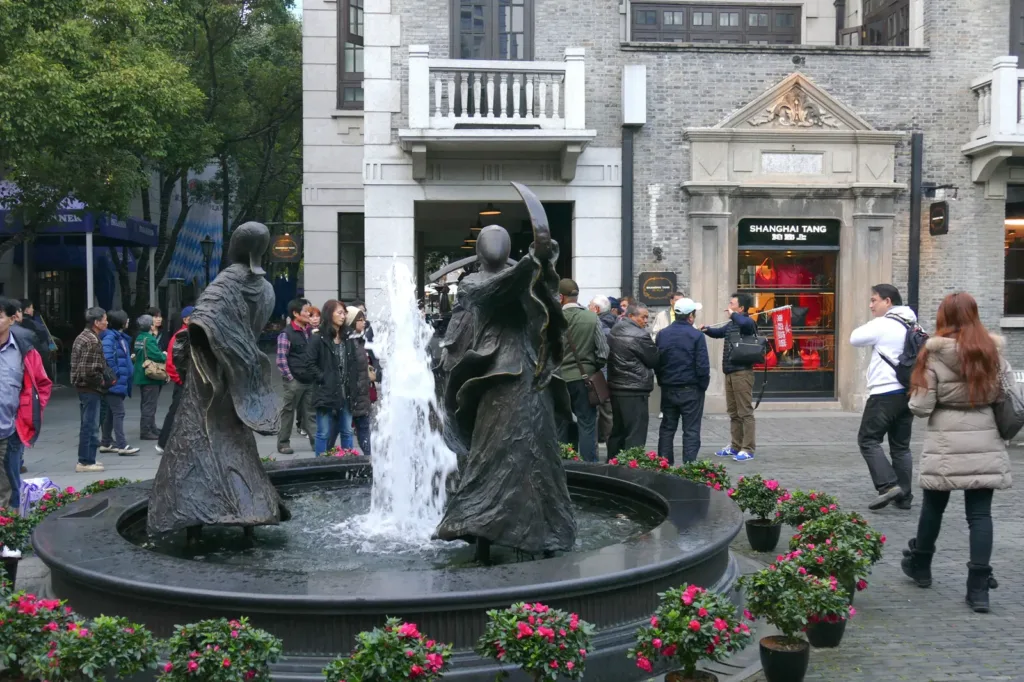
“Xintiandi” can mean the Shikumen lane quarter or the much larger city-core development around it. The operator describes Shanghai Xintiandi as a mixed-use project combining residential, office, retail, entertainment and cultural properties. For a visitor, the most legible historic layer is the Shikumen block: lanes of restored or adapted house fronts now used for restaurants, shops and cultural activity. The block was completed in 2001, and Shanghai’s municipal portal describes it as an early model for combining redevelopment with protection of historic buildings and cultural features.
That distinction matters. The old-looking façades do not mean that this is a living residential lilong frozen in time. Read Xintiandi as a designed heritage streetscape and an active commercial place: historic architectural forms remain visible, while the uses behind them have changed.
What to look at on a walk
Pause at the stone-framed entrance surrounds and dark wooden doors. Huangpu District’s account describes the architectural mix as stone enclosing black-painted timber doors, Chinese roof forms and Western decorative details. Look up from the storefront windows to the roofline and ornament; then compare how these historic forms sit alongside contemporary retail and dining uses. This gives the lanes a stronger story than treating them only as a restaurant strip.
A simple editorial visit is to walk the Shikumen lanes at an unhurried pace, notice how one lane opens into courtyards and commercial spaces, and then spend time in the surrounding contemporary development. Allow roughly 45–75 minutes for an exterior-focused stroll; that is a planning suggestion, not an official duration. Shops, restaurants and cultural venues have their own interiors and schedules, so do not assume that every doorway is open to casual visitors.
The nearby Site of the First CPC National Congress is a separate historic site, not simply another room within the commercial lanes. Huangpu District treats the meeting-site building and the neighbouring memorial hall as distinct places. If you want to include them, plan for their own visitor information and access arrangements rather than assuming a shared ticket or entry route with Xintiandi’s shops.
Getting there, access and costs
Shanghai’s official tourism portal gives Lane 181, Taicang Road, Huangpu District (上海市黄浦区太仓路181弄) as an address anchor for Xintiandi. For a taxi or ride-hail, use it to orient the journey, but do not treat it as a shared visitor gate or designated drop-off bay; enter the address of the specific shop, restaurant or cultural venue when available and follow local curbside restrictions. The same portal lists round-the-clock opening without a current verification date, so this guide does not treat that schedule as a confirmed 2026 opening promise.
The Metro station serving the area is named Site of the First CPC National Congress · Xintiandi (一大会址·新天地) and is served by Lines 10 and 13. Shanghai Metro’s 2021 renaming announcement established the current name; the Shanghai tourism listing also names these lines. Older maps and listings may still say simply “Xintiandi.” Use the current station name in a journey planner. A current reliable exit number and station-to-lane walking route could not be confirmed, so no exit is guessed; follow station signs toward your particular destination.
No specific bus route and stop pair is recommended here: a current authoritative route-to-stop match could not be confirmed. Xintiandi is a multi-venue district rather than one museum with a single published admission price or reservation channel. On 21 October 2026, the operator’s project page listed concierge service hours of 10:00–22:00 for Xintiandi and several related properties; those are concierge desk hours, not verified opening hours for every lane, shop, restaurant or gallery. The operator page did not state a district-wide admission ticket, booking procedure or universal opening schedule. Check the individual venue for its current hours, prices and any reservation requirement before setting out.
Combine your visit
A suggested sequence linking the specific features of this visit.
-
Shikumen commercial lanes
Look at the adaptation of traditional house forms for new uses.
-
First CPC Congress site中共一大会址
Compare the redeveloped district with a specifically preserved historic meeting place.
This order is editorial. Confirm access and any transfers between stops; it does not establish a walking route, same-day connection or common admission ticket.
Find Xintiandi
新天地 · 黄浦区
The pin marks the area, not the entrance.
More places nearby
Approximate straight-line distances between map pins, not travel distances.
Site of the First National Congress of the Chinese Communist Party 中共一大会址
Less than 1 km awayThe First CPC Congress site is preserved in shikumen buildings on Xingye Road. The meeting held here in July 1921 gives the house its historical significance within what is now Xintiandi.
View guide →Shanghai Museum — People’s Square 上海博物馆人民广场馆
Less than 1 km awayShanghai Museum’s People’s Square building is the branch on Renmin Avenue in central Huangpu. Its current programme is devoted to the Ancient Americas exhibition, scheduled from July 2026 to November 2027.
View guide →People's Square 人民广场
Less than 1 km awayPeople’s Square occupies part of Shanghai’s former racecourse in Huangpu. Its transformation into a civic centre brought museums, theatres, fountains and public space into the middle of the city.
View guide →Sources & visit information
Sources checked on 21 October 2026. Hours, tickets, reservations and transport can change; confirm with the operator before you go.
- Shanghai Xintiandi Shikumen Block ↗
- Shanghai Xintiandi official project page ↗
- Huangpu District Government on Shanghai Shikumen and Xintiandi ↗
- Shanghai Metro station name changes reported by People’s Daily Online ↗
- Shanghai Xintiandi — Shanghai Official Tourism Portal ↗
- Xintiandi on the Shanghai Tourism Board portal ↗
Image credits & notes (1)
- Fountain plaza and a Shikumen-style façade at Xintiandi, photographed in 2014. Businesses and details may have changed since the image was taken. Photo: Hermann LuykenPhoto: CC0 1.0