

Explore the region
About Eighth Route Army Taihang Memorial Hall
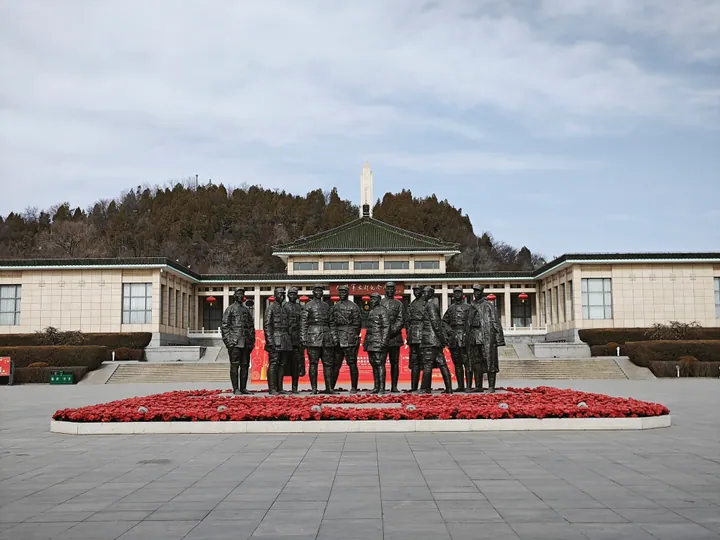
The Eighth Route Army Taihang Memorial Hall (八路军太行纪念馆) is a museum of the Eighth Route Army's war against Japan at 363 Taihang Street in Wuxiang County (武乡县), Changzhi (长治), Shanxi.
The hall opened on 3 September 1988 under a name plaque written by Deng Xiaoping in 1979, and it is ranked as a National First-Grade Museum. The Wuxiang county government calls it the only large memorial hall in China that covers the whole of the Eighth Route Army's war history. The grounds cover 14.8 hectares and hold 12,000 square metres of exhibition space; the main stops are the war-history exhibition hall, a hall of Eighth Route Army generals, the Taihang National Security Education Hall and the Baluxiongfeng stele forest park (八路雄风碑林公园). The county government counts 8,214 items or sets in the collection as of November 2023, 98 of them national first-grade relics.
The exhibition follows the army from its crossing of the Yellow River into Shanxi to the base areas it built behind Japanese lines in the Taihang Mountains (太行山). A 2025 People's Daily report describes the stops along the way: the victory at Pingxingguan (平型关), the ambush at Yanmen Pass (雁门关), the night raid on Japanese aircraft at Yangmingbao (阳明堡), and a replica scene of the Huangyadong (黄崖洞) arsenal. Further on are the bugle of Cui Zhenfang (崔振芳), who fought on alone for seven days and nights when the arsenal was attacked in 1941, and a display setting the army's rifles, broadswords and red-tasselled spears against Japanese machine guns and artillery. A marching pot with 17 iron patches, a national first-grade relic, comes from a badly wounded soldier found by a villager of Wangjiayu (王家峪) in Wuxiang during the Japanese offensive of spring 1938; the soldier had carried it since the Long March and, before he died, asked for it to be taken away.
Several exhibits are linked to the army's commander-in-chief, Zhu De (朱德). The Institute of Party History and Literature of the CPC Central Committee tells the story of his bamboo walking stick: in April 1938 a village doctor, Gong Maozhao (弓茂昭), spent half a month treating a sore on Zhu De's left calf, and Zhu De gave him the stick as thanks. The doctor wrapped it in oiled paper and buried it during the Japanese occupation; it was dug up by chance in spring 1956, collected by the Wuxiang cultural relics office in 1978 and moved to this hall when it was completed. The same galleries show a yellowed letter of 29 November 1937 in which Zhu De asked a boyhood friend in Sichuan for money to feed his two elderly mothers during a famine.
What to look for
- Deng Xiaoping's 1979 calligraphy of the hall's name
- The replica scene of the Huangyadong (黄崖洞) arsenal
- Cui Zhenfang's bugle from the 1941 defence of Huangyadong
- The marching pot with 17 iron patches, a national first-grade relic
- Zhu De's painted bamboo walking stick with a copper ring, given to the doctor Gong Maozhao in 1938
- Zhu De's letter of 29 November 1937 asking a friend to help his mothers
- The weapons display comparing Eighth Route Army and Japanese arms
- The Baluxiongfeng stele forest park (八路雄风碑林公园) in the grounds
Location & getting there
Getting to Eighth Route Army Taihang Memorial Hall
- Search for 八路军太行纪念馆 with 长治市 and 武乡县.
Find Eighth Route Army Taihang Memorial Hall
八路军太行纪念馆 · 武乡县
No reliable map pin yet: search by the Chinese name.
Sources & visit information
Written from the linked sources and fact-checked against them on 2026-09-23. Opening hours, admission and access arrangements are not covered; confirm current visitor information with the site.
Some facts checked against Wikipedia contributors, "八路军太行纪念馆" · CC BY-SA 4.0.
Image credits & notes (1)
- The Eighth Route Army Taihang Memorial Hall in Wuxiang County, with the soldiers' memorial statue · 武乡县八路军太行纪念馆及纪念雕塑Photo: 1969社论 · CC BY-SA 4.0 · taken 2025-02-06Resized for the web; the photo itself has not been edited. Thumbnails may show a cropped view.
