

Explore the region
Tap any red Chinese text to hear it in Mandarin.
Why this place is distinct
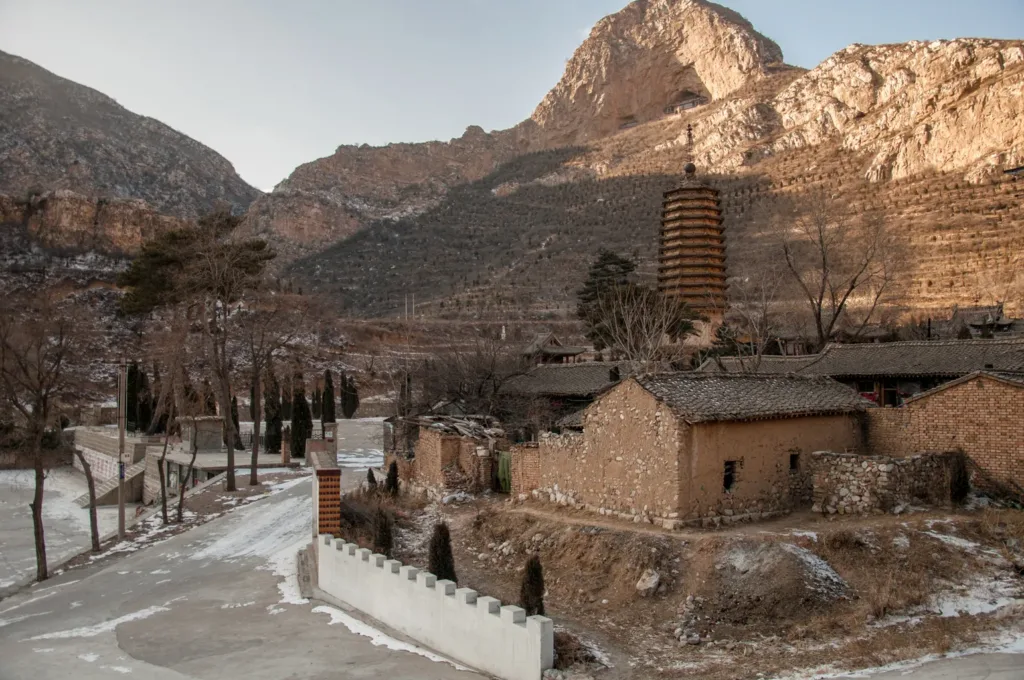
Jueshan Temple is a rural Buddhist complex in Lingqiu County, within Datong’s wider administrative area, not an urban Datong temple. The county government describes it as a south-facing, slope-following complex with three axes and five connected courtyards. The halls visible today mostly belong to the Guangxu-era rebuilding of 1885–1889, while the pagoda preserves the older Liao presence.
The temple’s story begins with a Northern Wei foundation in 483, traditionally associated with Emperor Xiaowen’s wish to honour his mother. The halls were damaged or rebuilt several times. A major earthquake in 1626 destroyed the halls but left the Liao brick pagoda standing; the temple was rebuilt in 1630, repaired in 1688, and rebuilt again in the late Qing. This layered history is easier to read on site than a single “ancient temple” label suggests: the pagoda, Qing halls and mountain setting belong to different moments.
What to look for
Start with the pagoda rather than treating it as a distant silhouette. It is an octagonal, thirteen-tier dense-eaves brick tower about 44 metres high. The base is the most detailed area: official descriptions record carved Buddhas, bodhisattvas, musicians and dancers, guardians, and paired dragons. The first-storey chamber contains about 62 square metres of Liao murals showing bodhisattvas, wisdom kings and flying apsaras. The chamber’s current visitor access is not established by the official visitor page, so do not assume that the murals can always be entered or viewed closely.
The Qing-era temple buildings are arranged along the slope in linked courtyards. If paths and local access allow, the official county description also points to the Xuanzhongyan relic cave (悬钟岩舍利洞), also called Cuiyun Cave (翠云洞), on the northwestern cliff, and to a 5.33-metre solid brick pagoda on the southwestern hilltop. These are part of the temple’s setting, but their current opening and safety arrangements are not published in the official source.
The pagoda has also become a useful case study in conservation. A 2014-approved restoration repaired the finial and other structural details, recorded 218 inscriptions—including dated Liao ink writing and Jin-dynasty inscribed bricks—and established that the dense-eaves body is hollow inside rather than solid as once believed. Give the carved surfaces and murals the same distance you would give any protected monument: do not climb, touch or photograph against posted restrictions.
Location and practical access
The visitor destination to show a driver or enter in a map app is 觉山寺(山西省大同市灵丘县红石塄乡觉山村). The official county page places it in Jueshan Village, Hongshileng Township, Lingqiu County; the Ministry of Culture and Tourism describes the temple as about 15 kilometres southeast of Lingqiu county town.
For rail travel, the Ministry of Culture and Tourism’s Lingqiu route names 北京丰台站 Beijing Fengtai Railway Station → 灵丘站 Lingqiu Railway Station. Lingqiu Station is a gateway to the county, not a temple entrance. Use the official 12306 site for the date-specific train and return ticket, because this article does not treat an old timetable as current.
From Lingqiu Station or Lingqiu county town, arrange a taxi or a pre-booked car to 觉山寺 Juéshān Sì and agree the return pickup before entering the mountain area. A current travel-platform visitor page reports no direct public bus and recommends a taxi from the county town; this is useful local planning advice, not an official bus timetable. The sources reviewed identify no metro, official temple shuttle or dependable scheduled last-mile service, so do not plan on finding one at the gate. The Ministry of Culture and Tourism also presents self-driving as the practical way to connect Lingqiu’s dispersed attractions.
The official local-government page does not publish current opening hours, admission, reservation or passport-specific entry instructions. Third-party listings show conflicting hours and ticket notes, so verify the day’s arrangements locally before setting out. The same check should cover whether the pagoda chamber, Xuanzhongyan/Cuiyun Cave and the small hilltop pagoda are open and safe to approach. Arrange the return journey before your phone signal or available cars becomes uncertain.
Find Jueshan Temple
觉山寺 · 灵丘县
The pin marks the area, not the entrance.
Sources & visit information
Sources checked on 25 October 2026. Hours, tickets, reservations and transport can change; confirm with the operator before you go.
Image credits & notes (1)
- The Liao pagoda of Jueshan Temple rises above the temple roofs and winter landscape in Jueshan Village, Lingqiu County. Photo: FymkingPhoto: CC BY-SA 4.0