

Photo adjustments
Resized and WebP compressed; subject not altered.
Explore the region
About Hongdong Dahuaishu Ancestor Memorial Garden
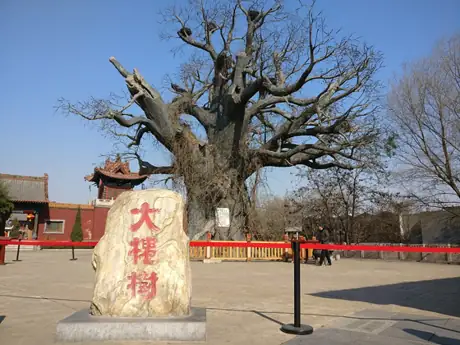
The original great scholar tree is gone; the old-tree-site pavilion, successor trees and modern memorial buildings belong to different stages of remembrance. The Migration Evidence Museum gives the commemorative landscape historical context, while the Ancestor Hall expresses the site's continuing ritual role. Visitors tracing family history should treat local legends as traditions to investigate rather than proof of an individual family's origin.
Following population decline in north China at the end of the Yuan dynasty, Shanxi was largely spared by natural disasters and warfare and, swelled by refugees from other provinces, became one of the most densely populated regions in the country. After founding the Ming dynasty, the government ordered the resettlement of Shanxi people into the depopulated central plains to restart agricultural production, a migration organized at Guangji Temple (广济寺), beside an ancient Han-dynasty locust tree on the post road, where migrants were gathered, registered and issued travel documents and funds.
According to the Ming History (明史), the Ming Veritable Records (明实录) and other sources, eighteen waves of migration were carried out from Shanxi between 1373 and 1417, ten during the Hongwu era and eight during the Yongle era, sending settlers to more than 500 prefectures and counties across Hebei, Henan, Shandong, Jiangsu, Anhui, Hubei, Shaanxi, Gansu, Liaoning, Jilin and Heilongjiang.
The site is now designated a national 5A tourist attraction (国家5A级旅游景区) and a Shanxi Provincial Cultural Relics Protection Unit (山西省文物保护单位). Customs such as eating cold food during the Hanshi Festival and steaming mian yan (面燕), commemorating the Jin-state minister Jie Zitui (介子推), spread to Shandong and Anhui with the migrants. The site also hosts events for the annual Qingming Festival.
What to look for
- The pavilion marking the remembered great-tree site and the later trees associated with it.
- The Migration Evidence Museum and Ancestor Hall, offering historical and commemorative perspectives.
Location & getting there
Getting to Hongdong Dahuaishu Ancestor Memorial Garden
Approach the Dahuaishu memorial garden in the Jia Village area northwest of central Hongdong and use the garden's main visitor entrance.
Combine your visit
Suggested order within this visit:
-
Migration Evidence Museum
Begin with the evidence and historical context.
-
Old-tree-site pavilion
Understand the memorial landscape and successor trees.
-
Ancestor Hall
Finish with the garden's commemorative focus.
This sequence is an editorial suggestion based on the features described in the sources. Access to individual buildings or areas should be checked locally; no travel time or shared admission is implied.
Find Hongdong Dahuaishu Ancestor Memorial Garden
洪洞大槐树 · 临汾市
The pin marks the area, not the entrance.
More places nearby
Approximate straight-line distances between map pins, not travel distances.
Guangsheng Temple 广胜寺
12 km awayGuangsheng Temple occupies the slopes of Mount Huo northeast of Hongdong. Its upper and lower compounds should be understood as separate parts of a hillside ensemble. The upper temple is dominated by Feihong Pagoda, whose…
View guide →Tiefo Temple (also called Dayun Temple) 临汾铁佛寺
26 km awayLinfen's Tiefo Temple, also called Dayun Temple, is identified by its glazed pagoda and enormous iron Buddha head. The head occupies the tower's lower chamber, while coloured religious scenes decorate the upper exterior. The…
View guide →Yao Temple 尧庙
26 km awayYao Temple in southern Linfen honours the sage ruler Yao, a central figure in Chinese traditional accounts of early kingship. Its buildings have been repeatedly repaired and reconstructed, so the site records centuries of…
View guide →Sources & visit information
The sources below support the place-specific description and arrival information. Suggested combinations are editorial planning ideas; confirm current opening, entry arrangements and transport services for your date.
- Wikipedia: 洪洞大槐树 ↗
- Zhoukou government: account of the Hongdong ancestral tree site ↗
- Dahuaishu operator material: memorial garden features ↗
- English Wikipedia: Locust tree of Hongtong (revision 1348106270, 2026-04-10) ↗
Visitor information adapted and edited from Wikipedia contributors · CC BY-SA 4.0. Source revision 93046233.
Background paragraphs translated and condensed from Wikipedia contributors, "洪洞大槐树", Chinese Wikipedia · CC BY-SA 4.0. Source revision 93046233.
Background paragraphs condensed from Wikipedia contributors, "Locust tree of Hongtong", English Wikipedia · CC BY-SA 4.0. Source revision 1348106270.