

Explore the region
About Linfen Museum
Its Taosi material is a particularly useful introduction to the archaeological site and its interpreted observatory, a theme also reflected in the museum's sun-and-moon-inspired exterior. The earlier-cultures displays and Jin-period galleries make a coherent sequence through local history. The museum now occupies a purpose-built riverside building, separate from its former home in Tiefo Temple.
Linfen Museum was founded in 1993, initially housed in the Tiefo Temple. Construction of the present museum began in August 2013, but the design and layout were halted for review in 2015 after experts identified problems, leading to a restructuring of the project after visits to museums in Shanghai, Nanjing and Shanxi. The museum opened to the public on 18 September 2018, at a cost of 498 million yuan; it closed again after nineteen open days, during which it received 279,146 visitors, and reopened on 18 December 2018.
The museum building stands south of Jiuzhou Plaza on Binhe West Road, rising 23.65 metres and covering a total area of 32,429 square metres. It has four floors, with three exhibition levels above ground and a storage level below; its roughly 140,000 items are mainly bronzes, ceramics, water-and-land paintings and woodblock New Year prints. One gallery, 'Ancient Footprints', displays Neolithic artefacts of the Dingcun and Shizitan cultures through to the Zaoyuan culture.
What to look for
- The Taosi archaeological displays and interpretation of the site's observatory.
- The early-cultures and Jin-period galleries, connecting Dingcun and related finds with later regional history.
Location & getting there
Getting to Linfen Museum
Go to Binhe West Road on the southern side of Jiuzhou Square for the current Linfen Museum. The old Tiefo Temple address is not the main museum building.
Combine your visit
Suggested order within this visit:
-
Remote Footprints gallery
Begin with the earliest local cultures.
-
Earliest China gallery
Concentrate on Taosi and its archaeological interpretation.
-
Jin Hegemony gallery
Continue into the later political and material culture of the region.
This sequence is an editorial suggestion based on the features described in the sources. Access to individual buildings or areas should be checked locally; no travel time or shared admission is implied.
Find Linfen Museum
临汾博物馆 · 临汾市
The pin marks the area, not the entrance.
More places nearby
Approximate straight-line distances between map pins, not travel distances.
Tiefo Temple (also called Dayun Temple) 临汾铁佛寺
2 km awayLinfen's Tiefo Temple, also called Dayun Temple, is identified by its glazed pagoda and enormous iron Buddha head. The head occupies the tower's lower chamber, while coloured religious scenes decorate the upper exterior. The…
View guide →Yao Temple 尧庙
5 km awayYao Temple in southern Linfen honours the sage ruler Yao, a central figure in Chinese traditional accounts of early kingship. Its buildings have been repeatedly repaired and reconstructed, so the site records centuries of…
View guide →Dingcun village 丁村
26 km awayDingcun's name refers both to an important prehistoric archaeological area and to a village of surviving Ming and Qing houses. The houses are the visible focus of this visit: older single courtyards in the northern group…
View guide →Sources & visit information
The linked encyclopedia sources support background and place descriptions. Current opening hours, ticket prices, booking rules and transport schedules have not been independently verified for this guide. Confirm them with the venue or operator before travelling.
Visitor information adapted and edited from Wikipedia contributors · CC BY-SA 4.0. Source revision 92034950.
Background paragraphs translated and condensed from Wikipedia contributors, "临汾博物馆", Chinese Wikipedia · CC BY-SA 4.0. Source revision 92034950.
Image credits & notes (1)
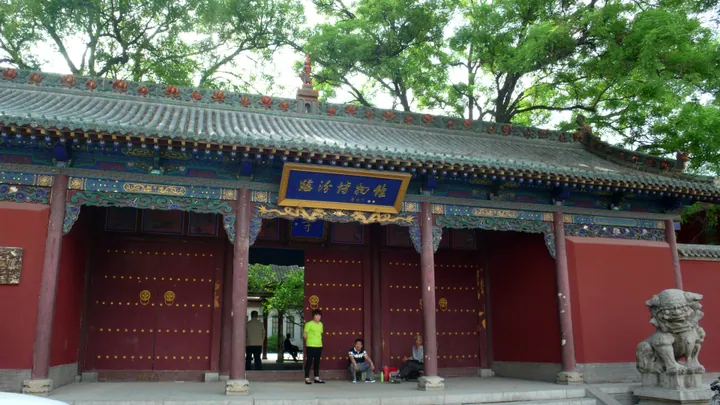
- Main gate of Linfen Museum · 临汾博物馆大门Photo: 三猎 · CC BY-SA 4.0 · taken 2016-05-05Resized for the web; the photo itself has not been edited. Thumbnails may show a cropped view.
