

Explore the region
About Yangtoushan Grottoes
Yangtoushan Grottoes (羊头山石窟) are Buddhist caves and niches cut into sandstone boulders on Yangtou Mountain (羊头山), 16 km northeast of Gaoping (高平) city in Shanxi. Work began in the Taihe era of the Northern Wei and continued under the Northern Qi, Sui and Tang.
Yangtou, 'sheep's head', takes its name from a summit rock that resembles one. The mountain stands where Zhangzi (长子), Changzhi (长治) and Gaoping meet. In local tradition it is the home of Yandi (炎帝), the Flame Emperor, also known as Shennong (神农), as a Shanxi Youth Daily (山西青年报) report carried on the Shanxi culture and tourism department's site puts it. The mountain has no large sheer rock faces, so carvers worked the scattered sandstone outcrops instead, usually one cave to a boulder, sometimes two or three, from the mid-slope to the summit. The Gaoping government counts more than 40 caves in all; the Shanxi Youth Daily report gives 22 larger caves and niches and over 80 small niches.
The carving falls into four phases: the late Taihe reign, the late Northern Wei (the busiest period), the Northern Qi and Sui, and the Tang. The Gaoping government sees the caves as a record of how Buddhist cave art travelled between the Northern Wei capitals of Pingcheng (平城) and Luoyang. Chinese Wikipedia counts nine caves and three cliff niches, with six stone pagodas from the Northern Wei to the Tang and one Northern Wei stele; a Qianlong-era Gaoping county gazetteer records that Qinghua Temple (清化寺) on the mountain was founded in the Taihe era and first named Dingguo Temple (定国寺). The grottoes were listed in the sixth group of Major Historical and Cultural Sites Protected at the National Level in 2006.
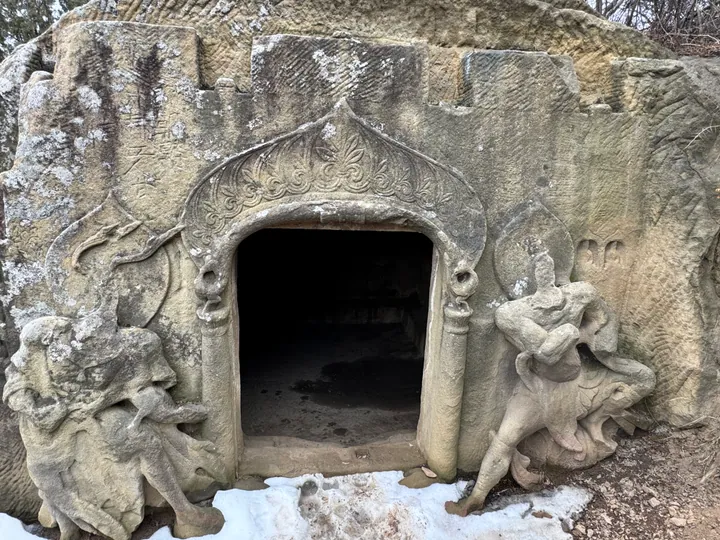
Cave 5, the largest group, carves three caves from one boulder. Its main niche shows the paired Buddhas Shakyamuni and Prabhutaratna with the slender bodies of Northern Wei style, and an inscription inside is dated 505. Two small Tang stone pagodas and a headless seated Buddha sit on top of the boulder. In front stands a stele about 4 m high covered on all four sides with more than 2,240 small Buddhas. Cave 7, the Thousand Buddha Cave, has 1,680 small Buddhas on its three walls. Beside Cave 3 is a small two-storey square stone pagoda with a flame-arched door and two guardians, a rare Northern-dynasties type. On the eastern summit a four-sided statue stone about 2.5 m high rests on a reclining sheep; its partly illegible inscription is read as a date equivalent to 489, before the Northern Wei moved its capital.
What to look for
- Cave 5, three caves in one boulder, with paired Northern Wei Buddhas and a 505 inscription
- The four-sided stele in front of Cave 5, carved with over 2,240 small Buddhas
- Cave 7, the Thousand Buddha Cave, with 1,680 small Buddhas
- The two-storey Northern-dynasties stone pagoda beside Cave 3
- The summit statue stone on a reclining-sheep base, inscribed with a date read as 489
- Two Tang stone pagodas and a headless seated Buddha on top of Cave 5
Location & getting there
Getting to Yangtoushan Grottoes
- Search for 羊头山石窟 with 晋城市 and 高平市.
Find Yangtoushan Grottoes
羊头山石窟 · 高平市
No reliable map pin yet: search by the Chinese name.
Sources & visit information
Written from the linked sources and fact-checked against them on 2026-09-23. Opening hours, admission and access arrangements are not covered; confirm current visitor information with the site.
Some facts checked against Wikipedia contributors, "羊头山石窟" · CC BY-SA 4.0.
Image credits & notes (1)
- The carved entrance of a grotto at Yangtoushan Grottoes in Gaoping, Shanxi, flanked by guardian figures. · 山西高平羊头山石窟,洞窟入口两侧雕刻护法造像。Photo: Patrick20242023 · CC BY-SA 4.0 · taken 2024-02-14Resized for the web; the photo itself has not been edited. Thumbnails may show a cropped view.
