

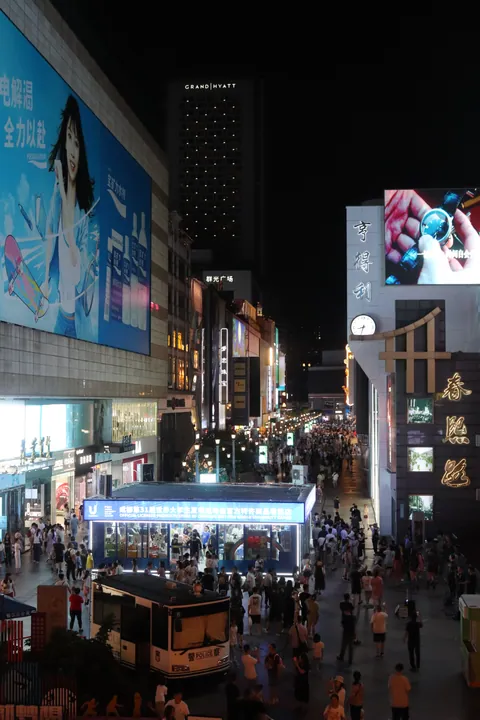
Photo adjustments
Full frame retained; proportionally resized and converted to WebP. No retouching or changes to the photographed subject. Card displays may crop the view.
Explore the region
About Chunxi Road and Taikoo Li
A China National Radio Sichuan-channel feature records that Chunxi Road was built in 1924 at the proposal of the Sichuan warlord Yang Sen and was first named Senwei Road after his title; it was later renamed Chunxi Road, drawing on a phrase from Laozi's Daodejing describing bustling, prosperous crowds. The Chengdu municipal government carried out a full renovation of the street in 2001. The report describes the present street as formed by two main axes, its north-south stretch paved in granite and imitation-antique tile, with century-old shops such as Tongrentang and Derentang still trading along it, and a set of cast-bronze pavement reliefs, 22 millimetres thick, depicting old Chunxi Road businesses including a Guangdong cutlery shop, the Fengxiang silver shop and the Sanyigong theatre.
Daci Temple, which stands near Chunxi Road, has a traditional founding date of the 3rd or 4th century AD, calculated from a Song-dynasty record of an Indian monk passing through the area. A Jinjiang District Library reference entry records that the monk Xuanzang was ordained there in 622, that Emperor Xuanzong of Tang bestowed the name Dasheng Ci Temple on it in 756 after seeing a monk there feed the poor, and that the following year's rebuilding gave it 96 courtyards and 8,542 rooms. The temple survived the 845 suppression of Buddhism because of its imperial inscription, becoming the only Buddhist temple left standing in Chengdu at the time; it held more than a thousand wall-panels of murals, which the writer Su Shi praised after visiting in 1056. Destroyed by fire in 1435 and again at the end of the Ming, it was rebuilt in the early Qing and again in 1867, when its surviving central-axis halls — mountain gate, Maitreya, Guanyin, Great Hero and Dharma halls, and a sutra library — were built. In 1981 it was named a Chengdu municipal cultural relics protection unit, in 1983 it became the Chengdu Municipal Museum, and it reopened as a temple on 8 April 2004.
Chengdu Taikoo Li, the open-air, low-density shopping district that opened in 2015, was built to coexist with Daci Temple in a design its developer, Swire Properties, describes as paying homage to traditional west-Sichuan architectural style; the development also includes The Temple House, a hotel in Swire's House Collective brand.
What to look for
- The cast-bronze pavement reliefs on Chunxi Road's north-south stretch, depicting old shops including a Guangdong cutlery shop, the Fengxiang silver shop and the Sanyigong theatre.
- The century-old shops Tongrentang and Derentang, still trading on Chunxi Road.
- Daci Temple's surviving central-axis halls — the mountain gate, Maitreya, Guanyin, Great Hero and Dharma halls, and its sutra library — rebuilt in 1867.
- The stone plaque over Daci Temple's mountain gate, reading 'Ancient Dasheng Ci Temple' in the hand of the Qing-dynasty official Huang Yungu.
- Chengdu Taikoo Li's open-air, low-density district and The Temple House hotel, built to coexist with Daci Temple in a design paying homage to west-Sichuan architectural style.
Location & getting there
Getting to Chunxi Road and Taikoo Li
Choose a precise starting address and return transport stop. Access to individual buildings, performances or viewing platforms is separate from access to public streets.
- Search for 春熙路与太古里 with 成都市 and 锦江区.
Find Chunxi Road and Taikoo Li
春熙路与太古里 · 锦江区
No reliable map pin yet: search by the Chinese name.
Sources & visit information
The linked sources support the identity and background described in this introduction. Opening hours, admission, activity availability and exact arrival arrangements have not been comprehensively checked. Confirm current visitor information with the venue; the original catalogue locality and editorial review flag are retained.