

Photo adjustments
Full frame retained; proportionally resized and converted to WebP. No retouching or changes to the photographed subject. Card displays may crop the view.
Explore the region
About Dege Parkhang
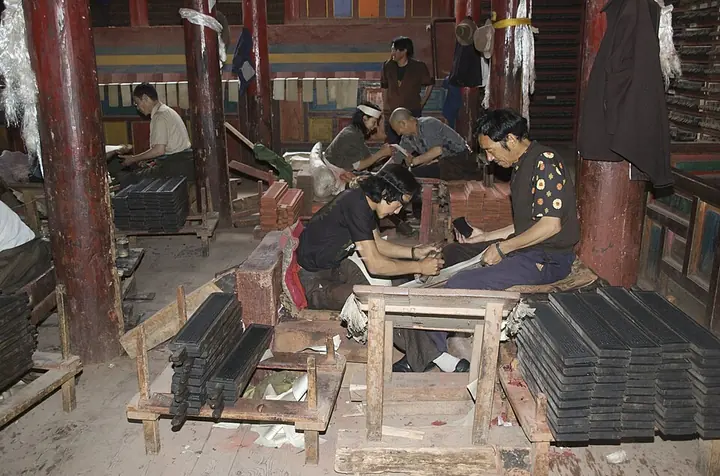
Its carved wooden blocks preserve religious works alongside literature, medicine and other subjects. Traditional printing uses inked blocks and sheets pressed by hand, connecting the stored texts with a continuing craft. Look at the racks of blocks and the building’s murals and sculpture; a visit should not depend on workers demonstrating at a particular time.
The institution was founded in the seventh year of the Yongzheng era (1729), when the Derge chieftain Denba Tsering (登巴泽仁) built an additional Buddha hall for block-carving and sutra printing within his family temple, Gonchen Monastery (贡钦寺); his son Sonam Gongpo (索朗贡布) later expanded it into the monastery's sutra-printing institute. It was listed as a Sichuan provincial cultural relic protection unit in 1980 and as a Major Historical and Cultural Site Protected at the National Level (全国重点文物保护单位) in 1996.
Gonchen Monastery is the leading monastery of the Sakya school. Its printed texts are mainly the Tibetan Kangyur and Tengyur (甘珠尔, 丹珠尔), along with Sakya, Nyingma, Kadam and Jonang works and the Bon-tradition Heibai Hualong Sutra (黑白花龙经). Its earliest printed work, the trilingual Prajnaparamita in Eight Thousand Lines (三体合璧般若八千颂), is considered among the finest of its holdings, and it also produced the widely known Degé edition of the Tibetan Buddhist canon (德格版藏文大藏经).
What to look for
- Carved wooden printing blocks are stored in long, closely packed collections.
- The Tibetan building contains murals and sculpture as well as printing spaces.
Location & getting there
Getting to Dege Parkhang
The printing house is on Wenhua Street in Gengqing town, the Dege county seat. Arrange the final approach to Dege Yinjingyuan on that street and follow the institution’s visitor route.
Combine your visit
Suggested order for the visit:
-
Printing-house exterior
Look at the Tibetan building form.
-
Woodblock storage and permitted printing areas
Understand how texts are preserved and reproduced.
-
Murals and sculptural details
Continue only through spaces open to visitors.
This is an editorial sequence of named spaces or places. It does not imply a verified walking connection or promise opening, ticket availability or a journey time.
Find Dege Parkhang
德格印经院 · 甘孜州
The pin marks the area, not the entrance.
More places nearby
Approximate straight-line distances between map pins, not travel distances.
Litang Monastery 长青春科尔寺
257 km awayLitang Monastery, also called Changqingchun Ke’er Temple, spreads across the northern hillside of Litang. Its large temple halls and tiered setting make it more than a single shrine. Much of the visible complex has been…
View guide →Tagong Monastery 塔公寺
325 km awayTagong Monastery is a Sakya Buddhist temple within the highland town of Tagong. Thangka paintings, painted sculpture and wall decoration provide an intimate counterpoint to the open grassland outside. Its stupa group adds a…
View guide →Zhonglu Tibetan Village 中路藏寨
335 km awayZhonglu’s appeal is the pattern of terraced fields, clustered Tibetan houses and older watchtowers beneath the Muerduo mountain landscape. The buildings occupy different heights on the slope, so a village-lane view and a wider…
View guide →Sources & visit information
The sources below support the place-specific description and arrival information. Suggested combinations are editorial planning ideas; confirm current opening, entry arrangements and transport services for your date.
- Derge Parkhang ↗
- Dege County: Dege Printing House ↗
- Chinese Wikipedia: 德格印经院 (revision 93086132, 2026-06-16) ↗
- English Wikipedia: Derge Parkhang (revision 1317744080, 2025-10-19) ↗
Visitor information adapted and edited from Wikipedia contributors, “Derge Parkhang” · CC BY-SA 4.0. Source revision 1317744080.
Background paragraphs translated and condensed from Wikipedia contributors, "德格印经院", Chinese Wikipedia · CC BY-SA 4.0. Source revision 93086132.
Background paragraphs condensed from Wikipedia contributors, "Derge Parkhang", English Wikipedia · CC BY-SA 4.0. Source revision 1317744080.