

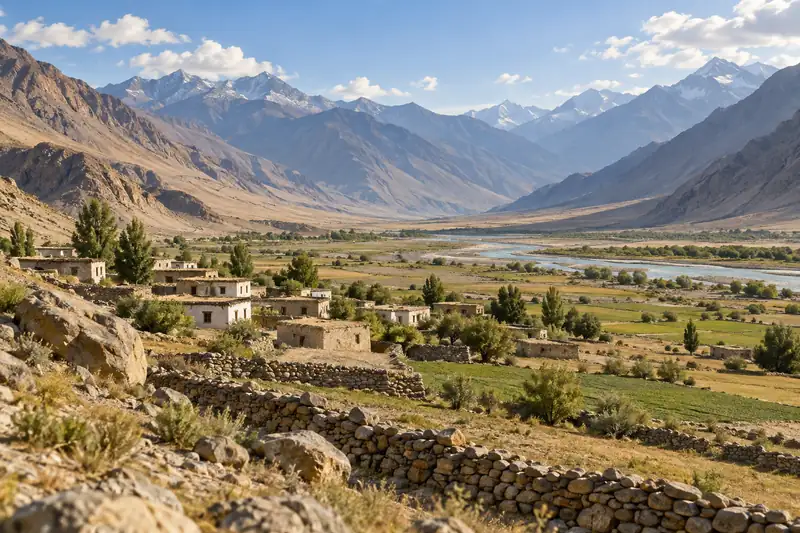
Explore the region
About Ganbao Tibetan Village
'Ganbao' is a Han transliteration of the Jiarong Tibetan 'Gongpu', meaning 'village on the slope'; its houses are built against a cliff and interconnected, and it is described as having the name 'first village of the Jiarong Tibetan region'. In the Tang dynasty the area fell under Weizhou's jurisdiction and became a fought-over military stronghold during the Tang-Tibetan wars of the Zhenguan era; after the Tibetan army occupied most of today's Jiarong Tibetan area, soldiers who stayed behind merged with the indigenous Geling people to form the ancestors of today's Jiarong Tibetans. Under the Ming the area belonged to the Zagu chieftaincy; in 1752 the Qing court abolished that chieftaincy and divided its territory into five garrisons and four chieftaincies, of which Ganbao was one of the five garrisons, administered by a shoubei, the garrison's highest officer, together with a qianzong and a bazong. Qing rule confined all garrison soldiers to military training, barring trade or scholarship, and Ganbao's officers were granted the exceptional addition of two shoubei posts, held by the Gou and Sang clans, for their record of military merit; the main building of the Sang clan's shoubei office survived intact until the 2008 Wenchuan earthquake. The village has also appeared in the work of the 19th-century English travel writer Isabella Lucy Bird, the American photographer Sidney David Gamble and the Chinese documentary photographer Zhuang Xueben.
The earthquake destroyed the village, which China Culture Daily, writing in 2011, described as long-established, richly cultured, distinctively built and large in scale. Hunan province's aid team rebuilt it to the standard of a 4A-grade scenic area, under principles of transmitting culture while protecting its character, repairing relics while rebuilding homes, uniting an old village with a new one, restoring the Tibetan-village landscape, and putting the waterways in order to create water features; funding came from Hunan but responsibility for the work was entrusted to Lixian county, which trained local Tibetan craftsmen during the reconstruction. The village is a provincial-level cultural relic protection unit and was named one of the 'top ten Sichuan villages of tourism value' and a 'Sichuan rural tourism demonstration village' in 2011. On important festivals villagers perform Boba Sengen, a national-level intangible cultural heritage dance depicting and commemorating Qing-dynasty Tibetan ancestors resisting foreign invaders, in the village's public square.
What to look for
- The village's cliffside houses, interconnected in the manner the provincial chronicles essay credits with the name 'first village of the Jiarong Tibetan region'.
- The Sang-clan shoubei office building, the main structure of which survived intact until the 2008 earthquake.
- A Boba Sengen performance on the village's public square, when it takes place on important festivals.
- The village's rebuilt water features and layout, designed to the standard of a 4A-grade scenic area under Hunan's post-earthquake reconstruction plan.
Location & getting there
Getting to Ganbao Tibetan Village
Identify the main visitor approach and any separately managed houses, museums or performances. Ask before entering residential spaces or photographing residents.
- Search for 甘堡藏寨 with 阿坝藏族羌族自治州 and 理县.
Find Ganbao Tibetan Village
甘堡藏寨 · 理县
No reliable map pin yet: search by the Chinese name.
Sources & visit information
The linked sources support the identity and background described in this introduction. Opening hours, admission, activity availability and exact arrival arrangements have not been comprehensively checked. Confirm current visitor information with the venue; the original catalogue locality and editorial review flag are retained.