

Photo adjustments
EXIF orientation normalized; resized without changing aspect ratio; converted to WebP. No subject edits.
Explore the region
About Huya Grand Canyon
The Xuebaoding National Nature Reserve lies in the same county, and no source cited here places the canyon inside it. The reserve, established in 1993 and upgraded by the State Council to national level in 2006, covers 63,615 hectares of high mountains and deep valleys cut by strong river downcutting; its highest point, 5,458 metres, forms part of the Xuebaoding summit at 5,588 metres, and its lowest point, where Tiziyan in Si'er township meets the reserve boundary, is 1,470 metres, a difference of nearly 4,000 metres. Its rivers all belong to the headwaters of the Fu river system and include a Huya river, and the research centre names a Huya pass fault belt among the structures that shape its geology. The National Forestry and Grassland Administration's nature reserve research centre records the reserve's main protection targets as the giant panda and its habitat together with primary forest and water-conservation land at the Fu river's source, and describes it as a key connecting corridor between giant panda reserves across the Minshan mountains; national first-class protected animals recorded there include the giant panda, golden snub-nosed monkey, leopard, forest musk deer, golden eagle and Chinese grouse.
Within the township, a Xinhua Sichuan photo feature names the Tudi Liang ridge, where wild azaleas more than a hundred years old grow on slopes at about 3,000 metres and come into bloom between April and June, which the feature says the snow mountains behind them make the more striking; it lists the Dalongkou waterfall, cloud seas and snow mountains among the township sights opened to visitors.
What to look for
- The Dalongkou waterfall, named by Xinhua's Sichuan channel as one of the township's features.
- The Tudi Liang ridge's wild azalea stand, trees more than a hundred years old rooted at about 3,000 metres that come into bloom from April to June.
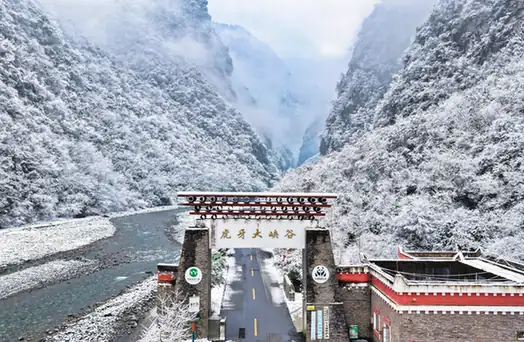
- The cluster of ice falls inside the canyon, which the Sichuan Online report describes as at its best for viewing in winter.
Location & getting there
Getting to Huya Grand Canyon
Confirm the visitor entrance and which boat or walking routes operate on your date. Rainfall, water levels and weather can change access.
- Search for 虎牙大峡谷 with 绵阳市 and 平武县.

Find Huya Grand Canyon
虎牙大峡谷 · 平武县
No reliable map pin yet: search by the Chinese name.
Sources & visit information
The linked sources support the identity and background described in this introduction. Opening hours, admission, activity availability and exact arrival arrangements have not been comprehensively checked. Confirm current visitor information with the venue; the original catalogue locality and editorial review flag are retained.