

Photo adjustments
EXIF orientation normalized; resized without changing aspect ratio; converted to WebP. No subject edits.
Explore the region
About Lingshan Temple
The temple was founded in the Qianlong era of the Qing. Liangshan's ethnic and religious affairs commission names its founder as Yang Xuexin, a man of Longyang county in Changde prefecture, Hunan, whose dharma name was Wuzhen and Buddhist name Pudu; he reached Mianning in the forty-seventh year of Qianlong, climbed Dengtaishan on hearing that the ancient Buddha Dipankara had practised there, settled in a thatched hut beside the Qinglong pool, and set about raising a temple with about a hundred local disciples. The building was finished around the fifty-ninth year of Qianlong, and the county magistrate Xin Dacheng gave it the formal name Xiling, though it has always been known locally as Lingshan Temple. Yang spent twenty-two years in Mianning, nine of them practising in the completed temple, and died seated in the second month of the ninth year of Jiaqing. The commission's account continues that his disciples opened the coffin after seven days and found the face ruddy as though alive, that the body was moved into the Buddha hall and venerated thereafter, and that it dried out entirely without decaying.
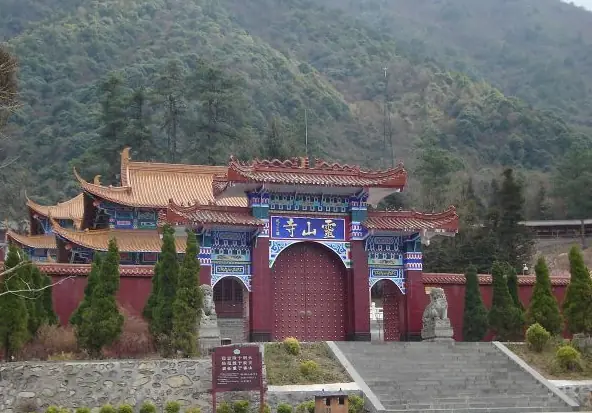
The Mahavira Hall is the main building. Shakyamuni is enshrined at the centre of the front hall with the eighteen arhats to either side, and the rear hall holds a carved wooden image of the founding patriarch. Facing the great Buddha is a seated figure of the guardian Weituo; the commission remarks that Weituo figures elsewhere stand, and passes on the local explanation that Lingshan was quiet enough not to need a guardian standing watch. A newly built glazed-tile mountain gate fronts the complex, and halls and corridors run on both sides of the main hall's courtyard, joined front and back into a single group of old buildings. The temple forms part of the Yihai-Lingshan scenic area that the prefecture has consolidated, and the county media centre lists it as a national 4A-grade tourist scenic area.
What to look for
- The Mahavira Hall, with Shakyamuni and the eighteen arhats in the front hall and the carved wooden image of the founder Yang Xuexin behind.
- The seated Weituo facing the great Buddha, which the prefecture commission contrasts with the standing Weituo figures it says are found elsewhere.
- Six old pines outside the mountain gate, some three or four arm-spans round and at least two hundred years old, which the commission calls the temple's principal marker.
- The prospect from the Buddha summit: north to the snows of Yangluo mountain, west over the fields along the Anning river, south towards the satellite launch base, east to the ranges of the Daliangshan.
- The glazed-tile mountain gate, and the halls and corridors that run on both sides of the main hall's courtyard and join front and back into one group.
Location & getting there
Getting to Lingshan Temple
Check which interiors and courtyards are accessible. Active places of worship and protected monuments may have different visitor rules.
- Search for 灵山寺 with 凉山彝族自治州 and 冕宁县.
Find Lingshan Temple
灵山寺 · 冕宁县
No reliable map pin yet: search by the Chinese name.
Sources & visit information
The linked sources support the identity and background described in this introduction. Opening hours, admission, activity availability and exact arrival arrangements have not been comprehensively checked. Confirm current visitor information with the venue; the original catalogue locality and editorial review flag are retained.