


Photo adjustments
Full frame retained; proportionally resized and converted to WebP. No retouching or changes to the photographed subject. Card displays may crop the view.
Explore the region
About Nankan Grottoes
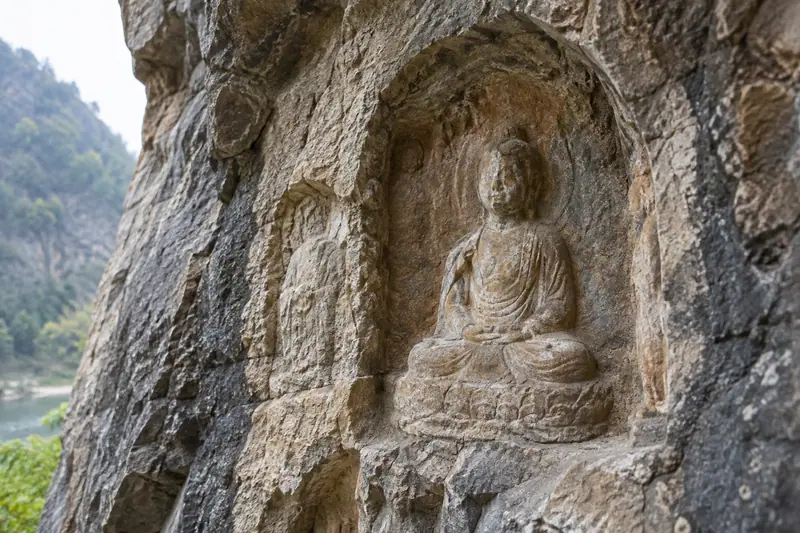
The carvings cover 12,960 square metres, running 324 metres north to south and 40 metres east to west against a cliff face up to 30 metres high, and are concentrated around Shanmenshi, Yunpingshi, Dafodong and Guanyinyan, with Dafodong the most densely carved. Cutting began under the Sui, was at its most extensive under the Tang, and continued through the Song to the Republican period. The State Council listed the site in 1988 in the third group of nationally key protected cultural relic units, and in 2001 the Shuiningsi, Xikan and Beikan grottoes elsewhere in Bazhou District were merged into the Nankan entry when the fifth group was published. The municipal bureau reported in 2024 that the absence of protective structures had sharply worsened cracking, unstable rock, weathering, salt efflorescence, loss of polychrome paint and biological attack on the images and their host cliff; the National Cultural Heritage Administration approved a project for protective canopies in December 2023.
The temple's imperial name dates from the Tang. Yan Wu, prefect of Jingzhao, was demoted to prefect of Bazhou in 758, repaired the run-down temple during his term and petitioned Emperor Suzong to name it, and the emperor decreed the name Guangfu. A stele carved in 760 records the repairs and the course of that petition, and its text remains legible. Among the individual niches, number 83 holds a two-headed auspicious Buddha, two figures sharing a single body seated on a Sumeru pedestal; Li Shengming, quoted by Sichuan Daily, says such two-headed images are rare and that this is the only one so far found in Sichuan.
What to look for
- The Dafodong section, which the municipal bureau describes as the largest and most densely carved part of the site.
- Niche 103, seen looking up from the front of Shenxianpo: a Tang Bodhi auspicious image on a cliff more than ten metres high, in a high jewelled crown, chest necklace and right armlet, seated on a lotus throne and representing Sakyamuni at his enlightenment.
- Niche 83's two-headed auspicious Buddha, two Buddhas sharing one body on a Sumeru pedestal.
- The stele of 760, whose still-legible text records Yan Wu's repair of the temple and his petition for the name Guangfu.
- The cliff itself, 324 metres long and up to 30 metres high, carrying the niches across the Shanmenshi, Yunpingshi, Dafodong and Guanyinyan sections.
Location & getting there
Getting to Nankan Grottoes
Check which interiors and courtyards are accessible. Active places of worship and protected monuments may have different visitor rules.
- Search for 南龛石窟 with 巴中市 and 巴州区.
Find Nankan Grottoes
南龛石窟 · 巴州区
No reliable map pin yet: search by the Chinese name.
Sources & visit information
The linked sources support the identity and background described in this introduction. Opening hours, admission, activity availability and exact arrival arrangements have not been comprehensively checked. Confirm current visitor information with the venue; the original catalogue locality and editorial review flag are retained.