

Entry & permits for Tibet (Xizang)
Foreign tourists need Tibet entry approval, commonly called a Tibet Travel Permit, and an organised visit arranged through a specialist travel agency in China. Confirm your approved route before booking transport. Requirements differ for Taiwan residents and for travellers using mainland or Hong Kong/Macao Chinese resident documents; check the document guide before you book.
Check the travel-document requirements →Policy scope verified: 2026-09-06. UK FCDO: China regional travel advice ↗ State Council Taiwan Affairs Office: Tibet entry approval ↗ Xizang Department of Culture and Tourism: Medog border permit notice ↗
Explore the region
About Jokhang Temple and Barkhor Street
The Jokhang Temple — also called Tsuklakang, Tibetan for 'chapel' — was built by Songtsen Gampo at the centre of Lhasa's old town; the district government states that the city's reputation as a holy place is tied to the temple, and that its original name 'Rasa' later gave the city its name, Lhasa. The temple has a history of more than 1,300 years. The circuit around its central Shakyamuni hall is called 'Nangkor'; the circuit around its outer wall is called 'Barkhor', and the street radiating from it is Barkhor Street; a still-wider circuit taking in the Potala Palace, Chagpori and the Ramoche Temple is called 'Lingkor' — together the three routes used for pilgrim circumambulation.
'Barkhor' is Tibetan for 'middle circuit'; its history traces to the seventh century, when pilgrims circumambulating the Jokhang clockwise wore a path that gradually became a mixed cultural, commercial and residential district. The Barkhor old town today houses residents of more than 20 ethnic groups and contains 56 historic courtyard compounds, 8 national-level cultural relic protection units and 10 items of national-level intangible cultural heritage. At its entrance stands the Tang-Tibet Alliance Stele, more than 1,000 years old, and a short distance on stands the exhibition hall at the former site of the Qing dynasty's Amban office, first established in Tibet in 1728. Barkhor Street was named one of China's first 'Historic and Culturally Famous Streets' in 2009 and one of the third group of National Tourism and Leisure Streets in 2023.
What to look for
- the Tang-Tibet Alliance Stele at the entrance to Barkhor Street, more than 1,000 years old
- the exhibition hall at the former site of the Qing dynasty's Amban (resident commissioner) office
- the Nangkor, Barkhor and Lingkor pilgrim circuits around the Jokhang
Location & getting there
Getting to Jokhang Temple and Barkhor Street
Check which interiors and courtyards are accessible. Active places of worship and protected monuments may have different visitor rules.
- Search for 大昭寺与八廓街 with 拉萨市 and 城关区.
Find Jokhang Temple and Barkhor Street
大昭寺与八廓街 · 城关区
No reliable map pin yet: search by the Chinese name.
Sources & visit information
The linked sources support the identity and background described in this introduction. Opening hours, admission, activity availability and exact arrival arrangements have not been comprehensively checked. Confirm current visitor information with the venue; the original catalogue locality and editorial review flag are retained.
Image credits & notes (1)
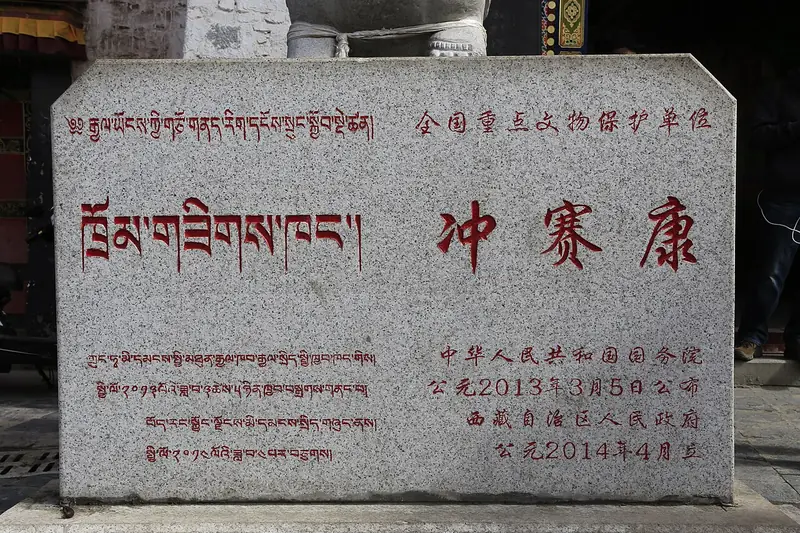
- Jokhang Temple and Barkhor Street (大昭寺与八廓街), Chengguan District. Photograph: "Lhasa khrom gzigs khang 2014.09.23 11-06-52".Photo: Zhangzhugang · CC BY-SA 3.0Resized for the web; the photo itself has not been edited. Thumbnails may show a cropped view.
