

Entry & permits for Tibet (Xizang)
Foreign tourists need Tibet entry approval, commonly called a Tibet Travel Permit, and an organised visit arranged through a specialist travel agency in China. Confirm your approved route before booking transport. Requirements differ for Taiwan residents and for travellers using mainland or Hong Kong/Macao Chinese resident documents; check the document guide before you book.
Check the travel-document requirements →Policy scope verified: 2026-09-06. UK FCDO: China regional travel advice ↗ State Council Taiwan Affairs Office: Tibet entry approval ↗ Xizang Department of Culture and Tourism: Medog border permit notice ↗
Explore the region
Tap any red Chinese text to hear it in Mandarin.
Why come
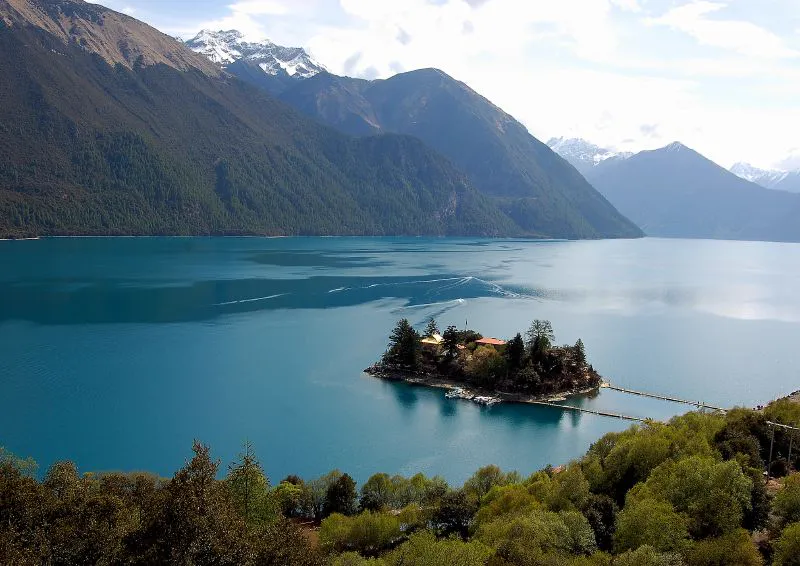
Basum Tso is a lake visit with a clear sense of place: open water sits inside a forested mountain basin, while a small island and its monastery give the view a religious centre rather than leaving it as scenery alone. The operator describes the lake at about 3,480 metres above sea level and roughly 27 square kilometres, and identifies the site as a national 5A scenic area. Those figures are useful for orientation, not a reason to treat every shoreline or extension as part of the same easy walk.
The best way to read the landscape is to pause at a broad viewpoint, then compare the water, wooded slopes and settled shore from closer range. The main experience is not a checklist of distant map pins. It is the contrast between a managed lakeshore, an active religious site and a village landscape within the same mountain basin.
What to see
Tashi Island and Tsodzong Monastery
Tashi Island (扎西岛), also called the lake island in local visitor material, is the cultural focus of the standard visit. Tsodzong Monastery (措宗寺 or 措宗贡巴寺) stands on the island; a China Tibet Online feature explains that “Tsodzong” means “lake castle” and identifies the monastery with the Nyingma tradition. Look first at how the compact island, prayer flags and water frame the building, then follow whatever visitor route is open rather than assuming that every interior or religious object is accessible.
This is a living Buddhist site, not a themed performance. Ask before photographing inside the monastery or people at worship. The UK Foreign, Commonwealth & Development Office gives the same specific advice for Buddhist monasteries in Tibet and the Tibet Autonomous Region.
Daqiela viewpoint and Jieba Village
The Linzhi tourism bureau’s visitor guide names Daqiela Viewpoint (达切拉观景台) as a place to look back over the lake and mountains, and Jieba Village (结巴村) as a separate stop on the scenic-area route. Use the viewpoint to understand the lake’s long shape; in the village, notice the relationship between homes, fields, forest and shore instead of treating residents as an attraction. Keep to public paths, ask before taking photographs, and do not enter courtyards or private land.
The operator’s site also lists a road-tour sequence linking the gate, Jieba Village, the island and Daqiela Viewpoint. That makes the village a useful complement to the island, not a substitute for it.
Water and deeper-lake options
The operator describes separate boat products using the island and Yiwang Wharf (遗忘码头), including a return boat between the island and wharf and longer combinations that include a short walk. Treat these as optional products, not as a guaranteed all-day ferry timetable. Boat departure, weather limits, boarding point and same-day availability should be confirmed at the gate.
A 2024 county announcement also described self-drive and rental-car access to a defined group of stops and warned that other areas were undeveloped, without visitor facilities, and not receiving tourists. That announcement was for a six-month trial beginning in November 2024, so do not carry its product period or vehicle rules into a current itinerary. If you are considering Xin Tso (新措) or another deeper extension, ask which route is open and managed on your date; do not follow an unmarked lakeside track simply because it appears on a map.
Tickets, transfers and timing
At the scenic-area gate, separate the things you are buying: scenic-area admission, the sightseeing bus, and any boat product are distinct categories in the operator’s descriptions. The pages read for this guide do not establish a current 2026 price, opening schedule, or passport-holder booking method, so confirm those items with the operator before travelling. Do not assume that an old winter promotion or a past trial price still applies.
The lake is around 3,480 metres above sea level. Bring a warm layer and rain protection even when Bayi is mild, and leave enough daylight for the return road. A short island visit can become a longer outing if you add the village, a viewpoint or a boat; decide the return connection before you set off.
Getting there
For public road transport, a Linzhi tourism bureau guide published in November 2024 listed a coach from Linzhi Passenger Transport Center (林芝客运中心) to Basum Tso, about 118 kilometres and roughly 2–2.5 hours, with a listed fare of RMB 62. This is a dated route reference rather than a current timetable. Confirm the departure day, fare, destination stop and return coach before relying on it.
There is no applicable metro leg to this rural lake; the practical alternatives are the coach or a road vehicle.
For a private car or taxi, give the driver the Chinese destination 巴松措景区大门 Bāsōngcuò Jǐngqū Dàmén, in 错高乡, 工布江达县, 林芝市 Cuògāo Xiāng, Gōngbùjiāngdá Xiàn, Línzhī Shì. The gate matters: a broad lake pin is not proof of a visitor entrance, a boat pier or a trailhead. The operator’s 2024 notice describes the scenic-area gate as the point for admission and transfers.
Basum Tso is in the Tibet Autonomous Region. The current UK government regional guidance says that foreign visitors must obtain a Tibet travel permit through a specialist travel agent in China and travel on an organised tour; permissions and local restrictions can change without notice. Arrange the approved route first, then confirm that your tour’s vehicle and scenic-area booking cover the island and any extension you want. A mainland Chinese identity-card procedure should not be treated as proof that a foreign passport will work for the same booking.
Combine your visit
Suggested order for this visit:
-
Tashi Island
Start with the monastery and the compact island landscape.
-
Main lakeshore viewpoints
Read the surrounding forested glacial valley.
-
Jieba village
Add the nearby village setting as a separate local transfer.
This is an editorial sequence based on the features described in the sources. Confirm access locally; no walking time, shared admission or guaranteed interior access is implied.
Find Basum Tso
巴松措 · 林芝
The pin marks the area, not the entrance.
More places nearby
Approximate straight-line distances between map pins, not travel distances.
Xiuba Ancient Towers 秀巴古堡
30 km awayFive surviving stone towers rise from Xiuba village near Bahe, with traces of walls and other buildings around them. Their faceted construction is unusually distinctive: the outside has twelve sides and ridges, while the hollow…
View guide →Kading Valley Wishing Pond 卡定沟许愿池
35 km awayThe Wishing Pond is a named stop within Kading Gorge, a forested valley near the Niyang River west of Bayi. The broader visit is defined by Tianfo Waterfall and Qianfo Cliff, whose natural rock shapes are interpreted as Buddhist…
View guide →Nyingchi 林芝
57 km awayNyingchi's urban base at Bayi opens onto the Niyang valley, where forested hills and river scenery replace the bare plateau landscape many visitors associate with Tibet. A coherent westward outing follows the G318 corridor to…
View guide →Sources & visit information
Sources checked on 1 November 2026. Hours, tickets, reservations and transport can change; confirm with the operator before you go.
Image credits & notes (1)
- Basum Tso, with the forested mountain basin and a small lake island connected to shore, viewed from the lakeside. Photo: Gao (Flickr user: star_trooper)Photo: CC BY 2.0