

Entry & permits for Tibet (Xizang)
Foreign tourists need Tibet entry approval, commonly called a Tibet Travel Permit, and an organised visit arranged through a specialist travel agency in China. Confirm your approved route before booking transport. Requirements differ for Taiwan residents and for travellers using mainland or Hong Kong/Macao Chinese resident documents; check the document guide before you book.
Check the travel-document requirements →Policy scope verified: 2026-09-06. UK FCDO: China regional travel advice ↗ State Council Taiwan Affairs Office: Tibet entry approval ↗ Xizang Department of Culture and Tourism: Medog border permit notice ↗
Explore the region
About Zizhu Monastery
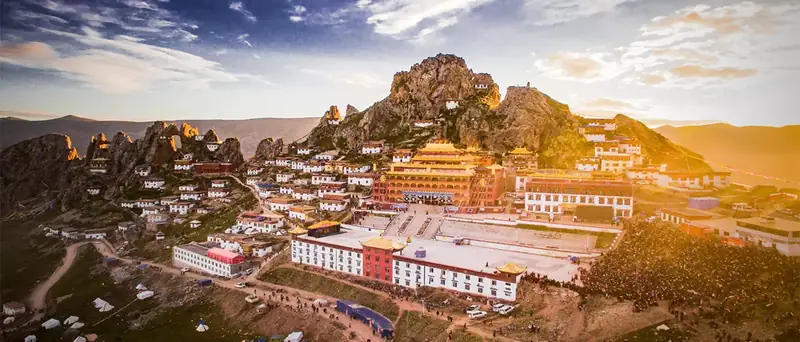
Zizhu Monastery (孜珠寺) is a Bon (苯教) monastery on Zizhu Mountain (孜珠山) in Jue'en Township (觉恩乡), Dêngqên County (丁青县), in the Chamdo (昌都) region of eastern Tibet. It stands at about 4,850 m, 17 km off National Highway 317.
"Zizhu" means six peaks in Tibetan, and the mountain is exactly that: six summits standing side by side like a steep wall, with the monastery's buildings hung against the rock below them. Bon counts it among its four sacred mountains. The Chamdo tourism bureau lists 108 meditation caves on the peaks and records blue sheep, vultures, red-billed choughs and snow leopards in the surrounding country. The site is a 4A scenic area on the Tibet list under the name Tianqiong Zizhu (天穹孜珠).
Tradition places the founding in the tenth century BC, as one of 37 Bon centres built under the second Tibetan king, Mutri Tsenpo (穆赤赞普). The monastery declined when Trisong Detsen (赤松德赞) suppressed Bon in the eighth century, was revived by Lodan Nyingpo (罗丹念布) in the fourteenth century and flourished under Sangye Lingpa (桑吉林巴) in the seventeenth. In 1926 Sang-ngag Lingpa (桑阿林巴) created the masked dance 'Heaven and Hell', which is performed only in Rooster years, once every twelve years, in the fifth Tibetan month. The monastery was pulled down in the Cultural Revolution; rebuilding began in 1982, and objects hidden by believers came back. It became a Tibet Autonomous Region protected site in 2007, and the Chamdo tourism bureau gave its community in 2020 as more than 200 monks.
Three kora routes circle the monastery, walked anticlockwise as Bon practice requires. Along the smallest are rocks marked with the footprints of past masters, a hole in a rock that pilgrims reach through, trying to touch their own ear, and, further on, the sky-burial ground. In the main hall, twelve cinnabar pillars rise through three storeys, a gilded 12 m image of the Bon founder Shenrab Miwo (辛饶弥沃) stands on the right, and a 12 m image of the Great Loving Mother (大慈母) stands on the left.
What to look for
- The six peaks of Zizhu Mountain (孜珠山), standing in a row like a wall behind the monastery
- Meditation caves on the peaks, including the cave of Muqiu Danzhu (穆秋丹珠) in the meditation college
- The anticlockwise kora with masters' footprints and a rock ring pilgrims reach through
- The sky-burial ground on the kora route
- The main hall's twelve cinnabar pillars and its 12 m gilded image of Shenrab Miwo (辛饶弥沃)
- The 12 m image of the Great Loving Mother (大慈母) on the left side of the hall
- The masked dance 'Heaven and Hell', held in the fifth Tibetan month of Rooster years
Location & getting there
Getting to Zizhu Monastery
- Search for 孜珠寺 with 昌都市 and 丁青县.
Find Zizhu Monastery
孜珠寺 · 丁青县
No reliable map pin yet: search by the Chinese name.
Sources & visit information
Written from the linked sources and fact-checked against them on 2026-09-23. Opening hours, admission and access arrangements are not covered; confirm current visitor information with the site.
Some facts checked against Wikipedia contributors, "孜珠寺" · CC BY-SA 4.0.
Image credits & notes (1)
- Zizhu Monastery · 孜珠寺Photo: greattibettour.comResized for the web; the photo itself has not been edited.