

Explore the region
About Baotai Mountain
The mountain covers some 150,000 mu of primeval forest and is made up of named areas including Jinguang Temple, Rhododendron Ridge, Jinping Chamber, Camellia Valley, the Bathing Pool, and a grove of old tea trees. The Ming-dynasty traveller Xu Xiake praised its landscape, describing the Lancang River and the Shamu River as encircling the mountain's foot 'one within, one without, one going, one coming, one following, one against'. More than three million Yunnan camellia trees grow through the forest around Jinguang Temple.
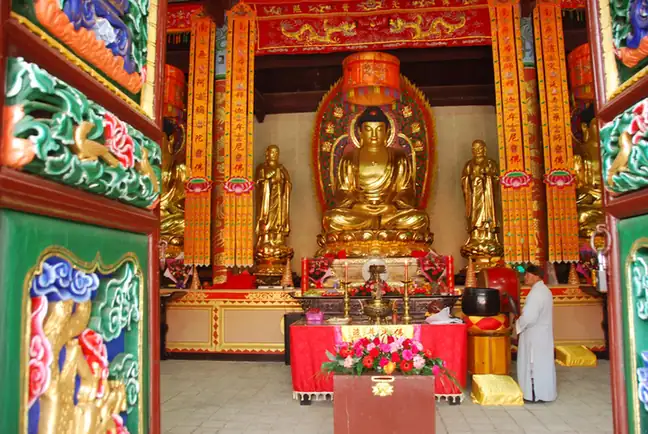
Jinguang Temple was first built in 1628, the first year of the Chongzhen reign, and still preserves 28 Ming-dynasty carved, openwork revolving doors made entirely of fine wood with three layers of openwork carving depicting birds, animals and flowers. Below the temple lies the Bathing Pool, a pool of clear water set within dense forest.
What to look for
- Jinguang Temple's 28 Ming-dynasty carved openwork revolving doors
- The forest of more than three million Yunnan camellia trees around the temple
- Rhododendron Ridge and Camellia Valley within the mountain's primeval forest
- The Bathing Pool below Jinguang Temple
Location & getting there
Getting to Baotai Mountain
Check weather, trail access and the last return service. A mountain or forest area is not one entrance, and a map’s central pin may be far from the trailhead.
- Search for 宝台山 with 大理白族自治州 and 永平县.

Find Baotai Mountain
宝台山 · 永平县
No reliable map pin yet: search by the Chinese name.
Sources & visit information
The linked sources support the identity and background described in this introduction. Opening hours, admission, activity availability and exact arrival arrangements have not been comprehensively checked. Confirm current visitor information with the venue; the original catalogue locality and editorial review flag are retained.
Image credits & notes (1)
- Baotai Mountain · 宝台山Photo: cn.tripadvisor.comResized for the web; the photo itself has not been edited.