

Photo adjustments
Wikimedia thumbnail; fitted to the ranking-card frame.
Explore the region
About Ganden Sumtseling Monastery
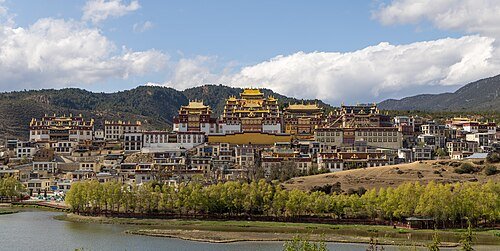
The arrangement makes the complex look layered when seen from below. Zacang Hall and the Jikang/Tsongkhapa hall form the central focus, with gilded roof surfaces and painted religious decoration adding detail at closer range. This is an active place of worship as well as a visitor attraction; follow the permitted circulation and treat prayer areas differently from a general sightseeing hall.
The Fifth Dalai Lama selected the site and gave the monastery its name. It was completed in 1683 on the ruins of Zixia Temple (孜夏寺) and belongs to the Gelug school of Tibetan Buddhism. An imperial order renamed it Guihua Temple in 1724. In 1750, it received a plaque bearing calligraphy by Yunli (允礼). The original buildings were destroyed in 1966, and reconstruction began on the same site in 1982. The monastery stands at an elevation of 3,380 metres and historically organised its community into eight khamtsen divisions.
What to look for
- The central Zacang and Tsongkhapa halls rise above the surrounding monastic quarters.
- Gilded roof decoration and painted religious interiors reward a closer look in visitor-accessible areas.
Location & getting there
Getting to Ganden Sumtseling Monastery
Travel north from Shangri-La to the Songzanlin scenic-area visitor entrance. The city guide identifies the northbound No. 3 bus as a connection to the monastery; confirm its current terminus and follow the scenic-area transfer arrangements rather than attempting to enter residential monastic lanes.
Combine your visit
Suggested order for the visit:
-
Lower approach
Read the stepped hillside arrangement.
-
Zacang Hall
Visit the main assembly-hall area when permitted.
-
Tsongkhapa hall area
Compare the principal halls and their decoration.
This is an editorial sequence of named spaces or places. It does not imply a verified walking connection or promise opening, ticket availability or a journey time.
Find Ganden Sumtseling Monastery
松赞林寺 · 迪庆州
The pin marks the area, not the entrance.
More places nearby
Approximate straight-line distances between map pins, not travel distances.
Dukezong 独克宗
6 km awayDukezong is Shangri-La’s historic centre, arranged around the slope of Guishan and Yueguang Square. Much of the town was rebuilt after the 2014 fire, and today its stone lanes mix visitor shops with Tibetan architectural forms…
View guide →Pudacuo National Park 普达措国家公园
29 km awayPudacuo combines highland lake shores, forest and meadow east of Shangri-La. Shudu Lake offers a focused introduction, with open water set against wooded slopes and a managed lakeside walking route. The wider park includes Bita…
View guide →Sources & visit information
The sources below support the place-specific description and arrival information. Suggested combinations are editorial planning ideas; confirm current opening, entry arrangements and transport services for your date.
- Wikivoyage: Shangrila ↗
- Songzanlin operator: monastery introduction ↗
- Diqing local report: Songzanlin architecture ↗
- Chinese Wikipedia: 噶丹松赞林 (revision 93563569, 2026-07-20) ↗
Visitor information adapted and edited from Wikivoyage contributors, Shangrila · CC BY-SA 4.0. Source revision 5333561.
Background paragraphs translated and condensed from Wikipedia contributors, "噶丹松赞林", Chinese Wikipedia · CC BY-SA 4.0. Source revision 93563569.