

Explore the region
Tap any red Chinese text to hear it in Mandarin.
In brief
Tuanshan Old Village is a historic settlement west of Jianshui where Zhang-clan residences combine southern-Yunnan courtyard planning with Han and Yi building traditions. Its gates, ancestral hall, Zhang Family Garden and carved house details reward a slow, respectful walk rather than a checklist visit.
Why this village matters
Tuanshan began as a mining centre in the late fourteenth century. Most of the surviving houses, gates, temples, ancestral halls and walls date from the nineteenth and early twentieth centuries, when trade with Southeast Asia was helped by the Yunnan–Vietnam railway. That history gives the village a different feel from a single restored mansion: its lanes and compounds form a settlement shaped by family, trade and local building practice.
A Ministry of Culture and Tourism route describes Tuanshan as a family-based village with more than 600 years of history and 21 surviving historic buildings. It identifies three overlapping traditions: Han-style brick courtyard compounds, Yi earthen houses, and tiled earthen houses that combine Han and Yi features. The same source identifies the village as a national 4A scenic area.
What to look for
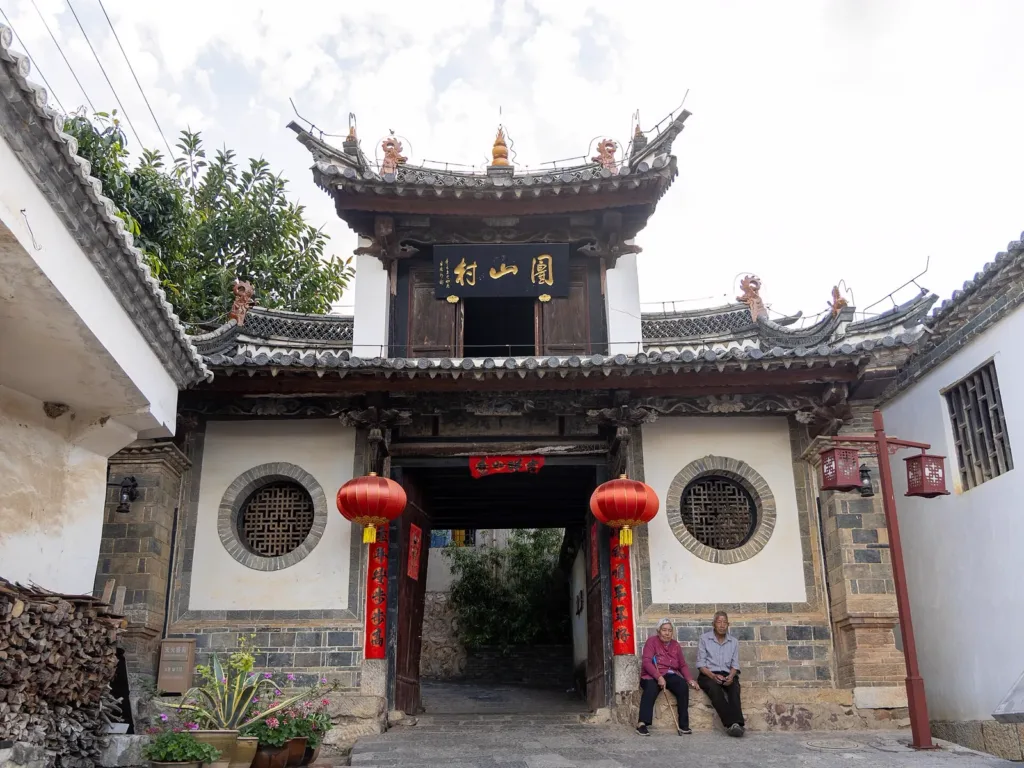
Start at the visitor approach and read the village as a sequence of thresholds. Compare the whitewashed walls, grey-tile roofs, projecting eaves and courtyard depth from the lane before entering a house. In the courtyards, look for the way a screen wall, skywell and covered passage control light, privacy and movement. This is more revealing than photographing one doorway in isolation.
Make time for Zhang Family Garden (张家花园), the Zhang clan ancestral hall (张氏宗祠) and Huang’en House (皇恩府), then follow the lanes between them rather than rushing from one named building to the next. The useful details are the carved and painted woodwork and the stone and brick carving: look closely at door panels, lintels, roof-edge brackets and worn surfaces, and notice where repair work differs from older fabric.
The three building traditions are a practical observation guide. A brick courtyard compound, an earthen Yi house and a Han–Yi hybrid may sit within the same village, but they do not use space or materials in the same way. Treat the categories as a prompt for comparison, not as a claim that every house fits neatly into one type.
Tuanshan is also a residential village. Do not enter a closed courtyard or photograph residents, domestic work or private belongings without permission. A named mansion is not automatically a separately managed museum, so follow the current signs and ask on site before crossing a gate.
Planning a visit
A current Qunar listing places Tuanshan Residential Quarters at the west side of Baituan Highway (白团公路西50米) and lists opening hours of 08:00–18:00, with entry stopping at 18:00. It also marks the attraction as ticketed and suggests allowing one to three hours. These are third-party planning details, not a guarantee of the day’s operation: confirm the entrance notice, admission price, payment method and any passport or reservation procedure before setting out.
Use the exact Chinese name 团山民居 Tuánshān Mínjū when checking Amap (高德地图). If a house, performance or seasonal activity is separately promoted, verify that it is operating on your date; do not assume that a listing or an old photograph proves current access.
Getting there and back
Bus. A current public route directory lists 建水19路 between 建水火车站 (Jianshui Railway Station) and 团山游客集散中心 (Tuanshan Tourist Distribution Center). The town-side direction includes 古城小火车站 (Ancient Town Small Train Station), and the village-side endpoint is the distribution centre. Use the Chinese endpoint name when boarding or asking for help.
The two direction pages do not agree on the final listed operating time: one gives 07:00–18:40 and the reverse page gives 07:00–18:30. Treat those times as a route-checking clue, not as a promise. For the return, board the reverse 建水19路 at 团山游客集散中心 Tuánshān Yóukè Jísàn Zhōngxīn towards 建水火车站 Jiànshuǐ Huǒchēzhàn, and leave enough time to confirm the last departure locally rather than waiting for the final published minute.
Tourist train. A September 2026 response from the Honghe culture and tourism authority says the 临安站–团山站 Lín’ān Zhàn – Tuánshān Zhàn tourist railway section is 12.8 km and is currently running in a stable, mature way. The page does not give a current departure timetable, ticket procedure or a verified transfer from 团山站 to the village entrance. If you choose the train, confirm all three points on the day; do not treat the station as the village gate.
Car or ride-hailing. Give the driver 团山民居,云南省红河哈尼族彝族自治州建水县白团公路西50米. No reliable fare, journey time or exact drop-off entrance was established here, so ask the driver to confirm the visitor approach before leaving the car. The same Chinese destination is the safest search term in Amap.
Find Tuanshan Old Village
团山民居 · 建水县
The pin marks the area, not the entrance.
Sources & visit information
Sources checked on 2 November 2026. Hours, tickets, reservations and transport can change; confirm with the operator before you go.
Image credits & notes (1)
- The East Gate of Tuanshan Old Village, photographed from the lane with its whitewashed walls, grey-tile roofs and carved gate details. Photo: 瑞丽江的河水Photo: CC BY-SA 4.0