

Explore the region
Tap any red Chinese text to hear it in Mandarin.
In brief
Yilong Lake is Shiping’s broad highland lake and wetland, where open water, reed beds, mudflats, lotus ponds and boardwalks make a slow walk more rewarding than a quick photo stop. County tourism material describes it as one of Yunnan’s nine major plateau lakes and gives the lake a surface area of about 31 square kilometres; the wetland park is planned at 3,749 hectares, with wetlands making up 97% of that area.
The park is on the Shiping side of Honghe Hani and Yi Autonomous Prefecture, not a compact single viewpoint. Come for the changing edge between water and land: winter birds and morning mist, summer lotus, and the small pavilions and paths that frame different shores. The place also carries Shiping’s local memory of “three islands, nine bends and seventy-two bays”, a landscape phrase recorded in county cultural material rather than a promise that every historic feature remains visible today.
What to look for
Start at Ruicheng Dishui (瑞成滴水), described by the county scenic-area note as the wetland park’s main entrance and core area. Its boardwalks, shallow water and planted wetland make it a useful place to watch waterbirds without walking into the reed beds. The same note records black storks, purple swamphens and other wetland birds, as well as fish associated with the lake; treat the species list as a source-dated ecological record, not a guarantee of a sighting.
On the north shore, Moshu Morning Mist (末束晓雾) is the right kind of place for an early, quiet observation: the park description points to mudflats, reeds and winter vapour rising from the lake. Nearby Laihe Pavilion (来鹤亭) at Xiaoruicheng village is a Ming–Qing-period heritage pavilion in that description, and its value is the long view across the lake. Look from the lane and pavilion first, then follow any current public signs; do not assume that a named heritage structure is an independently ticketed museum.
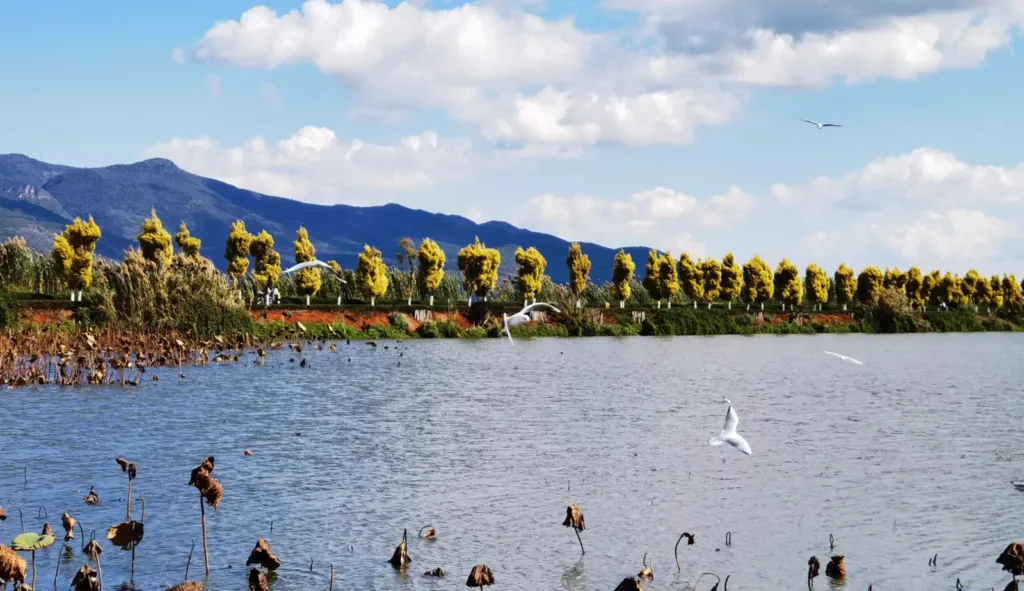
On the west shore, Huanwen Yinghui (焕文迎晖) pairs a lakeside exercise boardwalk with lotus ponds and a view towards Huanwen Pagoda (焕文塔). In summer, compare the geometry of the lotus beds with the open water; in winter, the same shore may be used by gulls. Jiuqu Diecui (九曲叠翠) on the south shore is the largest of the four areas described by the county. Its reeds, linked islets and winding paths are best read as a wetland landscape: notice where a path crosses water or reed edge, rather than trying to cover every bend.
Season changes the experience. County material records red-billed gulls (红嘴鸥) arriving in winter and a traditional lotus festival from 6 July to 1 September, but that festival date belongs to the dated scenic description and is not a current 2026 programme. Check local notices for this year’s bloom, activities and access before building a trip around flowers or birds.
Stay on marked boardwalks and public paths, keep distance from birds and nests, and do not feed wildlife or enter mudflats, water or closed conservation areas. A telephoto lens and a quiet pause are more useful here than chasing a close-up. The lake is a living community landscape as well as a park, so avoid photographing residents or private activity without permission.
Planning a visit
The current sources checked here do not establish today’s opening hours, admission price, reservation route, boat operation or passport-visitor procedure. The older China Revealed page likewise said that opening, admission and access arrangements were not covered. Search the exact Chinese name 异龙湖国家湿地公园 Yìlónghú Guójiā Shīdì Gōngyuán (or 异龙湖·石屏县 Yìlónghú · Shípíng Xiàn) in Amap and confirm the day’s entrance notice before setting out. The named entrance in the county description is 瑞成滴水 Ruìchéng Dīshuǐ; the sources do not support a fixed taxi drop-off pin, fee or journey time.
Getting there and back
Arriving in Shiping. Shiping does not have a passenger high-speed railway station in the transport information checked for this guide. A practical public-transport plan is to take rail to Jianshui Station (建水站), continue by road to Shiping County (石屏县), and then use a local bus, taxi or arranged transfer to the wetland. The road leg and same-day coach connections should be confirmed before booking. One separate English attraction page says that high-speed trains go directly to Shiping; that conflicts with the transport page and is not used here.
Local bus. A 30 April 2025 notice from the Shiping transport authority announced two Yilong Lake ring routes. Route 1 starts at 石屏火车站 Shípíng Huǒchēzhàn and lists 游船公司 Yóuchuán Gōngsī and 湿地公园 Shīdì Gōngyuán among its lakeside stops before continuing towards 通贡门 Tōnggòng Mén. Route 2 runs in the reverse lake-loop direction from 通贡门 Tōnggòng Mén, also passing 异龙湖湿地公园 Yìlónghú Shīdì Gōngyuán and 游船公司 Yóuchuán Gōngsī. The notice does not provide a current timetable or prove that the same bus returns directly to the railway station after your visit. Check the stop sign or operator locally, ask for the last return, and confirm the town-side connection before entering the park.
Taxi or ride-hailing. Give the driver 异龙湖国家湿地公园 Yìlónghú Guójiā Shīdì Gōngyuán and, if you want the main entrance described by the county, add 瑞成滴水(湿地公园主入口). Ask the driver to confirm the public entrance before leaving the vehicle. There is no reliable source here for a fixed fare, duration or exact last-metre walking distance, so none is supplied. For the return, arrange a pickup in advance or return to the signed bus stop while service is still running.
Find Yilong Lake
异龙湖 · 石屏县
The pin marks the area, not the entrance.
Sources & visit information
Sources checked on 2 November 2026. Hours, tickets, reservations and transport can change; confirm with the operator before you go.
Image credits & notes (1)
- Winter waterbirds over Yilong Lake, with the lotus marsh and mountain ridge on the far shore. Photo: 鹿苑Photo: CC BY-SA 4.0