

Explore the region
Tap any red Chinese text to hear it in Mandarin.
A living historic quarter
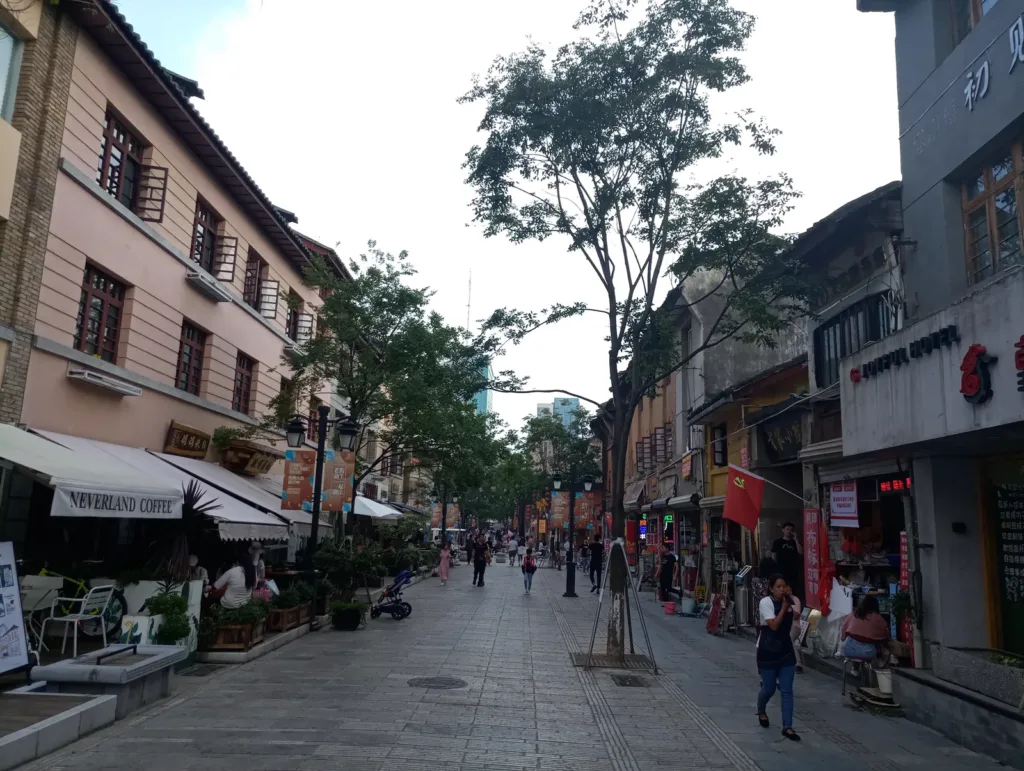
Kunming Old Street is not a single ancient-town gate or one preserved lane. It is a central quarter of Wuhua District, broadly bounded by Zhengyi Road on the east, Wuyi Road on the west, Jingxing Street on the south and Renmin Middle Road on the north. Guanghua Street, Wenming Street, Jingxing Street, Wenmiao Zhijie, Yongdao Street and Qianwang Street are part of the walk. The area was formally named Kunming Old Street in 2005 around eight traditional streets.
The quarter grew with Kunming’s urban centre. It was within the city’s footprint by the Nanzhao period and became a political, commercial and cultural centre during the Ming and Qing periods. The present streets retain late-Qing and Republican-era buildings, but they are also a working central neighbourhood of shops, food stalls and small businesses. Recent reporting describes 112 historic buildings in a 328.8-mu protection area; an earlier local report used a narrower count of eight cultural-relic protection units and 20 listed protected buildings. These figures describe different protection categories, not a single total to add together.
What to look for on foot
Walk slowly and use the street names as your guide rather than trying to find one “main entrance.” On Yongdao Street, the name recalls its former role as an access passage to the Qing-era Yunnan–Guizhou Governor-General’s office. Its Nos. 73–74 hold Nie Er’s former residence, a restored two-storey yikeyin (“single-seal”) courtyard house with photographs, instruments, scores and personal objects. Access to the residence is separate from simply walking along the public street.
In Xiaoyingui Lane, look for the Ma Family Compound, a 1923 Bai-style courtyard residence built with carved wood and stone. Wenming Street is a short, recognisable row of old shopfronts; Jingxing Street carries the older flower-and-bird-market association, while Qianwang Street places craft and retail businesses beside historic houses. The quarter also includes the former Fuchunheng trading-firm site, the Fu family residence and other protected buildings. The point is the relationship between houses, lanes, shops and remembered local commerce, not a single monumental façade.
Eat as part of the walk
Small-pot rice noodles (xiaoguo mixian, 小锅米线) are a useful taste of everyday Kunming rather than a dish invented for this quarter. A small copper pot cooks one serving at a time, letting broth, rice noodles, minced pork or another topping, chives, pickled greens and seasonal vegetables meet directly in the pot. The result is a hot, savoury bowl with soft noodles and tender pieces of meat; the exact topping and sauce vary by shop. Kunming’s rice-noodle culture also includes tofu-topped, cold, braised and stir-fried versions, so do not treat one bowl as a fixed recipe or assume a dish is vegetarian from its appearance.
The traditional process behind Kunming’s thicker suanjiang rice noodles uses rice and water, with soaking, grinding, fermentation, kneading, pressing, washing and draining before the noodles are sold. The noodles’ freshness and slight tang are part of the local style. If you are sensitive to heat, taste the broth carefully: small-pot noodles are served very hot. Ask about pork, fermented seasonings, chilli and other ingredients when allergies or dietary restrictions matter.
Visiting and getting there
The public streets form a walkable historic quarter, but individual residences, museums, performances, shops and restaurants can have different opening hours, admission rules or temporary closures. No current district-wide ticket, single entrance or universal opening schedule should be assumed. Check the specific venue if you want to enter Nie Er’s former residence, the Ma Family Compound or a performance space.
- Metro: Wuyi Road (五一路) is served by Kunming Metro Lines 3 and 5 and is a practical central approach to the quarter. Continue on foot using the Chinese street or venue name; the exact exit and the best pedestrian route depend on which part of the district you choose.
- Taxi or ride-hailing: Give the destination as 昆明老街(五华区). Because the historic quarter spans several streets, set a specific starting street such as 光华街, 景星街 or 文明街, then confirm the pedestrian drop-off and a return pick-up point in the map app.
- Walking within the area: Keep the Chinese names 昆明老街 Kūnmíng Lǎojiē, 甬道街 Yǒngdào Jiē, 小银柜巷 Xiǎoyínguì Xiàng and 景星街 Jǐngxīng Jiē available. Public-street access and entry to a particular building are separate questions; check the latter locally on the day.
Find Kunming Old Street
昆明老街 · 五华区
The pin marks the area, not the entrance.
Sources & visit information
Sources checked on 23 October 2026. Hours, tickets, reservations and transport can change; confirm with the operator before you go.
Image credits & notes (1)
- Wenmiao Zhijie in Kunming Old Street, showing a pedestrian lane with shopfronts, older façades and everyday street life. Photo: 瑞丽江的河水Photo: CC BY-SA 4.0