

Explore the region
About Huaping
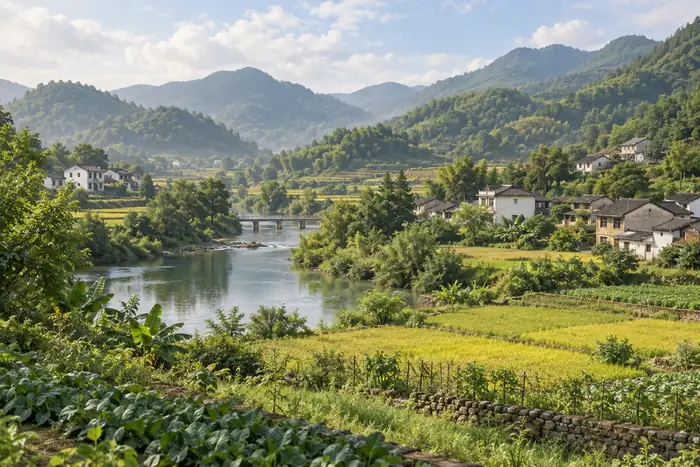
In Longtou village, orchards spread around white-walled houses with tiled roofs, while Guozishan’s visitor facilities connect the cultivated landscape with rural tourism. The county’s Mango Park provides another place to understand the fruit-growing identity. Plan around the season and an agreed orchard visit; flowering trees, ripening fruit and harvesting are different experiences, and working plantations are not automatically public grounds.
Human settlement in Huaping dates to the Neolithic era, evidenced by the Huilongwan archaeological site (回龙弯遗迹). The area came under Han dynasty rule from 130 BC and was established as Shifu County (姑复县) under Yuesui Commandery in 111 BC. It later fell within Yunnan Commandery, then Yao Zhou under the Tang dynasty, was absorbed into the Nanzhao Kingdom late in the 8th century, and later formed part of the Dali Kingdom under the Song dynasty. In the late Qing dynasty it was administered under the Yongbei Zhili Department (永北直隶厅), and Huaping County was formally established in 1909. It came under the control of the People's Liberation Army in 1950 and was placed under Lijiang's jurisdiction in 1980.
Huaping lies in northwestern Yunnan, in the southeastern part of Lijiang City on the north bank of the middle Jinsha River, and covers an area of 2,142 square kilometers; the county seat is at Zhongxin town. Its population includes Lisu people, divided into the Flowery Lisu (花傈僳) and the Black Lisu (黑傈僳), the former known for colorful dress, and a branch of the Yi people called the Shuitian Yi (水田彝族), about 8,000 people, who are noted for their distinctive homemade laza wine (腊渣酒).
What to look for
- Longtou village combines mango orchards with white-walled, tiled-roof houses.
- Mango Park provides a public landscape connected with the county’s signature crop.
Location & getting there
Getting to Huaping
For the village and orchard outing, arrange transport to Longtou village in Rongjiang Town, Huaping County. Confirm visitor access with the Guozishan facility before continuing into cultivated areas.
Combine your visit
Suggested order for the visit:
-
Mango Park
Begin with the county’s mango-themed public landscape.
-
Longtou village
Make the road transfer to see the village and surrounding cultivation.
-
Guozishan visitor area
Use an agreed orchard or rural-tourism visit where available.
This is an editorial sequence of named spaces or places. It does not imply a verified walking connection or promise opening, ticket availability or a journey time.
Find Huaping
华坪 · 华坪县
The pin marks the area, not the entrance.
More places nearby
Approximate straight-line distances between map pins, not travel distances.
Chenghai Lake 程海
63 km awayChenghai is a plateau lake in Yongsheng, with open water set against low mountain slopes and a shoreline of villages and wetland vegetation. At Jinsha Lishui, the lake-replenishment outlet provides a specific viewing stop where…
View guide →Jinlong Bridge 金龙桥
89 km awayJinlong Bridge, also called Zili Bridge, is an iron-chain crossing of the Jinsha River between the Lijiang and Yongsheng sides. Its suspended wooden deck and chains make the engineering legible from the riverbank. The crossing…
View guide →Lijiang Golden Pagoda Scenic Area 丽江金塔景区
103 km awayThe Golden Pagoda complex stands at Dewei village in the Jinshan area of Lijiang. Its central landmark is Dongbao Zunsheng Stupa, whose gold-coloured form contrasts with the surrounding temple halls. Guanyin Hall and the…
View guide →Sources & visit information
The sources below support the place-specific description and arrival information. Suggested combinations are editorial planning ideas; confirm current opening, entry arrangements and transport services for your date.
- Lijiang field report: Rongjiang Longtou village ↗
- Huaping official press briefing ↗
- Chinese Wikipedia: 华坪县 (revision 94267504, 2026-09-09) ↗
- English Wikipedia: Huaping County (revision 1293126979, 2025-05-30) ↗
Background paragraphs translated and condensed from Wikipedia contributors, "华坪县", Chinese Wikipedia · CC BY-SA 4.0. Source revision 94267504.
Background paragraphs condensed from Wikipedia contributors, "Huaping County", English Wikipedia · CC BY-SA 4.0. Source revision 1293126979.