

Explore the region
Tap any red Chinese text to hear it in Mandarin.
Dukezong is not a sealed museum compound. It is a historic urban area in Jiantang Town where residents, shops and visitor facilities share the old-town fabric. A local legal-affairs account describes it as a Tang-era town on the Tea Horse Road with more than 1,300 years of history, while the operator’s official mini-program presents it as one of China’s best-preserved and largest Tibetan residential groups.
What to see
Begin at Moonlight Square (月光广场), the named meeting point in the official guide map and one of the old town’s most useful orientation spaces. From there, follow the uphill route towards Guishan Park (龟山公园). The official mini-program provides real-name reservation for the park and places it within the old town’s core cultural route; check the current slot before setting out rather than assuming that walking into the streets also guarantees entry to the park.
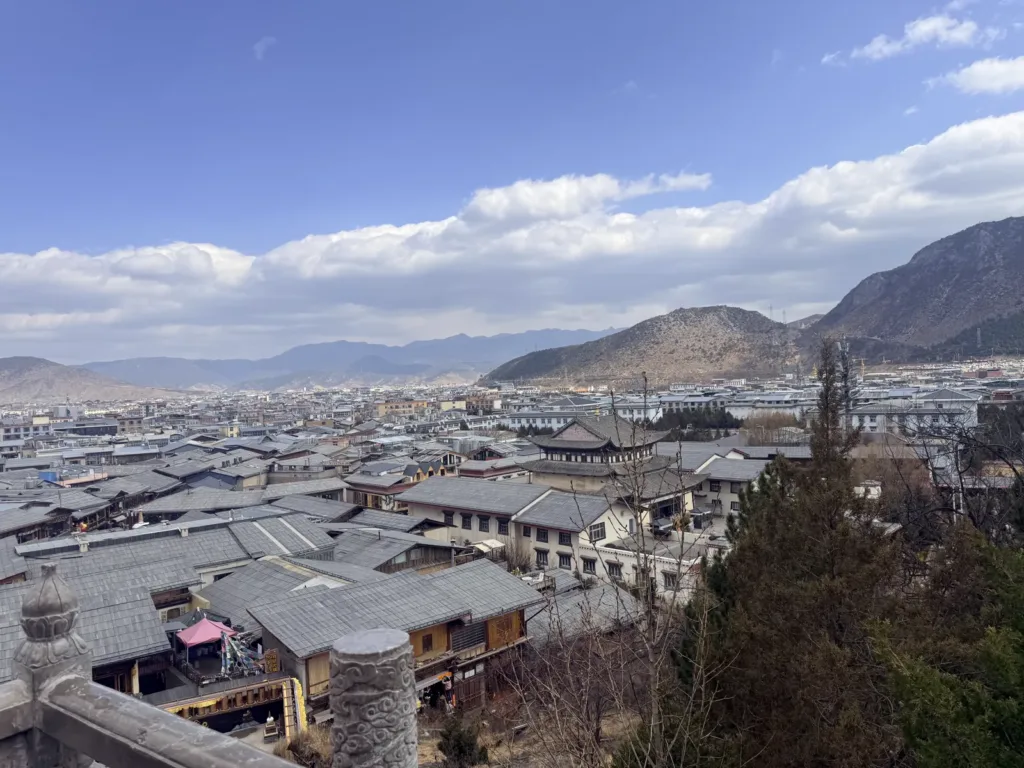
Use the lanes between the square and the hill as a living neighbourhood, not as a set of staged exhibits. The official guide map marks turning-prayer and cultural routes, while the local government describes a protected core area, historic buildings and community services within the town. Look for the relationship between the sloping lanes, Tibetan houses, small shops and the public spaces instead of rushing from one photo stop to the next.
The town also has cultural workshops and food-oriented spaces. A 2025 local report describes hands-on experiences involving Tibetan incense and thangka painting, as well as Tibetan embroidery, leather carving, Tibetan songs and Nixi black pottery. These are reported cultural offerings, not a guaranteed daily programme: ask what is open on the day and observe demonstrations without treating residents or makers as a performance.
At dusk, Moonlight Square may become a shared public space where residents and visitors dance the Guozhuang circle dance. The local account describes this as an evening scene rather than a fixed show. Watch from the edge, join only when the participants make space for you, and do not photograph people at close range without permission.
Tickets, entry and timing
The old town should not be described as one universal ticketed enclosure. The official mini-program specifically offers real-name reservation for Guishan Park and a guide map for the wider area, but the pages read here do not state a single current ticket, a complete opening timetable, or whether a domestic-ID reservation can be used with a foreign passport. Confirm the park slot, any separate museum or workshop arrangement, and passport acceptance with the operator before travelling.
Getting there
By rail: Arrive at Shangri-La Railway Station (香格里拉站), on the Lijiang–Shangri-La railway. Shangri-La’s railway service is part of the city’s current transport network, and a station travel guide recommends a taxi onward to Dukezong Ancient City. Show the driver 独克宗古城 or 月光广场 Yuèguāng Guǎngchǎng. For the return, agree on a vehicle-accessible edge or meeting point before walking deep into the lanes; do not assume a car can collect you from every old-town street.
By air: Diqing Shangri-La Airport (迪庆香格里拉机场) is another arrival option. Ask for 独克宗古城 or 月光广场 Yuèguāng Guǎngchǎng rather than relying on an English-only pronunciation. Fixed airport-bus details were not established in the pages read here, so confirm the live pickup point and the return arrangement with the airport or driver on the day.
Metro and bus: No metro leg is needed for this visit, and no current city-bus number was reliable enough in the pages read to publish as a route to the old town. A taxi to the Chinese destination above is the clearer last-mile option when carrying luggage.
A slower, safer visit
Shangri-La sits at about 3,300 metres above sea level. Give yourself time to acclimatise, take the climb to Guishan Park slowly, and stop if you develop headache, nausea or unusual breathlessness. The old town’s public areas, park reservation and individual cultural venues can operate on different arrangements, so keep the official guide map and same-day notices in view rather than forcing the whole visit into a promised timetable.
Combine your visit
Suggested order for the visit:
-
Yueguang Square
Begin at the meeting point between town and hill.
-
Guishan Park
See the prayer wheel and roofscape.
-
Jinlong Street and neighbouring lanes
Explore the restored street setting.
This is an editorial sequence of named spaces or places. It does not imply a verified walking connection or promise opening, ticket availability or a journey time.
Find Dukezong Ancient City
独克宗 · 香格里拉市
The pin marks the area, not the entrance.
More places nearby
Approximate straight-line distances between map pins, not travel distances.
Ganden Sumtseling Monastery 松赞林寺
6 km awaySongzanlin Monastery climbs a hillside north of Shangri-La, with its principal halls rising above the surrounding monastic buildings. The arrangement makes the complex look layered when seen from below. Zacang Hall and the…
View guide →Pudacuo National Park 普达措国家公园
29 km awayPudacuo combines highland lake shores, forest and meadow east of Shangri-La. Shudu Lake offers a focused introduction, with open water set against wooded slopes and a managed lakeside walking route. The wider park includes Bita…
View guide →Sources & visit information
Sources checked on 1 November 2026. Hours, tickets, reservations and transport can change; confirm with the operator before you go.
Image credits & notes (1)
- View over Dukezong Ancient City from Guishan Park, Jiantang Town, Shangri-La, Yunnan, photographed on 25 February 2026. Photo: 祝鱼贵Photo: CC BY-SA 4.0