

Explore the region
About Xiushan Hill
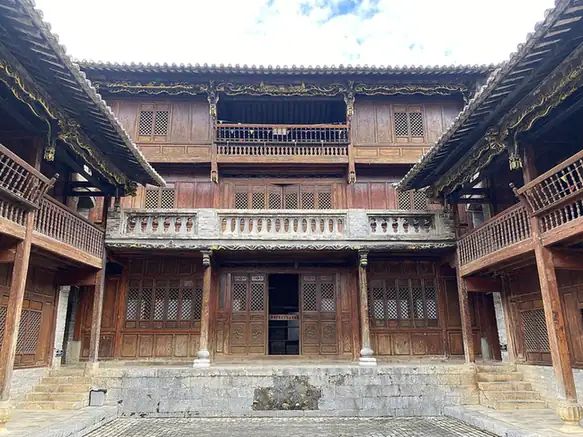
The county's tourism bureau describes Xiushan as traditionally one of Yunnan's 'Four Great Mountains', its architecture damaged over the centuries by earthquakes and by the Cultural Revolution and repaired since by local government and residents. A five-year renovation begun in 2012, overseen by a purpose-formed construction headquarters for the Xiushan-Confucian Temple townscape coordination zone, with a conservation plan drawn up by Tsinghua University, raised more than 70 million yuan from central, provincial and municipal sources by 2017. Within the complex, the Gubai Pavilion at Yongjin Temple is one of only two Song-dynasty buildings surviving in Yunnan, built without a single nail and reflecting the Song-dynasty Yingzao Fashi building style; provincial and national experts who examined it called it the progenitor of Yunnan's local ancient architecture. The Yuan-dynasty style is concentrated at Puguang Temple and the Ming-dynasty style at Yuhuang Pavilion, and as of 2017 three points in the complex had recognised geological-hazard problems: Yongjin Temple, Qingliang Terrace and Sanyuan Palace.
The hill's own site describes it as a compact wooded rise behind the Tonghai plain, quoting a visiting Zhu De's description of it as standing behind the strong town with groves as lush as a jade pot. Tonghai's 'Three Kings culture' initiative links the hill with three figures the county calls close to its ancient history: the Dian king Zhuang Qiao, King Wubo of the Ting state, and Duan Siping, founding emperor of the Dali kingdom. The county moved the retired-cadres bureau out of the Tingwang Temple and put up statues of the three kings and a bronze relief of Tonghai's history there, and the county tourism report quotes Zhao Zhihua saying the Tingwang Temple in Xiushan park could carry the 'Three Kings culture'.
What to look for
- The Gubai Pavilion at Yongjin Temple, one of only two surviving Song-dynasty buildings in Yunnan, built without a single nail and reflecting the Song-dynasty Yingzao Fashi building style.
- Puguang Temple, where the complex's Yuan-dynasty architectural style is concentrated.
- Yuhuang Pavilion, where the Ming-dynasty architectural style is concentrated.
- Qingliang Terrace and Sanyuan Palace, both named by the county among Xiushan's historic structures.
- The Tingwang Temple in Xiushan park, where the county set up statues of the 'Three Kings' – the Dian king Zhuang Qiao, King Wubo of the Ting state and Duan Siping – and a bronze relief of Tonghai's history.
Location & getting there
Getting to Xiushan Hill
Check which interiors and courtyards are accessible. Active places of worship and protected monuments may have different visitor rules.
- Search for 秀山 with 玉溪市 and 通海县.
Find Xiushan Hill
秀山 · 通海县
No reliable map pin yet: search by the Chinese name.
Sources & visit information
The linked sources support the identity and background described in this introduction. Opening hours, admission, activity availability and exact arrival arrangements have not been comprehensively checked. Confirm current visitor information with the venue; the original catalogue locality and editorial review flag are retained.
Image credits & notes (1)
- Xiushan Hill · 秀山Photo: 瑞丽江的河水 · CC BY-SA 4.0Resized for the web; the photo itself has not been edited.
