

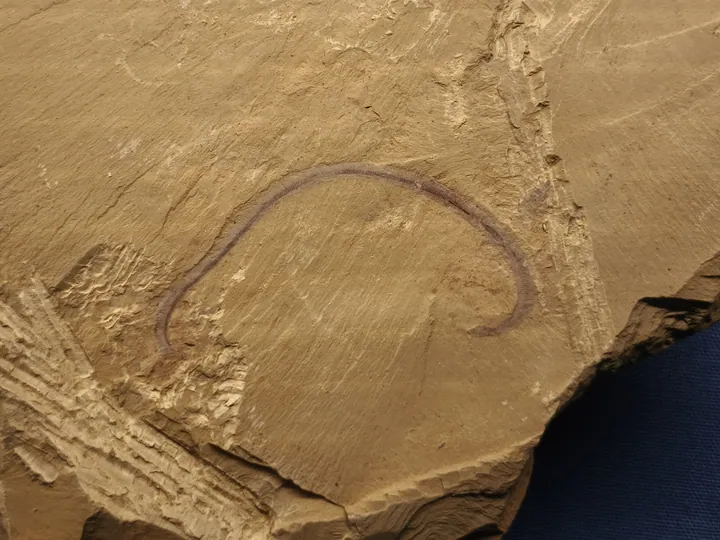
Photo adjustments
Full frame retained; proportionally resized and converted to WebP. No retouching or changes to the photographed subject. Card displays may crop the view.
Explore the region
About Chengjiang Fossil Site
The World Natural Heritage Museum provides the most practical introduction, with fossils from the protected site explaining an ocean ecosystem that existed long before the present lake landscape. Maotianshan is the separate discovery-area landscape, not the same place as the museum beside Fuxian Lake. Begin with the exhibits and visit only the authorised areas of the protected site if they are available.
Early-twentieth-century investigations around Maotianshan (帽天山) recorded fossils that were described in 1912. Wider recognition followed Hou Xianguang's (侯先光) discovery on 1 July 1984. Systematic investigations developed in the 1990s, and a provincial nature reserve covering the hill and its surroundings was established in 1997. The fossil site was inscribed on the World Heritage List in 2012.
The protected fossil site covers 512 hectares, with fossil-bearing strata concentrated in the Maotianshan Shale member (帽天山页岩段) of the Heilinpu Formation (黑林铺组). The assemblage includes 16 phyla and nearly 300 species. Preservation extends to features such as eyes, skin, digestive tracts and nerves. These remains provide evidence for the study of marine life during the Cambrian explosion.
What to look for
- Museum displays present fossils from the Chengjiang fossil deposits.
- The preserved body outlines and soft-tissue anatomy explain why these fossils reveal more than shells alone.
Location & getting there
Getting to Chengjiang Fossil Site
The World Natural Heritage Museum is at 14 Hanwuji Avenue, off Huanhu North Road in Yousuo Town, Chengjiang. Use this museum address for the exhibition visit. Maotianshan lies inland and needs a separate journey and confirmation of authorised visitor access.
Combine your visit
Suggested order for the visit:
-
World Natural Heritage Museum
Start with the fossil displays and their interpretation.
-
Fuxian Lake northern shore
Place the fossil story within the present landscape.
-
Maotianshan, if visitor access is confirmed
Make a separate visit to the protected discovery-area landscape.
This is an editorial sequence of named spaces or places. It does not imply a verified walking connection or promise opening, ticket availability or a journey time.
Find Chengjiang Fossil Site
澄江化石地 · 玉溪
The pin marks the area, not the entrance.
More places nearby
Approximate straight-line distances between map pins, not travel distances.
Fuxian Lake 抚仙湖
17 km awayFuxian Lake is a deep plateau lake with a long, varied shoreline. Luchong offers a concentrated visit on the western side, where an old fishing settlement meets the water beneath Bijia Hill. The hill provides an elevated view of…
View guide →Dianchi Lake 滇池
31 km awayDianchi gives Kunming a broad lake horizon, with the Western Hills rising across the water. The northern shore is the easiest place to make a focused visit: Haigeng Park brings you to the lake edge, while Guanjing Road offers an…
View guide →Xingyun Lake 星云湖
38 km awayXingyun Lake occupies the Jiangchuan basin, with wetlands and an ecological corridor along its shore. Yue Liang Wan Wetland Park offers one focused place to see the transition from planted shore to open water. The corridor…
View guide →Sources & visit information
The sources below support the place-specific description and arrival information. Suggested combinations are editorial planning ideas; confirm current opening, entry arrangements and transport services for your date.
- Wikivoyage: Chengjiang ↗
- UNESCO: Chengjiang Fossil Site ↗
- Chinese Wikipedia: 澄江化石地 (revision 92557407, 2026-05-06) ↗
Visitor information adapted and edited from Wikivoyage contributors, Chengjiang · CC BY-SA 4.0. Source revision 4423664.
Background paragraphs translated and condensed from Wikipedia contributors, "澄江化石地", Chinese Wikipedia · CC BY-SA 4.0. Source revision 92557407.